)

|
|
|
|
The Japan Times
WORLD EYE REPORTS
GERMANY'S RHINE-MAIN REGION |
|
|
|
|
|
©THE JAPAN TIMES
|
Thursday, October 25, 2001
|
|
Frankfurt leads beloved deutsche mark's farewell and euro's historic welcome
Despite its official launch in January of 1999, the European Union's new currency, the euro, has yet to emerge from electronic transactions and into the hands of the European Monetary Union's 300 million consumers. But they won't have to wait much longer. A trip to any cash-dispensing machine after New Year's Eve on January 1, 2002 will get their hands on the brave new currency. And Frankfurt, in the heart of Germany's important central economic region between the Main and Rhine rivers, is playing a key role in paving the way for a smooth transition.
|
Falling in value against the US dollar for most of the past two years, the euro has had analysts pointing towards a general weakness in the fundamentals of the currency and doubts in the capabilities of member nations to roll out the new banknotes glitch-free. Despite the skepticism, the euro has begun to rebound in value as it approaches monetary D-Day, and optimism in the new currency has risen accordingly.
Within this context, the German city of Frankfurt on the river Main has been thrust into the limelight because it
|
|
 AGAINST THE BACKDROP of the Deutscher Aktienindex (DAX) big board companies, traders at the Frankfurt Stock Exchange prepare for the euro. AGAINST THE BACKDROP of the Deutscher Aktienindex (DAX) big board companies, traders at the Frankfurt Stock Exchange prepare for the euro. |
is home to the European Central Bank (ECB) and many of Europe's leading financial institutions. Frankfurt has been dubbed the "Heart of the Euro", and it is from here that the ECB's ambitious information campaign is emanating during the latter half of 2001. With all of the city's billboards proclaiming "a more integrated Europe", and public officials pointing out that the new currency will bring unheard-of advantages for investment, less attention has been paid to the European public's sentiment towards the single currency.
In Germany in particular, rallying the wary public around the euro has been an arduous task. For the average working class German, giving up the mighty deutschmark for a virtual currency like the euro has required a giant leap of faith. The memories of a ravaged economy after the Second World War are not easily forgotten, and it has been the deutschmark that has stood as the symbol of the success of western Germany's post war economy.
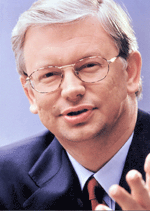 Roland Koch, Minister-President of Hesse Roland Koch, Minister-President of Hesse |
|
As Ernst Welteke -- current president of the Deutsche Bundesbank, the German central bank -- also points out, German unification was very much based on the stability and attractive economic power of the deutschmark. In fact, memories of trucks taking the haloed West German banknotes to former East Germany are still very fresh in a country reunified only recently.
Now, it is the actual physical introduction of the brand-new notes and coins that will mark the culmination of the ambitious change. "European integration was always something virtual for most Germans," explains Welteke. "Now people will get a very important symbol in their hands -- notes and coins that show that European integration is a reality now more then ever."
|
If the roll-out of over 15 billion new banknotes and over 50 billion coins proceeds with only minor glitches, then the introduction of the euro will be a great public relations opportunity for all of the EMU's member governments. So while most of the logistical procedures have been ironed out in the ECB in Frankfurt, success will also lie in the central bank's ability to educate the public on just what changes the new currency entails.
In the German Bundesland of Hesse, its Minister-President Roland Koch has tackled the issue of public awareness with great resolve. "Since the European Central Bank is sited here in Frankfurt, we want to make an exemplary conversion to the new currency," he explains. "The transition is running right on time, and the state administration is ready for the conversion. We have a Euro-Info-Mobile currently touring the state, which informs our citizens about the new currency and advises them about the exchange from deutschmarks to euros. Furthermore, we have furnished all banks in Hesse with extensive information materials to get our citizens and businesses ready for the euro."
|
|
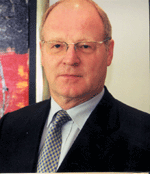 Ernst Welteke, President of the Deutsche Bundesbank Ernst Welteke, President of the Deutsche Bundesbank |
From rocky beginnings in June of 1988 when the European Council first laid out the goal of binding European countries together through currency union to the establishment of the ECB in June of 1998, the countries of the euro-zone have had to overcome immense political and economic hurdles to finally reach the objective of a single currency.
On the first day of 2002, Frankfurt will take the lead - bidding goodbye to its beloved deutschemark and welcoming in the euro in full force - in a brave new day for unified Europe.
|

|

