

|
|
|
| . |
|
|
Consumers and companies around the world can not seem to get enough of Baden-Württemberg's products. The region's manufacturers occupy prime positions in almost every field, and in the league table of exporters the state is second to none. So what makes this region so special? The answer lies in the unique character of its citizens and in their natural tendency to embrace change.
Of course, the mountains are still there, as are the villages. Unhappily, raw materials are still scarce. But the farmers of yesteryear are now running world-beating high-tech companies hidden away in the valleys and forests of this beautiful region. The miracle of this transformation is explained very simply: Baden-Württembergers love nothing more than a challenge. The more impossible the task, the better. Even as farmers, they questioned tried and tested methods and often came up with innovative solutions that were later adopted by their neighbors. In Swabian, one of the local dialects, they even have a name for these innovators. They are known as Teuftler and count among their ranks household names like Albert Einstein, Carl Benz and Gottlieb Daimler. The region is immensely proud of this legacy, and has made considerable efforts to ensure that the tradition continues; nowhere else in the world is such great emphasis put on research and development or education and technology transfer. As the state's Minister President Erwin Teufel pointed out, "Companies established here profit enormously from the outstanding training and research infrastructure. With a research quota of 3.7 percent of the GDP, our state not only leads the other German regions, but also assumes a prime position on the international playing field. This considerable investment in research is clearly reflected in the number of innovative patent registrations. With 120 registrations per inhabitant, Baden-Württemberg is a leader in this field in Germany and in Europe." This passion for invention gives the state a distinct competitive advantage over many of its neighbors. In times of recession, Baden-Württemberg has shown time and again that it is capable of bouncing back quickly. In periods of growth, the region's companies are usually to be found at the cutting edge, setting the trend. During the automotive industry crisis of the early 1990s, doom merchants were quick to predict the demise of the region as a major economic force. Car manufacturers were hit very hard and companies associated with the automotive industry had to dig deep. In the machine tool sector, effects were particularly devastating and the temptation was to cut back on spending, particularly in R & D, and wait for an upturn. But, as managing director of the machine tool manufacturer EMAG Jürgen Müller explained, this is not the way of the Baden-Württemberger.
"Of course the cost of the product was also reduced significantly. We were suddenly able to offer the same performance as previous models for 40 percent less. By further expanding the range of these machines, we were able to conquer the market very quickly. And remember, all of this was achieved during a crisis!" he concluded. This is by no means an isolated case, and the positive effects of the necessary restructuring undertaken during that decade are bearing their fruits today in many of the region's core industries. "Following a difficult process of restructuring in the first half of the 1990s, our state has now regained its former strength," says Teufel. "Our industrial enterprises have actually succeeded in increasing their overall turnover during the past five years by 32 percent and their export sales by an amazing 74 percent. Our core sectors have an extremely sharp competitive edge in the international marketplace, and this has allowed our economy to profit substantially from the expansion in world trade and to gain an increased share in world markets," he added. The crisis also acted as a timely warning to the region that it was becoming dangerously reliant on its traditional areas of strength. Typically, Baden-Württemberg is swift and decisive in its reaction to wake-up calls, and new industries in the microelectronics, multimedia, environmental technology and biotechnology sectors are now being actively encouraged to invest in the region.
"With these measures we have provided an environment in Baden-Württemberg that is not only conducive to the development of companies starting up in these new sectors, but one which will also attract new companies from further afield," he explained. "What's more, these new technologies also play an important role in the so-called traditional branches of industry. Any modern automobile, for instance, features a whole range of highly complex communication systems and environmental technologies." It is difficult to predict which direction Baden-Württemberg will take in the years to come. But, with leading companies like Carl Zeiss continuing to build production sites in the region, the medium-term outlook looks good. Whether the future holds any surprises for the current crop of Teuftler in this unique state remains to be seen, but it is hard to think of anything that would faze these hardy entrepreneurs. In this automotive stronghold, perhaps the only fitting challenge would be the re-invention of the wheel.
|
 |

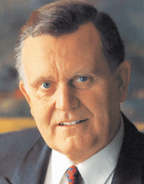 Erwin Teufel, the state Minister President, heads the top European region in patent registrations.
 Located in idyllic towns and cities, Baden - Württemberg's small and medium - size companies are world beaters in every field.
 The state Minister of Economic Affairs, Dr. Walter Döring, is shaping the focus on new product sectors.