|
|
|
 |
The Japan Times WORLD EYE REPORTS BRANDENDURG STEADILY MOVING FORWARD |
 |
|
|
|
|
|
©THE JAPAN TIMES |
Friday, June 18, 1999 |
B1 |
|
|
The reason behind this is our industrial and service sectors. Our close ties to the Central European nations such as Poland are very important as well. Our exports to Poland have doubled since the beginning of the 1990s. We have the longest border with Poland, 250 km, of any other German state. Together with my colleague in Warsaw, the economics minister, we are developing the border area to establish technology intensive operations on the German side and locating the more labor-intensive operations on the Polish side. Our experts are working on a pilot project in the area around Frankfurt on the Oder. So its now possible to invest on both sides of the border and combine the best of both worlds. We have a policy of reindustrialization. This means stabilization of the former industrial centers of the state. We have also established six new technical schools, three new universities and new research and development centers. Now we see the first wave of young people graduating from this institutions, and they are the best capital this region has. We have been concentrating our efforts on the sectors where we are convinced we have unique advantage, such as film, energy, traffic, biotechnology, microstructures, chemicals, machinery and food production. Naturally we are also part of the metropolitan area of Berlin, which provides us with the great benefits of that city's culture, science, academic institutions, infrastructure, new international airport and future high-speed rail system. We currently have only 2.5 million inhabitants, but that's increasing because this is am attractive place for Berliners and others to relocate. More than 90 percent of our companies are small local firms with less than 30 employees. This means we have about 100,000 "Brandenburg" jobs, and this is very interesting because under the old government system, entrepreneurship did not exist. We have the highest rate of founding new firms of any other Eastern German state. Some of them are already very successful in global market. We also have about 250 foreign companies in the state. One-third of the investment in Brandenburg since reunification has come from abroad. In our industries, there are about 25,000 employees working either direct or indirectly in foreign-owned companies such as Sumitomo, Samsung and Honeywell, just to name a few. We have invited everyone to come to this dynamic and open region.
As the "tiger" economies of Asia lose their roar and many emerging markets lose their appeal, the heads or multinational corporations building global production and distribution structures are challenged more than ever to find a business location offering stability, affordability, developed infrastructure, cooperative local government, skilled labor, flexible unions and large local market potential. In short, they want the best of both worlds, according to Dr. Knut Solzbacher, CEO of Brandenburg Economic Development Corp. The "new" federal state of Brandenburg, the state that encircles Berlin, is such a location. "We can offer investors a central location in the heart of Europe with a highly skilled labor force. In areas of Berlin and Brandenburg, there are more than 150,000 students studying in all branches," Solzbacher de-said. The know-how in the population of Eastern Europe is also a great advantage, and according to Solzbacher, the flexibility of the workforce is a major benefit: "We also have a longer work week than western German states - 40 hours. And we estimate that the average wages in Brandenburg are roughly 65 percent of those in the western states. This strategic advantage should continue for roughly the next 10 years." He added that many foreign investors ask about the flexibility of the unions in Brandenburg and other eastern German states. "Our unions are very cooperative, and this is an important aspect when considering a business location," he said. There are also numerous grants and subsidies available for investors in securing. These are mainly provided by the EU. Foreign investment in Brandenburg has played a major role in the state's recent development. About 80 percent of current investment projects in the region are from Germany. In the beginning, however, much of it came from all over Europe, especially France, Britain and Italy. Solzbacher said, "The U.S., of course, is the largest foreign investors, but we are hoping to gain more investment from one of the largest investor nations in the world - Japan. So we are concentrating our efforts on Germany, the US and Japan."
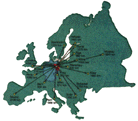
Solzbacher recalled that the level of expectation after the fall of the Berlin Wall was very high. The local press was predicting a flood of Japanese companies into the region. But according to Solzbacher, "Japan had already made a great deal of direct investment in the late 1980s in West Germany and Europe and was not in a position to increase it any more after the political situation changed here." Despite the flattening of the German economy after reunification, however, Brandenburg and Berlin still captured significant investments from Japan with such flagship projects as the Sony compels at Potsdamer Platz in Berlin. Brandenburg's central location is an ideal staging area for companies interested in reaching both East and West.
"The countries around us, such as Hungary, Poland and the Czech Republic, have normalized. This is a market of over 100 million people," Solzbacher reasoned. "Together with the West European market, there are nearly 400 million people. So if the Japanese lose business in Asia due to the economic situation there, they can step into the European market from Brandenburg. From here, one can cover both East and West." Many executives in the private in the private sector have confirmed Solzbacher's assertions. Dr. Reiner Schieban is managing director of tire firm Pneumant Reifen GmbH in Fuerstenwalde (Spree), which is owned by Sumitomo's Dunlop. He said, "The main benefits of the Brandenburg business location are lower wage levels compared to the western states of Germany. There is also a longer working week in our factories than in Western Germany, and the government provides subsidies for investments in Brandenburg, which are also attractive." Pneumant produces passenger car tires for original equipment manufacturers and replacements. Scheiben said, "The state government is very effective in attracting new investors to the region and is eager to ensure the best environment for all business activities." Rainer Geiser, managing director of Daimler-Chrysler MTU Maintenance Berlin-Brandenburg in Ludwigsfelde, also mentioned the state government's willingness to make settling in the region as easy as possible. He said, "We have received very good support from the ministers of the state of Brandenburg. The land on which our plant was built is in an industrial area on a fully developed site, part of the regional planning zone. This qualifies us for government funds." The regional plan designed to attract industry, along with the earnest efforts of the state government to encourage investment in key sectors, appears to be paying off. BASF Schwarzheide GmbH, a fully owned subsidiary of BASF AG, operates a number of chemical plants producing polyurethane, engineering plastics, foams, water-borne coatings, dispersions and crop protection products. In 1998, its 2,250 employees and trainees achieved sales of DM 871 million. Dr. Hans-Ulrich Engel, CEO of BASF Schwarzheidi, said, "Ours are among the most modern chemical plants in the world, and we have reached a competitive position compared with other BASF sites. To manage this turnaround, from a state-owned industry to this modern production facility, we invested DM 1.5 billion over the last eight years. Of course this was only possible through close cooperation with state authorities. And we produce in an area where the chemical industry is accepted and supported at a high level." Heavy investment is also being made in Eastern Germany's famous "autobahn" network of motorways puts a broad European market of some 200 million consumers within just one day's journey by truck from Brandenburg. The future trans-European high-speed rail lines from Paris and Amsterdam to Moscow and from Oslo and Stockholm to Vienna will cross in Berlin. In addition, a promising high-tech project for a maglev train, called the Transrapid, is planned from Berlin to Hamburg, and the region is connected through a network of canals with Poland, Ruhr area and the seaports. Berlin and Brandenburg have some of the most modern communication infrastructure and well prepared for the coming age of telecommunications. As a result, the region has a chance to develop into one of the largest regional markets for communication services. The complete digitalization of the local telephone connection has ISDN capability. Mobile radio-telephone networks are available and provide total area coverage. No matter how well-developed the infrastructure or how cooperative the local authorities, however, the decision to relocate to the region would still be difficult if the quality of life were not attractive. Brandenburg wins points on this issue as well. Engel of BASF described the lifestyle that managers relocating to Brandenburg can enjoy: "Brandenburg is the fifth-biggest state in Germany and has relatively few inhabitants. Its beautiful countryside, with lots of lakes and forests, old villages and cities filled with history - like Potsdam - offer excellent and healthy living conditions. Berlin, with its exciting cultural attractions, sports events and entertainment possibilities, influences the feel of Brandenburg. This combination of rural areas and the metropolis of Berlin characterize the special personality of our state." Low costs, large markets, a skilled labor force, cooperative local authorities, attractive subsidies, modern infrastructure, proximity to decision-making centers, a great way of life - the list of Brandenburg's advantages goes on and on. Brandenburg is back,and multinationals looking for the best of both worlds are encouraged to come take a close look.
10 good reasons for investing in Brandenburg
Source: Brandenburg Economic Development Corp.
HOME About
Us Careers Contact
Us Reports Advertisers About
Japan Times
© 1999 World Eye Reports
|
||||||