

|
|
|
| . |
|
|
The globalization of the world's economy has provided the stage upon which companies either compete or perish. As a leading producer of precision mechanical and electrical components, Danfoss has positioned itself to meet the industry's increasingly difficult challenges. With 53 factories in 21 countries producing goods to turn out sales in 2000 of 1,985 million euros, the company exemplifies successful globalization.
To solidify its position as global leader, Danfoss will look to strengthen two primary areas: research and development, as well as acquisitional growth. Clausen states: "Danfoss decided that we wanted to become Number One and Number Two in all areas that we consider our core business." The company's business segments can be broken-down into three areas: refrigeration and air conditioning, heating and water, and motion controls. While the company is the market leader or second in some areas already, it has not reached this level yet in others. In the next 10 years Clausen hopes the Danfoss vision will propel them into leading positions in all sectors. Though research and development will strengthen the company's position considerably, Clausen also plans to look to acquisitions to further its foothold within the industry. Potentially, Danfoss will be seeking to acquire large companies on each continent. With such ambitious plans on the horizon, Clausen admits the company is contemplating a flotation. Perhaps the only reason for going public would be for Danfoss to get the financial leverage to acquire other companies and thus remain competitive. Led today by Jorgen Clausen, the oldest son of Danfoss founder Mads Clausen, the company is a family-owned company operating on a global scale. The company's founding history, which can be traced back to one individual's ingenuity, is a quintessential success story which has something of an inspirational status for Danes today. Therefore, though Danfoss may lose its status as a privately owned company in the years to come, it will not lose its essence - remaining a company which believes strongly in relationships and partnerships. Exemplifying Danfoss' success in the realm of partnerships is its alliance with Sauer. In May 2000, Danfoss moved to merge with the world leader in engineered hydraulic systems. Before, the Sauer-Danfoss partnership Danfoss was sixth in this industry worldwide. After the merger the company moved to the leading positions within the mobile hydrolics industry. This move to the top through merging is typical of the company's plans to move to the forefront. Having had such success with this move, Sauer-Danfoss then looked to strengthen its presence in Japan. This was done through a joint-venture with Daikin Industries. Hioraki Kikuiri, president and CEO of Sauer-Danfoss-Daikin, which handles sales for the entire Asia-Pacific Region (APAC), comments: "Sauer-Danfoss-Daikin (SDD) will be APAC's number one supplier of highly engineered products in mobile hydrolic business which is growing in East Asia." Additionally, he comments: "Japan is a huge market for Sauer-Danfoss. Our penetration in Japan is therefore critical for global growth." Danfoss' success with mergers and joint-ventures bodes well for it as the company will be on the lookout in the Japanese market for further joint-venture possibilities. Additionally, with other Asian markets looking equally enticing, there is no doubt that the previous experience garnered from a presence in Japan will position Danfoss solidly ahead of its competitors on a global scale.
|
 |

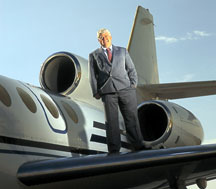 CEO Jorgen Clausen is steering Danfoss on a high-powered course for global competition.