

|
|
|
| . |
|
The city-state of Hamburg is Germany's oldest commercial center. Today, it is the country's most important foreign trade hub. Hamburg's trade links with Scandinavia and Eastern and Central Europe are 800 years old. The first English and French trade links were set up in the 16th century, followed by the Dutch and the Spanish in the early 17th century. Merchants from Hamburg were traveling as far as Japan, China, and Indonesia by the 19th century. Built upon such strong traditions, the city of Hamburg has grown into Northern Europe's premier business center.
Hamburg is home to almost 170 financial institutions, including 39 foreign banks with a total of 678 branches within the region. Hermes Kretiversicherungs was the world's first credit insurance company, and is now among the world's largest. Th company insures retailers all over the globe, and is now making headway in the Japanese market. Another local institution, Berenberg Bank, caters to high net worth clients all over the world, refusing to sell its operations to bigger multinational banks. Berenberg is one of the most trusted financial institutions for the world's elite.
Media is Hamburg's third largest industry by turnover and its fourth biggest employer. Companies such as Axel Springer, which produces Europe's biggest publication by turnover -- Bild -- as well as Germany's most international newspaper -- Die Welt -- make their home in Hamburg. Gruner + Jahr, another of Germany's publication giants, is also based here. In addition to projects on the ground, Hamburg has also taken to the skies. Hamburg is the world's third most important commercial aviation center. Airbus Germany, formerly called Daimler-Chrysler Aerospace, is the center of assembly for fuselage sections, interior fittings, and paintwork for most of the Airbus line. With a third assembly line on the way, the company is gearing up to work on the largest civil aviation project in history -- the enormous Airbus A380 that is scheduled for delivery in 2006. Hamburg is also home to the world's largest aircraft maintenance, repair, and overhaul company, Lufthansa Technik. Now a completely separate entity from Lufthansa, Lufthansa Technik services more than 300 of the world's leading airlines. The company has also become the world leader in customizing jumbo jets for private use. All of these facilities are situated near Hamburg Airport, Germany's fourth largest and the most profitable in the country.
In the first half of 2001, the port increased cargo handling by 10.8 percent from the same period in 2000, despite a worldwide downturn during the year. It is the only Northern European port (a group which includes Rotterdam, Amsterdam, Antwerp, and Bremen) that achieved double digit growth in the first half of 2001. Headed by Dr Juergen Sorgenfrei, the port offers easy access for incoming ships and easy connections to roads. It also boasts the best transshipment infrastructure of any port in Northern Europe. Hamburg is Europe's biggest rail container handling center, where cargo can go from ship to rail anywhere in the continent quickly and efficiently. There is over 4,000 km of truck freight-bearing roads, as well as 2,400 bridges for additional cargo transport. The Port of Hamburg also acts as a transshipment port for the Baltic ports of Luebeck and Kiel, which give it indirect access to 50 million consumers in the Baltic region.
|
 |

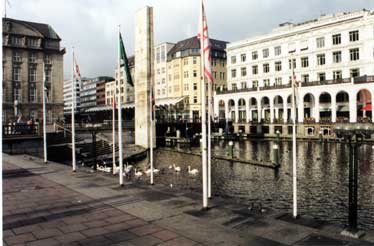 Hamburg has outlived and outclassed several cities as a bustling trading center.
 Hiroshi Sakurai, Japan's consul to Hamburg
 Claus G. Budelman, managing partner of Berenberg Bank