

|
|
|
| . |
|
While most of the world's wax use continues to be in the traditional candle industry, Hamburg-based Schümann SASOL has developed a large number of other applications, all of which help to make products last longer and perform better.
Candles still constitute 40 percent of the demand for wax worldwide. In many developing countries, candles are still used as a primary source of light in the absence of reliable electricity. On the other hand, candlelight can also mean ambiance -- the creation of a warm and cozy atmosphere in restaurants and at home. More recently, candles have become not just a source of light but also a carrier for fragrances. Schümann SASOL'S Scenti® line leads the world in scent-carrying waxes for both paraffin and gel-wax candles. But Schümann SASOL is looking beyond candles. Its Fischer-Tropsch wax is used as an adhesive component by the packaging industry to seal boxes and bags for food. Wax is also an integral part for the rubber and tire industry, which uses the substance to prevent surface cracking from heat and UV light exposure. New applications are taking shape in the cosmetic and gloss emulsions industries. "We are working on altering the hydrocarbons in order to store energy," said Schrenk, explaining another new product developed and marketed by the company's Rubitherm division. "We have projects which use this characteristic of wax to make it applicable in industries which need a substance that will stay warm or cold longer," the executive explained. "One such product is a neck roll that you can microwave and then use as a scarf. It remains at 50 to 60 degrees for about two hours." Different temperature ranges are being used for a variety of transport applications such as food and medical products. Such applications use "phase-change" material, which goes from liquid to solid state or vice versa within a predetermined temperature range. As the change takes place, the substance releases or stores energy -- thus the temperature change. The potential is huge and applications go from construction to clothing. Perhaps Schümann SASOL most revolutionary product is Sasobit, a synthetic bitumen/asphalt modifier. "A big problem for road users is that due to heavy usage over time, the road surface bunches up due to auto braking, especially in front of traffic lights and intersections," he says. "Heavy trucks literally move the surface [of the road] when they apply the brakes, causing deformation of road surfaces. "If you add 3 to 4 percent of Sasobit to the road asphalt mix before paving it, these problems disappear. We have a test track outside our office here in Hamburg that has shown no sign of damage after four years of heavy use. Elsewhere in Germany and abroad, several road sections, as well as one of the runways of the Hamburg Airport, have since been constructed using this unique additive," Schrenk continued. "Using Sasobit, road surfaces do not have to be redone every 2 to 3 years or so. It does cost a bit of money in the beginning, but it is an investment for the road owner, saves unnecessary maintenance costs." Schenk added that another important payback is safer driving conditions for road users.
|
 |

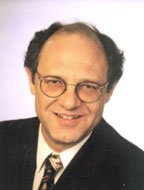 Deodatus Schrenk, Chairman of the management board of Schümann Sasol