|
World Eye Reports on Italy's Northwest |
||
| ©THE JAPAN TIMES |
|
B3 |
|
JAPAN-ITALY RELATIONS
Common ties A message from Masayoshi Kusuda, Japanese consul general to the Lombardy region To mark successful diplomatic relations between Italy and Japan and increase awareness about the importance of this relationship, a yearlong exhibition will take place in 2001 in both Japan and Italy. For Italian people, it is an opportunity to introduce themselves and highlight their expertise in fine food, wine, and their urban living. For the Japanese, it is a chance to learn about Italian culture and creativity, and present their technological know-how. |
"This likeness has led to excellent trade relations between the two countries," said kusda. "The Japanese are the first to buy Italian fashion and design, and the Italians welcome Japanese exports. Japanese visitors to Italy are also an important part of this market. Last year Japanese tourists were numbered almost 4.5 million. Their stay on average was two days." But this relationship has not always been so fruitful. Kusuda remembers the period between 1969 and 1972 when Italy was suffering from high inflation, strikes and government instability. "During this period it was very difficult to get anything done. Trade volume between Italy and Japan was at an all time low, and the bureaucracy in Italy scared potential investors." explained Kusuda. Although the recession and the corruption scandals rocked confidence in Italy's economy, the country managed to stay united. The government introduced a range of new measures to combat the economic decline, and today Italy is secure in its recovery. "These results have been achieved by investors overcoming their prejudices. The trade volume between Italy and Japan still remains low, but if we look at the amount of direct investment from Japan, this is very high," said Kusuda In 1998, following a proposal to the Italian Chamber of Commerce on how to promote Japanese investment in Italy, the result was very positive. Kusuda recalls: "80 percent of the Japanese said they received good results while here. Sixty-four percent of Italian productivity is of the same standard as that of Japan." Kusuda's future vision is to promote mutual understanding between Italy and Japan, in the hope that their relationships will continue to deepen and investment will grow. Learning flexibility and creativity A significant bulk of trade between Japan and the rest of the world goes through large Japanese trading house. Among these trade giants are companies like Mitsubishi. Mitsubishi Italia's main business activity is the export of Italian goods to Japan. It also imports certain goods from Japan to Italy and participates in so-called abroad business, or triangle trade between third-party countries. Mitsubishi's main exports to Japan are typical Italian products such as textiles, shoes and other fashion goods. Furniture and food products are also important. Naturally, such business depends greatly on market conditions in Japan. "When the Japanese market is very low, as it has been in recent years, our export business suffers," said Toru Sugita, president of Mitsubishi Italia. "However, we expect an increase in the latter part of 2000 due to the economic recovery in Japan. Total private consumption expenditure in Japan has increased very slightly this year. This is a good sign for us." Despite Japan's lagging marketing conditions, which have squeezed out many Italian exporters, Mitsubishi has been able to maintain its business level. "We have maintained our business because we have diversified the product range we export to Japan. For example, we found some new apparel brands that were not so famous as the major designers. So we were able to sell these at a lower or mid-range price level. Also, we found other new suppliers here," explained Sugita. In locating new apparel brands, Sugita commented on the importance of networking. "By the time the new brands are written up in the newspapers, it is too late. You must get the information early. Like in Japan, personal connections are very important in Italy," Overall, Sugita finds that the Italians are very open to working with Japanese. "The Italian manufacturers understand the big export possibilities with Japan. However, they comment that the taste of Japanese people changes very quickly. They are requested to respond to such quick changes in taste," Sugita pointed out. In addition to his position at Mitsubishi, Sugita is the current president of the Japanese Chamber of Commerce and Industry in Italy, an organization devoted to increasing trade and investment between the two countries. One of the recent topics between Italy and Japan is Italy in Japan 2001, a one-year trade and cultural exhibition supported by the Italian government and headed by Italian "captain of industry" Umberto Agnelli. This event, similar to what has been done in Japan by other countries, is expected to make the business relation between Italy and Japan much closer and stronger. The Chamber has also organized some recent industrial tours for Japanese to come and see how Italian industry works. Sugita said that Japanese industrialists have a lot to learn from their counterparts in Italy. "I was very impressed with the way Italian factories operate." he stressed. "They have a lot of creativity and flexibility in their industrial approach. I also think that it's important to note the structure of the industrial base in Italy. In Japan, industry is vertically integrated. In Italy it is very horizontal. Many small companies cooperate to perform the task of what one very large company would do in Japan. The Italian structure is well-suited to put out small volumes of production. This allows flexibility and speed to enter new products into the market." "Japanese industry has always been known for its efficiency and precision. But I think it could benefit from learning some of the flexibility and creativity that thrives here in Italian factories." *Note: 163 Japanese companies comprise the Japanese Chamber of Commerce in Italy. More than 80 percent are in Lombardy Region, followed by Rome and Piedmont. Founded in 1986, the company is based nearby Turin, hometown of Fiat Group. The joint venture is the unparalleled effort between Fiat Group and Hitachi Construction Machinery. It boasts 13 product lines, 65 basic models and over 250 versions, making it Europe's only full-line supplier of earthmoving machines. Above and beyond being a good example of a joint venture, Fiat-Hitachi is a leading European manufacturer. "From the start, we knew this was a win-win situation," said the company's energetic managing director, Fausto Lanfranco. The joint venture was very much a product of its times. During the 1980s, there were duty barriers for Japanese producers to supply Europe. In order to localize, Hitachi needed a European partner. At the same time, Fiat was looking for a company with good technological knowhow. Hitachi, already a world leader in earth-moving machines, was an ideal candidate.
"This was definitely a risk, but we could see the market was growing, and we decided that we should be ready with fresh products," explained Lanfranco. By any standards, the risk has paid off. As they expected, the market rebounded and Fiat-Hitachi has enjoyed sustained growth ever since. Their results for 1999 were especially positive, with sales topping the $500-million mark and unit sales at about 9,000 machines worldwide. In Europe, company sales grew by 30 percent versus a mere 17 percent growth in the market. "These results have been achieved thanks partially to an extensive sales network of 185 dealers and importers around the world," explained Lanfranco. "We are now in a position to keep our dealers stocked with new machinery." The product renewal investment program that began in 1997 was completed last year, with a total renewal of the crawler- and wheel- excavator range as well as the wheel-loader range. New products include the EX455 excavator, a 46-tonne machine unveiled during the International Show of Public Works, Construction and Mining Machinery in Saragozza. The EX series is the most technologically advanced excavator in the world. The factory sometimes has problems keeping up with market demand for the EX series.
By investing heavily in product range, product quality, technological innovation and its sales network, Fiat-Hitachi has successfully increased customer loyalty. Lanfranco explained, "In our industry, loyalty is important. By providing good performance and excellent customer service, people come to us time and time again. By offering a full line we are at an advantage because we have a stronger loyalty network. This does bring complexity, but as we have the financial power and the muscle, we have to be there for them." Fiat-Hitachi offers product support that is committed to supporting its dealer network. And providing adequate support to ensure quality and rapidity of response to technical issues contributes to customer satisfaction. Its product-support service operates through advanced communication technologies, including an Internet site, call services and video conferencing through PC work stations. In addition, important investments are being carried out in the area personnel training. The training center, located at the Fiat-Hitachi plant in Lecce in the south of Italy, is targeted at training staff of the company as well as the dealerships. Lanfranco explained, "The creation of an innovative technological base to support communications has enabled Fiat-Hitachi to operate even closer with its dealerships to achieve the common objective of full customer satisfaction."
Summing up the company's situation, Shinoda said, "When we walk around the plant, it is great to see we are standing in one of the biggest excavator plants outside of Japan. But it is even more impressive to realize this has been made possible by one of the oldest joint ventures in Italy. The success of Fiat-Hitachi is an example of a strategy that has worked well. It combines a transfer of skills and knowledge. Even more important, however, is that it represents the cooperation between two nations that have much more in common than just technological knowhow." Over the past several decades, perhaps no other nongovernment individual has done more to strengthen relations between Japan and Italy than Agnelli. For his achievements in this regard he has received several important awards, including the Trade Award in 1995 from the prime minister of Japan for his extraordinary contributions to the bilateral economic exchanges and in 1996, the revered Japanese award the Grand Cordon of the Order of the Sacred Treasure. Agnelli will continue this career of industrial diplomacy as president of Italy in Japan 2001 Foundation, the government-sponsored organization responsible for coordinating the exhibition next year in Japan to heighten awareness of Italian business and culture. In an interview with World Eye Reports, Agnelli shared his views on this subject. WER: What are the hopes and ambitions for Italy in Japan 2001? Agnelli: I am very proud of my country, and I would like people around the world to know and understand Italy as it is. Historically, we are famous for our culture and natural surroundings. But we would also like to show the modern Italy and the quality of life that comes with it. The Japanese are very keen to have a better quality of life, and we want to show them this is possible. WER: You are considered the "technician" of relations between Italy and Japan. How did this come about? Agnelli: My connection to Japan started in the late 1970s. This was during the trade war between Europe and Japan related to the automotive industry. We had to identify a place where we had common ground and try to overcome the friction. We managed to get a deal for the market to open completely in 2000. I don't think this deal was a gateway, but it certainly opened up trade and investment. From then on, I've been considered the technician of relations with Japan. WER: You have received a number of awards for your work with Japan. In your own opinion, what do you think has been your greatest achievement in stimulating awareness and trade between Italy and Japan? Agnelli: It was mainly to stop this trade war. But for the future, I would like to encourage more joint ventures in the small- and medium-sized enterprises. It is important to exchange knowledge, and in this global world all companies need to be active. By trading ideas, we can join together. WER: What advice would you give to Japanese or other foreign investors thinking of coming to Italy? Agnelli: First, they should know what is going on. Things like the Italy in Japan 2001 Foundation and the Internet are going to help in this respect. Selling globally also means dealing with foreign cultures, so it is important to make personal contacts. WER: How important do you think interpersonal relationships are for a successful business in Italy? Agnelli: This is an essential ingredient to successful business management. You must develop confidence. You should be able to go out and drink a beer with a business partner and not only talk business. For the Japanese, I would encourage them to be more individualistic and less group-oriented. Try to be a little more independent in having contacts and also in selling yourself. Be a citizen of the world. I do believe that in general the attitude of the Japanese is changing. For the Italians, I think what we have to sell most is our ability to have a good-quality life -- fashion, food, tourism, wine, all these sorts of things. We need to sell this under the best possible conditions. WER: What is your assessment of the current economic climate in Piedmont? Agnelli: This region has gone through many phases - First as a leading textile center and then, hosting Fiat and its suppliers, as a key region for industry. Today, I believe we are moving into the service area. The banking system is getting stronger and stronger; there are a growing number of software houses and there are many research and development facilities. Our bureaucracy still, however, scares the Japanese. We have to help them get over their suspicions and give assurance that the system works well. More than machines Behind the business and engineering of Fiat-Hitachi is an intangible, but all-important aspect to the organization's success: the human element. The understanding and cooperation between Japanese and Italians can be seen from the executive offices down to the factory floor. "When we arrived at the Fiat site, our primary goal was to enhance production of quality excavators. However, with time, we have found it was imperative to embrace societal resposibilities and contribute to the community. Working in this environment has personally helped me develop social and cultural ties with Italy, and make lon-lasting realationships with staff members and the surrounding communities," commented Shoji Iino, senior manager of the Manufacturing and Engineering Industrial Division. The senior manager of the Marketing Division, Kazuo Arai, added, "Japanese employees with experience at an Italian company are very much sought after. After working for Fiat-Hitachi, our workforce have been applauded for their English skills, ability to learn quickly and their high level of technical expertise," This can partially be attributed to a successful exchange program. It is the company's policy to host a number of Japanese colleagues at the plant for a duration of three to five years. This is intended to increase understanding of the Italian culture and join Japanese technical methods with Italian administration. "To improve activity in the plant, we have to constantly strive to improve relations between the two nations. With understanding and harmony, we can continue to move forward, and elevate production and quality," said company vice president Shoji Shinoda, also a senior member of the Japanese Chamber of Commerce and Industry in Italy.
HOME About Us Careers Contact Us Reports Advertisers About Japan Times © 2000 World Eye Reports |
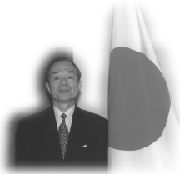 Masayoshi Kusuda, consul general to the Lombardy region
 Fausto Lanfranco, managing director and general manager, Fiat-Hitachi Excavators SpA
 In the past three years, Fiat-Hitachi has renewed 90 percent of its product range. Featured above is its W-Series wheel loader.
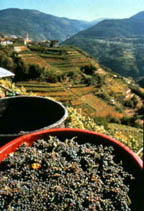 IN THE NORTHERN REGIONS of Piedmont and Trentino-Alto Adige, the sub-alpine climate nurtures unique flavors and colors of grapes.
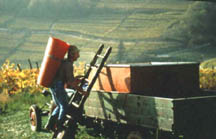 ITALY GROWS more grape varieties and produces more wine than any other country --nearly one-fifth of the world's total supply.
 Dr. Umberto Agnelli, "captain of industry" and president of Italy in Japan 2001 Foundation