

|
|
|
| . |
|
|
Disaster struck Asia in 1997. A currency crisis caused the near-collapse of many of the region's most promising economies, and brought about emergency intervention by the International Monetary Fund. Bankruptcies swept many of the highest flyers completely off the table, and the economic landscape underwent drastic and painful reform. It was not uncommon to see tent cities and breadlines in many of Korea's largest cities, images which were a far cry from the booming Asian Tiger the world had known during the 1990s.
Heavy industry continues to be one of the country's pillars. Lead by Hyundai, Korea is the fifth largest producer of automobiles in the world, and they remain one of the leading export industries. With an annual production volume exceeding 3 million units and quality steadily improving, Korean auto brands are increasingly visible on highways abroad, further fueling the country's economic engine. This shift in production has brought forth a new Korea, one that would have been unthinkable just 10 years ago. Korea is becoming the hub of northeast Asia, and a full- fledged member of the international community. The drive to be a regional hub has produced the new Incheon Airport, built at a cost of nearly $6 billion. It is able to handle 170,000 flights and 27 million passengers annually, and is but one cog in a fully integrated transportation and logistics hub consisting of a fully integrated port, rail, and highway system that provides the arteries for both the domestic and export economy.
Once rivals, Korea and Japan are now working to bridge their differences and form alliances that will benefit both of them equally. In the eyes of Tetsuke Terada, the Japanese Ambassador to South Korea, the potential for growth through mutual cooperation is immeasurable. "The strategic objective of both governments is to conclude with a Free Trade Area," he comments. "We are encouraging Korean investment into Japan and vice-versa. This will assure the development of a sound investment and lending environment between Japan and Korea."
"As a country with a high ratio of exports and investment in its economy, there are limits to an economic growth driven by domestic demand. Accordingly, Korea needs to convert the current economic recovery, boosted by consumer spending, into solid economic growth led by a balanced increase in consumption, exports and investment," comments the country's Minister of Commerce Industry and Energy, Shin Kook-Hwan, on the need for an globally oriented economy.. Internationalization has been the most significant factor in Korea's growth over the past decades, and it will be responsible for forcing the reforms that have let Korea emerge from its financial crisis and resume its position as a leader in Asia and beyond. While the challenges facing the country are still severe and the threat of conflict with North Korea remains a looming cloud on the horizon, things are beginning to look brighter. For the first time in years, Korea is standing on its own - able to maintain a thriving and vibrant country as a true member of the global village.
|
 |

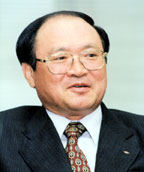 South Korean Trade Minister Hwang Doo Yun
 Seoul's urban sprawl has grown vertically as well, ready to resume its dynamic global role.
 Terusuke Terada, Japanese ambassador to the Republic of Korea