

|
|
|
| . |
|
|
Omron, one of the world's leading producers of industrial control components and systems, controls its European operations from its headquarters in the Netherlands. As the European arm, Omron Europe focuses primarily on the Italian, Spanish, German and French markets.
The company's main business is sales, distribution and servicing for Omron's products: sensors, components and control units for industrial automation, image identification and positioning equipment, motors and drivers, intelligent operating systems and programmable control systems. "In anticipation of future growth and expansion, we will not reduce our sales force, as many of our competitors have done over the past years," says Steve Yukawa, president & CEO of Omron Europe. "We will pursue our markets with strong communication networks. Whatever the customer needs today, we can deliver in good time." Omron's fundamental role is not only to provide a variety of sensing and control products to its customers, but also to develop new strategies for products and services to meet future needs. To accomplish this, Yukawa explains that it is vital to understand the business practices and cultures of the people in the countries where they operate. "We have a strong presence in Southern Italy and Spain, and our attention is now toward the larger potential markets of Germany and France," he explains. "We have to keep in mind that people and attitudes are different in both areas. For Omron, this means making sure our individual business units work to strengthen their respective operations in harmony with their environments." "Our products are as basic for the industry as bread and butter," adds Yukawa. "Automobile companies like Nissan use our products, but it is important to know we do not just target Japanese companies. We hope to increase our customer base of bigger influential customers, because we know we have to stay ahead of the game with competitors like Siemens and Schneider ahead of us." Yukawa envisions each business operation meeting the particular characteristics of the local market in which it operates. "So far, I believe we have been product-oriented," he concludes. "But now we need to become more communication-oriented, and customize our services. This means more value for the customer, and a step up the ladder to providing the best solutions for our customers' diverse needs. Our goal is to satisfy our 21st century pan-European market."
|
 |

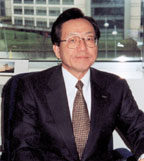 Steve Yukawa, president and CEO of Omron Europe