|
|
On the road of EU membership
Poland has been redefined. After more than 40
years of Soviet influence and centralized government, the country
has embraced the new market economy. A nation with a vibrant entrepreneurial
class, a population of 39 million and billions of dollars in foreign
investment is transforming itself into the economic powerhouse
of Central and Eastern Europe.
The last 10 years of reform have produced as new
image of the country, Maria Wisniewska, president of Grupa Pekao,
Poland’s largest commercial bank, said, “Poland is no longer considered
an emerging market, but a converging market.”
|
|
Central and Eastern European nations are following Poland’s
example. Today 64 percent of the country’s exports go to the European
Union and only 8 percent to Russia. Warsaw has taken full advantage of
its new opportunities to sail away from the influence of Moscow and reassert
itself as a clearly different nation.
Through tough structural and institutional reforms,
Poland has become a leader in the region and has been able to survive
the grueling tests of a global financial shakeup. Its membership in
NATO and the inevitable integration into the EU will further strengthen
the country’s role in the region.
Many challenges undoubtedly remain for Central Europe’s
largest country before it becomes a full partner with the West. Even
though it is a different country than a decade ago, Poland’s farms,
factories and bureaucrats still have a steep hill to climb before they
meet European standards. Industries like telecommunications, construction
and energy are still crying out for investment and restructuring while
many state-owned enterprises face a heavy burden. The push down the
road to integration with the West may lose popularity as the cost reaches
deeper into Polish pockets.
As Poland strives to secure its spot on the international
plateau, pressures to change will only intensify. But the country has
already proven it is different. Poland exemplifies progress through
reform.
The last five years have provided a gross domestic product
growth rate between 5 percent and 7 percent. Both inflation and unemployment
dropped to below 10 percent last year, and despite a global slowdown,
growth of 5.1 percent is predicted for 1999.
These statistics are helping make Poland the destination
for billions of dollars of foreign investment. Low labor costs and widely
available skilled labor combined with a huge domestic market and 17
special economic zones are attracting eager investors from around the
globe.
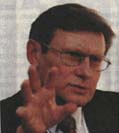
Vice Premier and Minister of Finance Lescek Balcerowicz |
Privatization of Poland’s largest enterprises
has also played a role in the country’s growth. Proceeds from
privatization in 1999 are expected to be in excess of $4 billion.
“Poland is one of the most fascinating countries
in the world in terms of attracting foreign investment,” stated
Dr. Andrzej Polaczkiewicz, managing director of the Foreign Investors
Chamber of Industry and Commerce, an agency assisting foreign
investors in Poland. The organization provides consulting services
and helps to promote and coordinate investment projects.
|
"Everyone who comes to Poland will be successful,”
asserted Polaczkiewicz. “We are educated, learn quickly and have something
one does not often find in many parts of the Western world: flexibility
of people.
“Germany has supplied Poland with very high technology.
Today, many Polish companies are operating at a very high level and
offering products that are competitive with other parts of the world.”
A bourse to reckon with
Even the Warsaw Stock Exchange has shown continuous
growth in a year characterized by many sluggish bourses.
One of the oldest stock exchanges in the world, the
Warsaw bourse was founded in 1817. It operated until 1939, but after
World War II, due to the change of political and economic systems, capital
markets could not be re-established. In 1991, the exchange was set up
again, ironically enough in the former headquarters of the communist
party, and it has shown enormous growth in the past nine years. At end
of 1998 the listed companies numbered just shy of 200 and had a market
capitalization increase of more than 60 percent.
The initial public offering of Telekomunikacja Polska
SA, Poland’s national fixed-line telephone company, was the biggest
news of the year as 15 percent of the company’s shares, owned by the
state treasury, were floated to attract foreign investors.
“LOT Airlines, large oil refineries, electric companies
and the shipyards are scheduled to be listed in 1999 to draw a new class
of foreign investors,” said Dr. Wieslaw Rozlucki, president of the Warsaw
Stock Exchange. “This will change the market capitalization. We are
still in the fortunate position of being able to privatize some of our
crown jewels.”
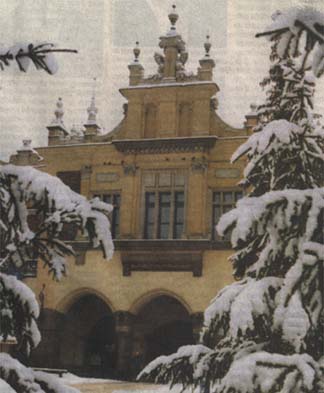
Winter snow dresses up Krakow's historic main market
square. |
“In particular, the market is awaiting the privatization
of large enterprises. It has never had a problem to digest these
large, attractive companies. On the other hand, great progress
has also been made among small and medium-size businesses. There
are thousands of entrepreneurs, and the number of new companies
in Poland is incredible. This not only shows the strength of the
Polish economy but of the people as well.”
Rozlucki warns investors against the tendency to group all Central
and Eastern European countries together and perceive them as one
economy. “Our task is to differentiate ourselves in the region
and prove that we will react differently,” he said.
“Poland is not a target for hot money. Emphasis
is on transparency and maintaining a close correlation between
the actual facts and the figures reported. We are striving to
attract cautious investors who like to invest in a transparent
market. We’d like to see more investment from Japan, too.”
|
Strategic
partner
Prime Minister Jerzy Buzek, the eighth prime minister
of Poland since the fall of communism in 1989, speaks about the changes
his nation faces.
What sector will have the strongest impact on the
future economic growth of Poland, and what is being done to improve
Polish exports?
At the turning point in 1989, the Polish economy was
weak, having been practically destroyed by 45 years of isolation from
free market mechanisms, and it was also suffering from a financial crisis.
The economy was based on exploration and export of raw materials, especially
coal, to our main trading partners like the Soviet Union and other countries
of the Council for Mutual Economic Assistance.
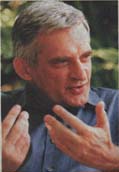
Prime Minister Jerzy Buzek of Poland |
In recent years the Polish economy has successfully
ridden out the crisis. Inflation was tamed and foundations were
laid for an economically strong system. However, the problem of
giant state industries, which were indebted both to external creditors
and the state treasury, still needs to be sorted out. Such industries
as mining and steelworks have to be restructured.
One of the most important tasks for the Polish
economy is to reach higher export levels. We are trying to analyze
and assess our export processes in order to forecast areas where
growth in exports will exceed growth in production sold.
|
Statistics indicate that our largest export potential may
be in electrical machinery industries, where exports grew 122.6 percent
in the first six months of 1998. Other industries with export potential
include food and chemicals.
What is your opinion on the development of relations
between Poland and Japan?
Relations between Poland and Japan have a long tradition.
This year, we will celebrate the 80th anniversary of establishing relations
between our countries. We consider the anniversary a very important
event, and Poland perceives Japan as having great international importance.
We treat Japan as our strategic partner in Asia.
Permanent political dialogue and a wide range of contacts
in many areas tend to justify our expectations of Japan. Both sides
agree, however, that our economic cooperation is still nor fulfilling
the potential of the two countries, particularly in the amount of Polish
exports to Japan.
In 1997, the total value of trade between Poland and
Japan amounted to $792 billion, yet only $58.2 million was Polish exports.
Nevertheless, we are pleased to note that in recent years the number
of investment projects involving Japanese companies has continued to
grow in our country. I would particularly like to mention such companies
and ventures as Philips Matsushita, Battery Poland, NSK/Nichimen, Marubeni,
Hitachi, Panasonic, Sony, Nikko Denki, Pioneer and Bridgestone-Firestone
Poland, which have contributed to the growth in investments.
What benefits will Poland’s membership in NATO bring?
Poland is a country of Central Europe, and Poles have
always had strong feelings about being part of the Western European
civilization. For several years we have been a member of the Council
of Europe, and currently we are aiming to strengthen links within our
region. Applying for membership in the European Union will help Poland’s
social and economic position. The entry into NATO, possibly this coming
winter, will enable us to increase our external security, which has
historically been full of misfortune. As a member of NATO, we will not
limit ourselves to just enjoying the benefits of security generated
by the organization; we will actively contribute to it.
Why has Poland become such an important target for
foreign investment?
Our geographic position is advantageous to trade. We
are at the crossroads of some major European trade routes. We have a
fairly large population of about 40 million and are neighbors with Russia
and Germany, an economic giant. We also have strong links to the West.
Poles have a good educational background and have been focusing on improving
their communication skills. Moreover, Poles have always liked people
from other countries very much and are happy to have them as guests
in their homes and in their country.
Country Profile
POLAND
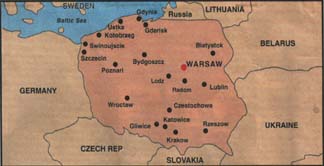
| Official
Country Name: |
The
Republic of Poland |
| 1998
GDP growth rate |
5.2
percent |
| Inflation
rate : |
9.9
percent |
| Unemployment
rate: |
9.7
percent |
| Currency: |
Zloty |
| Area: |
304,500
sq. km. |
| Population: |
38.7
million |
| Official
Language: |
Polish |
| Type
of Government: |
Parliamentary
democracy |
|
|
A transforming city
Since 1989, the arrival of the market economy in
Poland, the face of Warsaw has undergone rapid changes. The city's skyline
is a tangle of cranes and buildings-in-progress.
Warsaw is quickly becoming the most dynamic and cosmopolitan city in
Central Europe. Monstrous postwar slabs are being replaced with newly
constructed steel-and-glass towers, while shop windows are being filled
with color and design. Within a decade, Warsaw has changed into an exciting,
busy, Western-style city attracting businesses from all countries.
The city is set roughly in the center of the country and has 1.6 million
inhabitants. This is twice as populous as the nation's second largest
city, Lodz. Its size and status make it the focus of political, educational
and business life in Poland. No matter where your interests lie, Warsaw
can offer more in terms of luxury hotels, theater, restaurants, shopping,
museums and other services, than any other Polish city.
In the middle of it all
Poland's capital is a sprawling city, so the city center, close to all
businesses and many tourist attractions, is the most convenient place
to stay. In the heart of the city stands the most visible relic of the
communist era, the Palace of Culture and Science. This 230-meter structure
was a gift from Soviet Russia to the people of Warsaw in 1952. It resembles
Moscow's tower blocks built in the style of socialist realism.
Across the street one can see the largest hotel of the city, the Forum
Hotel Warsaw. Covered with a runway-sized Pepsi banner, it is a member
of the Intercontinental Hotel Group, located at the intersection of
two main streets in Warsaw – Marszalkowska and Jerozolimskie. With 733
rooms, this monolith offers superb views of central Warsaw and is right
in the middle of the business hub.
"Our location in the city center is the best in Warsaw," said Wieslaw
Wilk, general manager of the Forum Hotel Warsaw. "This is the best place
for guests of the city, particularly for businesspeople. Everything
is within their grasp. There are shops, different museums, the ministries,
banks and foreign trade organizations. One can walk to all of these
places within 10 minutes. That is why we are the choice for those conducting
business in Warsaw."
This year marks the 25th anniversary of the hotel. It was originally
designed to cater for tourists, especially those coming in groups. Nowadays,
the Forum has recognized the importance of Warsaw as the business capital
of Poland and is therefore adding more services for businessmen. In
25 years, "we have created very good relationships with the local business
community," said Wilk.
Even though Warsaw has become the business center in Poland, it still
lacks sufficient conference and exhibition facilities. This is yet another
advantage for the hotel. It can accommodate conferences, banquets or
exhibitions up to 500 people and it has smaller meeting rooms for private
conferences and meetings.
"We want make the Forum a more attractive place for people doing business
in Warsaw," said Wilk. "That is why we are planning these renovations.
We are sure that we can fulfill all of our guests needs and that they
will be more than satisfied with our services."
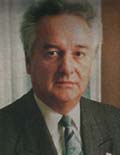
Wieslaw wilk, general manager, Forum Hotel, Warsaw |
As Wilk
pointed out, like in all industries, one has to focus on becoming
closer to the guest. "This is very important for us and our guests.
We have been changing the mentality of the people working in the
service industry. It may sometimes be more difficult to change the
stereotypical view of what people are like in Poland. People are
friendly."
Many things have changed in Warsaw over the last ten years. In 1989,
according to Mr. Wilk, there wasn't much competition. There were
only three hotels appropriate for receiving guests. Today, there
are about 12 very expensive hotels in Warsaw.
|
One of the more posh hotels that have popped up in Warsaw
in this time is the Jan III Sobieski, named after one of Poland's famous
kings. King Sobieski was known as the "Great Warrior," but the name is
also associated with Polish hospitality. Located just down the street
from the Hotel Forum along Jerozolimskie Avenue, the Sobieski was seen
as one of the first hotels to 'break the grayness' of Warsaw.
Emitting wondrous colors and crowned by a glass dome, its mesmerizing
facade resembles more of the old town of Warsaw, which make it one of
the city's most attractive hotels. This seven-story building has 413 rooms
and was designed in the shape of a Pentagon with a garden in the middle.
This is the hotel's greatest attribute where one can escape the clutter
of the city.
There are more and more hotels popping up within the city, preparing for
the rush of tourists and businessmen. The city of Warsaw looks to have
a golden future, and the hotel industry is preparing for it.
Krakow
2000
For more than 500 years, Krakow was the capital of
Poland. Although the seat of government is now in Warsaw,
Krakow remains Poland's spiritual and historic center. It
is one of few Polish cities that escaped the devastation
of World War II. In no other city will you find so many
historic buildings and monuments, and nowhere else will
you encounter such a vast collection of works of art. Wawel
Castle, the very symbol of Poland, rests on the hill overlooking
Krakow's historic Main Market Square.
In the year 2000, Krakow will be featured as one of nine
European Cities of Culture. The Krakow 2000 festivities
include concerts, plays, performances, and exhibits of famous
Polish art. Also of interest in Krakow is the Manggha Japanese
Art and Technology Centre. This museum and culture center
was conceived by Polish film director Andrzej Wajda and
designed by the Japanese architect Arata Isozaki.
For comfortable and convenient accommodations while in Krakow,
visit the Hotel Pollera. Pollera is a short walk from the
rail station, main market square and Wawel Castle. The hotel's
150-year history is evident in the Secession style restaurant
and the two stained-glass windows, designed by renowned
artist Stanislaw Wyspianski.
For reservations at Hotel Pollera, call: Tel. (48)(12) 422-1044
|
|

HOME About
Us Careers Contact
Us Reports Advertisers
About Japan Times
© 1999 World
Eye Reportss
|