

|
|
|
| . |
|
|
Portugal's center-right social democratic government, elected in April 2002, has its work cut out. On the economic front, it is focusing primarily on reversing the low productivity and lack of competitiveness that is preventing the country from achieving high growth rates. Sacrifices being made today should bring the country back in touch with the fast track of Europe in the future. There is no need to worry as one look back at Portuguese history shows that its people have the spirit needed to succeed.
Manuel Alves Monteiro, executive director of the Lisbon Stock Exchange and Euronext, says Portugal must develop four fields of expertise in order to stay competitive in world markets. "The first one is distribution," he explains. "The second: education and training. The third: marketing. And the fourth: R&D." Portuguese were the first Europeans to ever set foot on Japanese soil, so long-standing historical relations between Japan and Portugal are not only of great trading importance but of significant cultural value as well. Today, 460 years later, both counties are taking steps towards increasing economic and cultural ties further.
Portugal has a number of attractive assets for foreign investors. There is still the advantage of a relatively low-cost labor force, as well as easy access to the rest of the EU. Manuel Alves Monteiro of Euronext points out that even though the competition for foreign investors has increased, Portugal has still been kept in the sights of foreign investors in recent years. "In the last few years, we have witnessed growing interest from foreign investors in a number of sectors." Perhaps the greatest asset of the pioneering country that is Portugal is the entrepreneurial spirit of the Portuguese themselves. "The same spirit that made us sail to distant seas and contact other people and cultures, establishing trade and cultural relations all over the world, is still present in the Portuguese people," Monteiro concludes.
|
 |

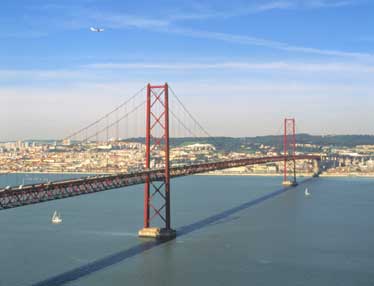 Lisbon's 25 de Abril bridge symbolizes its growing links with the world
 Takeru Sasaguchi, Japan's ambassador to Portugal