

|
|
|
| . |
|
|
In April 1994, the victory of Nelson Mandela's ANC party (African National Congress) in South Africa's first post-apartheid elections heralded a promising new era in the country's history. Mandela, an icon of the struggle against the apartheid regime, and his successor, Thabo Mbeki, have since worked to right the wrongs of the past. One of the most daunting tasks they faced was reintegrating the economy into the global scene while narrowing its crippling social and economic inequalities.
Thanks to its ready provision of coal, South Africa also offers affordable electricity to its populace while maintaining reliable supply even at higher output levels. The country holds the world's largest reserves of gold, manganese, chrome, titanium, aluminum and platinum group metals, making it a major force in international commodity markets. Meanwhile, the diversity and stunning beauty of South Africa's landscape and wildlife is making it a tourist destination of choice. On the other hand, the challenges are equally large. Twenty years of exclusion from the international community has created a warped, inward-looking economic structure, unduly focused on strategic industries such as mining, arms and oil. The apartheid regime also left much of the workforce underskilled and the labor market somewhat inflexible. Furthermore, South Africa has not been spared the global economic turmoil of the past few years. The local currency, the rand, has lost fifty percent of its value against the U.S. dollar in the space of three years. The country suffers from alarmingly high crime statistics, in particular around the main cities. This has often been amplified abroad and has so far significantly limited South Africa's attractiveness for tourism and business alike. Moreover, proximity to its more unstable and problematic neighbor Zimbabwe has unjustly contributed to preventing the delivery of its full potential for growth.
Currency exchange controls have been reduced significantly and no longer represent any obstacle to investment and trade flows. State intervention in the economy, widespread under previous governments, is now limited. The large state conglomerates have been extensively restructured and many have been privatized, although more work remains to be done. Incentives have been introduced for companies to encourage export growth. In particular, Alec Erwin's Motor Industry Development Program has been highly successful in securing foreign investment, boosting local industry and obtaining lucrative export contracts around the world.
The South African central bank has observed a strict monetary policy and managed to keep inflation low. From highs of up to 13.5 percent in the 1980s, inflation has been cut by half. With South Africa's reintegration into the global economy, trade has picked up and continues to grow at a rapid pace. Total imports into the country stood at $18 billion in 2000, from $11 billion in 1994, a 60 percent increase. Exports have seen similar strong growth over the period, from $8.3 billion to $17 billion. Furthermore, while much of this outgoing trade still remains in minerals, metals, and agricultural products, the breakdown is clearly shifting towards more value-added products. In particular, motor vehicles, chemical products, and machinery equipment are doing increasingly well in foreign markets.
Trade has also flourished between the Japan and South Africa. Since 1994, Japanese imports into South Africa have increased by over 25 percent, and reached $1.5 billion in 2000. Japan's share of South Africa's growing imports now stands at close to 8 percent. South African exports to Japan have more than doubled in the same period, attaining $1.7 billion in 2000 for a market share of 8 percent. Japanese companies have been in the forefront of the "beneficiation" process, which aims to increase the share of semi-finished, value-added goods in the export basket, as opposed to the traditional mineral and metal products that they have been trading in for years.
|
 |

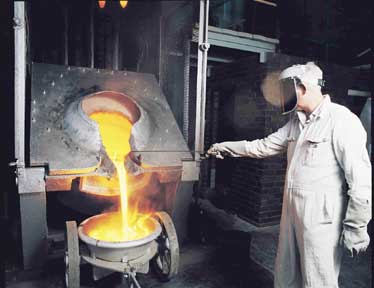 South Africa is funnelling its wealth of natural resources into more value-added products for international markets.
 South African Trade and Industry Minister Alec Erwin
 Yasukuni Enoki, Japan's ambassador to South Africa
