

|
|
|
| . |
|
|
Lower Saxony's capital, Hanover, is home to the world's biggest trade fairs, including CEBIT, the largest technology showcase in the world. Every year at CEBIT, the very latest in world innovation is seen here first, and a city of only 500,000 people stands at the center of the technological world. Five out of the 10 biggest trade fairs in the world are held in the sprawling exhibition halls of Deutsche Messe - the largest single exhibition ground in the world. Little known to most people, the German state of Lower Saxony is a place where the world's prime innovation is not only exhibited, but also created.
There can be no innovation without research, and being a global technical and research center is a key strength of Lower Saxony. The state serves as a technical center for such industries as auto components and machinery. Clustered around VW, the world's leading auto suppliers are taking advantage of Lower Saxony's engineering expertise and setting up their research and development centers for Europe. The same goes for heavy machinery and automation companies. They are transforming into tomorrow's application engineering providers -- refining processes and assembly lines in nuts and bolts, automotive, packaging, and food processing industries. In the constantly evolving and revolutionary field of biotechnology, Lower Saxony's intellect is attracting worldwide attention. The creation of the 'research triangle' made up of the cities of Hanover, Göttingen and Braunschweig means clusters of biotechnology companies and research institutions have been set up within the area. With 12 universities, 36 research facilities in university and non-university foundations, 130 biotech companies -- including 50 startups in the last 4 years -- and over 80 non-academic research institutions, Lower Saxony is aiming to become a one-stop-shop in the biotechnology field. This includes the fields of marine, agricultural, and medical biotechnology: a complete mix that makes Lower Saxony unique. Even the hardware for such research is developed and produced here, from companies such as Carl Zeiss with its light microscopes, Sartorius - Germany's second largest biotechnology supplier, and Lambda Physik - inventor of the excimer laser - all based in Göttingen. "Lower Saxony is well-prepared, better certainly than five or ten years ago, to manage any short-term setback," says Sigmar Gabriel, Minister President of Lower Saxony. "We see opportunities to improve our streamlining and concentrating resources to key technologies and services which will guarantee growth in jobs, profits, and public revenues for years to come." "We're on track with growth industries like biotechnology, information services from software to databases to telephone call centers, the automotive sector and mobility. Compared to other regions in Germany and Europe, Lower Saxony follows a solid strategy that's not dependent on short-term gains or losses on the trading floor," he adds. In Germany's second largest federal state (also its greenest) it is easy for some of the world's leading companies to get lost in the woods that fill Lower Saxony. In fact, it is in the small towns and cities that dot the region where world-leading companies are located. The town of Bad Bentheim, not well-known even to many Lower Saxons, is the home of Deutag, the world leader in oil drilling equipment. In a compound surrounded by forest, the world's largest and most technically advanced oil field equipment is produced before being shipped off to the remotest locations of the planet. Sennheiser, the multi-awarded manufacturer of microphones for the film, music, and media industries, is located in the town of Wedemark. In this quiet, green area, the undisturbed surroundings are the perfect backdrop for creating the world's finest microphones and headsets.
Germany's greenest state in terms of natural resources is also seen as its greenest in terms of ideology. Germany is the world's most widespread user of wind energy, and Lower Saxony is the country's industry leader. This is lead by companies such as Enercon, Germany's largest producer of wind turbines. They have redefined the whole concept of the wind turbine - making it more efficient, and long-lasting. Germany currently employs more people in the wind energy industry that it does in the nuclear power industry. Aside from harnessing wind, Lower Saxony has Germany's richest natural gas reserves, with 22 percent of the country's total. The state currently provides 95 percent of northern Germany's natural gas needs. The world's only sustainable plastics company, Cognis of the Netherlands, also has its plastics and chemical additives manufacturing facility in Loxstedt. Cognis leads the world in copper mining technology, and - most importantly - all of its chemical and plastic products are derived mainly from natural and sustainable technologies found not in petroleum but in agricultural crops. Infrastructure improvements within the state are creating a platform for a more important role for Lower Saxony in Germany. The Hannover 2000 Expo created a direct rail link from the Hannover Airport to the city, and Hannover itself lies within two hours by rail from Germany's financial capital of Frankfurt. It is also a mere hour away from Germany's largest port of Hamburg. The state's global trading role is still developing. A new shipping harbor is being developed in Wilhelmshaven - a natural deepwater port that could potentially have the world's largest cargo and container ships loaded right on the edge of its coastline. Plans to develop the harbor completely should be developed by 2007, and it will become Germany's only deepwater port. Hamburg, without the deepwater advantage and lacking space to grow further, will be complimented by the development of Wilhelmshaven. "All of Lower Saxony offer strong points for logistics because we`re a nerve center for transcontinental trade with northern and eastern Europe, by road as well as by sea," says the Minister of Economics, Technology, and Transport, Dr Susanne Knorre. "Japan, China, and other Asian markets have had bridgeheads here for years, but the Hannover Expo solidified and improved our business ties. Let's just take the Transrapid high-speed train which was developed and tested here in Lower Saxony and is now exported to China. I'd give the Expo a high rating for boosting international trade to and from our state," she adds. On the back of being a logistics center, Lower Saxony is also an information center for the entire country. Being the only state where people generally speak a pure German without a trace of regional accent, Lower Saxony is becoming the region for national call service centers for the entire country. Both German and multinational companies are taking advantage of this linguistic feature of Lower Saxony. With German reunification and the rising growth of Eastern European economies such as Poland, Hungary and Czechslovakia, Lower Saxony's geographical location also makes it an ideal trans-shipment point into these rapidly developing economies. Organizations are taking advantage of the state's technical, developmental, research and engineering capabilities for product development within the state.
Japanese companies have also found a home in Lower Saxony. Minolta Europe located here in the 1970s, and Konica has its European operations based in Lüneburg - along with Matsushita's component technical center based next door. "I'd like to say we do a lot to make our visitors from Japan feel at home - especially for employees, their families and children for whom an International School guarantees a first class education. Our Japanese community has steady growth rates, and it shows. Our new HAKUBA club, for example, is a great forum for German-Japanese business contacts," says Knorre.
|
 |

 Minister President Sigmar Gabriel keeps Lower Saxony on track for growth in future-oriented industries.
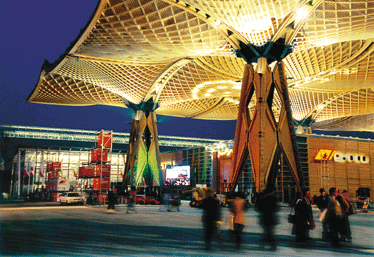 The Deutsche Messe exhibition halls in Hanover, the state capital, showcase the world's best technology - much of it home - grown.
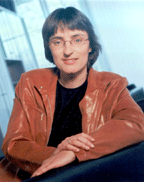 Dr. Susanne Knorre, the state minister of economics, technology and transport, lauds the infrastructure developments brought about by the Hanover 2000 Expo.