

|
|
|
| . |
|
|
It is possible that only a few people have heard of a place called Wolfsburg in Germany, but many more know the heart that pumps life to this city: the Volkswagen Group. Volkswagen stands atop Europe as its largest automotive manufacturer and the fourth largest automobile producer in the world.
As the worldwide automotive industry continues to consolidate, Volkswagen's successfully implemented strategy is leaving the competition in its wake. "We have all the brands we need to position ourselves in the whole range of world markets," he added, "from entry models up to high luxury brands." The Volkswagen strategy consists of building each brand independently and customizing it to each market segment -- from massive global advertising campaigns for the flagship Volkswagen and Audi brands to the one-on-one client relationships that are critical in the premium lines. One part of this mix is the runner-up position the group received in the Asahi advertising awards in Japan for Volkswagen's campaign. On the other end of the market, the premium brand Bentley returned to the worldwide racing circuit and won a third place finish at Le Mans (behind two Audi cars) in the first race it entered after a 70-year absence. The ambitious Autostadt project, Volkswagen's modern engineering museum, uniquely demonstrates the group's commitment to the automotive industry. "This is an all-new marketing and communication platform, used for the first time ever on the planet," said Büchelhofer proudly. "It is a project that shows our brands in various pavilions, and demonstrates the group's level of competence in engineering and marketing. "This is a new expression of Volkswagen's innovation, dynamism, and youthfulness," he continued. In fact it is on these foundations that the Volkswagen Group has built its brands. Innovations within the group are numerous. "If you take Audi for instance, there is the aluminum space frame technology of the four-wheel drive Quattro," Büchelhofer pointed out. The new VW Passat W8, to be released in Japan later this year, is a 4-wheel drive, 8-cylinder compact that will inaugurate a class of car never seen before. In new diesel technologies, Volkswagen has taken a worldwide leadership position, both in market share and innovation. "In the European market in total, our market share in diesel is above 40 percent," he explained. "Diesel cars, for quite some time, have been known as fuel efficient but slow and noisy, perhaps more apt for commercial use. This has changed completely. "Diesel engines are now very powerful and fuel efficient, with low levels of noise. They are now not only available for commercial use, but for private use as well. Our diesel models range from small up to luxury cars. This is an all-new level for diesel engines that has nothing to do with the old image of black smoke, sluggishness and low power." he added. "We invented the first car that consumes of less than three liters of diesel per 100 kilometers," Büchelhofer boasted. "We will push this technology further, and we will also be the first to offer a ten-cylinder diesel engine." All this fits into the big picture of the Volkswagen group. As the executive described it, "Brand building and awareness of good brands makes the difference. Of course you have to deliver. Every promise must be delivered, because you can't live on promises alone. There must be a perfect fit. Volkswagen delivers on these important issues: economy, practicality, and approachability." Using this strategy, Volkswagen has become the leading foreign automaker in Japan -- the world's toughest car import market. Japan has become the third largest market in the world for the new VW Beetle, arguably Volkswagen's most recognized image. "Last year we sold nearly 70,000 cars in Japan, with a share of the import market close to 25 percent -- an all-time record for import volumes in Japan. Our German-engineered Volkswagen products are very attractive for the Japanese market. We offer the kind of driving enjoyment that sets us apart," Büchelhofer said.
|
 |

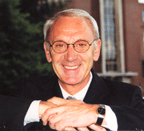 Dr. Robert Büchelhofer stresses the Volkswagen Group's focus on an innovative, dynamic and youthful outlook.
 A cross-section of VW's classic Beetle at the Autostadt engineering museum.