

|
|
|
| . |
|
Despite a population of just around four million, Singapore has one of the higher per capita income levels in Asia. And the general population is almost as gadget-happy as Japan. The latest audio and visual equipment is readily available island-wide, and many managing directors from the local offices of companies like Canon, Pioneer, Clarion and Olympus will tell you that Singapore tends to be a “showroom” for the rest of the region. Once products are accepted in Singapore, it generally doesn’t take long for their popularity to spread to Malaysia, Indonesia, Thailand and beyond. More importantly, a large number of consumer electronics companies have selected Singapore as their regional headquarters – not simply for Southeast Asia, but for territories often stretching from the Philippines to Pakistan and from South Korea to New Zealand.
Each of Canon’s subsidiary companies are run independently and is encouraged to become even stronger and more localized to meet the different demands and trends in each market. As internationalization continues, Canon will retain a strong centralized headquarters in Southeast Asia to maintain a consistent brand image. “There is immense diversification in this huge region economically, politically and culturally. So to run our business from Singapore makes sense because we are in the middle of it all,” says Eiji Fukui, president and CEO of Canon Singapore. “Singapore is also at the forefront of technological and market development, which later spreads throughout the region. Although the population and geography of Singapore is relatively small, the per capita GDP here is very high so there is a very condensed scene of technology and economic movement here.”
“Canon has a unique character, which clearly differentiates our products from the competition,” he says. “We have a full line of document and digital input devices such as cameras, scanners, video cameras, and output devices such as printers and copiers that can all be interconnected. This is becoming increasingly important in our industry. Our products are very user friendly because they provide total imaging solutions and connectivity. This will certainly continue Canon’s success in the future.” The first and second quarters of this year proved to be very difficult and challenging times for the camera and digital imaging equipment business in Singapore. Due to SARS, there was a 70 percent plunge in sales within the industry. However, government strategies and policies, along with national concern and cooperation, managed to get the country back on its feet again within a short period of time.
Iwaoka is set on charging ahead. “Currently we are focusing on the positive aspects of the business, such as our exciting new image,” he comments. In March of 2003, Nikon Corporation introduced a new logo, announcing a united, group-wide effort to strengthen the Nikon brand globally. With a long history of supplying outstanding products, the company has established a fresh face to highlight its reputation for superior quality and reliability. The introduction of the new logo, and the brand statement “At the heart of the image,” adds momentum to the group’s initiative to distinguish itself within the imaging market.
The launch of the new holding company is in conjunction with the new Konica Minolta Group logo. The combination of their respective strengths enhances both their competitive business capabilities and earning capacity as a group. The primary objective of the integration is to ensure a strong and solid position within the industry in order to survive amidst today's increasing global competition. “The industry today is constantly changing. This hybrid will be a good weapon against our competition. The strategic alliance will develop our strengths in order to better serve our customers whose needs are shifting drastically,” says Naoki Kobayashi, director of Konica Asia. “People nowadays are moving quickly towards digital photography. Imaging and printing companies such as ourselves have to be able to adapt and respond to these market trends. The future of our industry is being paved by the shift towards digitalization.” Konica has been present in Singapore for almost two decades and has set up its regional head quarters here. “Singapore is a benchmark for the region. Trends in the industry are set in this country and eventually trickle down to other South East Asian nations. It is the best place to test the market and learn more about our customers. Due to this, our presence here in Asia is strong,” explains Kobayashi. “We are cultivating a printing culture and are a total digital business solutions company. Our domain is to promote a lifestyle of photography alongside the growing buying power of Asian consumers.” Banking on brand recognition A recent survey conducted in Singapore named Mitsubishi Electric as the sixth most recognizable brand name for consumer products. This reputation was built on the foundation of a long history with the country and customer loyalty. “We have been heavily investing in the region for some time now. Our Asian clients are very familiar with our products and identify our name with quality and reliability,” says Naokazu Tomimoto, chief representative and managing director of Mitsubishi Electric Asia (MEAP). “Our leading market share over the last few years reflects the confidence that our customers place on our products. We have held the number one spot for a while now and are going to continue to do so into the future.” Mitsubishi Electric established its presence in Singapore over 26 years ago and in 1998 assumed its current function as Asian corporate office. With 20 factories and subsidiaries in South East Asia, MEAP’s responsibilities include factory automation, white goods and escalators and elevators. “At present, our white goods division is doing remarkably well,” Tomimoto comments. “We are going to focus our strengths on expanding throughout the region as well as boosting our other divisions. Singapore is a trend setting country and now that we have conquered the market, we are looking ahead towards other nations with increasing buying power.” The future indeed seems bright for Mitsubishi Electric. With their introduction of mobile phones, medical technology and printers, the company is charging ahead and set on dominating the region. Tomimoto excitedly predicts: “These are exciting times for us and as we head into the 21st century, we will break frontiers with our technology and continue to improve the quality of life of our customers in both the home and workplace.” Raising the bar Amid heavy competition in the consumer electronics sector, Japanese companies have been focusing on high-tech products to compete with lower priced, basic products from China and Taiwan. One Japanese firm driving innovation with these advanced products is Pioneer. The Japan-based company established regional headquarters in Singapore in 1992 under the name Pioneer Electronics Asiacentre. Since then, this office has set up four marketing subsidiaries in Singapore, Malaysia, Thailand and Taiwan and two exclusive distributors in Indonesia and the Philippines. Pioneer Electronics Asiacentre also oversees manufacturing operations in Malaysia, Thailand and Singapore. The manufacturing division accounts for about 80 percent of its total turnover, while 20 percent comes from the company’s sales and marketing arm for Southeast Asia. Products manufactured from Southeast Asia are also sold in the United States and Europe. Although the head office in Japan controls overall manufacturing operations worldwide and positioning strategies, Pioneer Asiacentre enjoys some autonomy in promoting its brand image and marketing strategies in Southeast Asia. And efforts to create a strong brand image have apparently paid off. Pioneer is positioned between one and three depending on the region. Pioneer currently holds the number two position in Singapore and continues to climb in Thailand and Malaysia. "It is most important for us to produce a good product at the right time and at the right place. Singapore can be compared to a showcase for the rest of Asia and the ASEAN countries. Although there is tight competition, there are also very demanding consumers who drive us to produce better products and marketing strategies," explains Toshiyuki Ito, managing director of Pioneer Electronics Asiacentre. "There are many ways to measure brand awareness but there is also a direct correlation to the amount of money companies are willing to spend on advertising. There needs to be a balance and a stronger focus on higher quality products and the success will follow," Ito adds. Sales of Pioneer DVD players and recorders have been growing stronger each year. In fact, it has a market share of between 20 to 25 percent for its DVD players in Asia. Pioneer has also been pushing hard to achieve similar success with its plasma screen displays. Pioneer has also actively supported local community projects. In Singapore, it donated several plasma displays to the Esplanade theatre and cultural center, the city-state’s premier arts and culture venue that celebrates its first anniversary this month. |
 |

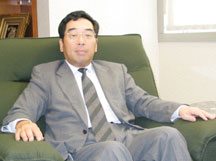 Eiji Fukui, president and CEO of Canon Singapore
 Toru Iwaoka, managing director of Nikon Singapore
 Toshiyuki Ito, managing director of Pioneer Electronics Asia Centre
 Naokazu Tomimoto, chief rerresentative and managing director of Mitsubishi Electric asia
 Naoki Kobayashi, director of Konica Asia