

|
|
|
| . |
|
But like many tourism boards around the world, the Singapore Tourism Board is anything but discouraged by the downturn. After a major restructuring at the start of the year and an ongoing series of post-SARS programs underway, the STB is well on its way to helping the Lion City roar again. “One of the things that made SARS particularly challenging for us was that many people didn’t realize that while we were on the WHO’s (World Health Organization) SARS-affected list, Singapore was never on the travel advisory list unlike Hong Kong Taiwan, Beijing or Toronto,” explains Lim Neo Chian, deputy chairman and CEO of STB. “Our ability to control the spread of the disease was very successful. The problems were basically people’s impressions and people’s fears. This was what we really had to overcome.”
Singapore Roars consists of three parts: a continuation of the confidence-building measures, a series of about 200 incentive packages and programs to attract visitors from key markets and a strong global advertising campaign. Currently, Singapore’s top five markets in order of importance are Indonesia, Japan, China, Malaysia, and Australia. “Japan’s current situation is not so bright,” Lim remarks. “At the peak, we had about 1.2 million Japanese arrivals per year. That was about 7 years ago. Last year we had 730,000. Generally, it’s been on the decline.”
“The logic behind the creation of the eight STUs is one that is akin to the strategies of commercial companies. If you look at commercial companies, many are structured into business units,” said Lim. “So we decided that if we really want the tourism sector to grow, we need to organize it into business units so that we can set targets. Now we have eight engines to drive the tourism in the respective areas.” Of the eight STUs, most are traditional areas that the STB has always been focused on but education and healthcare represent two new areas in which Singapore would like to see more tourist activity. “In the traditional areas, such as shopping and sightseeing, we are going to have to try to do a better job because over the last few years these are areas that have dropped a little bit,” said Lim. “In the new areas of healthcare and education , which have always been there but never promoted, there should be a high growth potential and we need to promote them.” |
 |

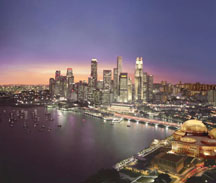 All lit up and ready to go, Singapore dazzles the world
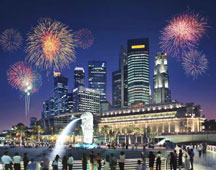 Fireworks light up Singapore's night sky
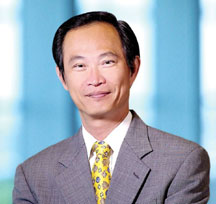 Lim Neo Chian, CEO of the Singapore Tourism Board