|
|
|
 |
The Japan Times WORLD EYE REPORTS SWEDEN A NATION OF GLOBAL EXPERTISE |
 |
|
|
|
|
|
©THE JAPAN TIMES |
August 5, 1999 |
B1 |
|
Swedish companies are maintaining their position in the big league of global competition. Such names as Volvo, Ericsson, SAAB, Electrolux, ABB, Astra, Atlas Copco, Alfa Laval, Scania, Stora and Ikea have expanded from their base in Sweden to become technology leaders in their industries. "In a country like Sweden with a small domestic market, it was very important for our companies to expand internationally at an early stage of the industrial development period," said Bosse Ringholm, the newly appointed Swedish minister of finance. "The challenges in the future consist mainly of maintaining the good position our firms have achieved over the decades and developing new leading firms in expanding sectors of the world economy." Recently, some of Sweden's big players have participated in the waves of mergers and acquisitions that many industries have undergone, which are said to strengthen global competitiveness. Volvo sold its passenger car division to Ford Motor Co.; Astra merged with the British pharmaceutical company Zeneca Plc; and Stora merged with the Finnish paper and pulp manufacturer Enso Oy. These moves have caused some speculation about the future development of "Sweden Inc."
"In order for us to fulfill our ambitions in the fields of employment and welfare, we need to increase the supply of labor in the medium and long-term," asserted Ringholm. "A tax reform should be broad and should aim at stimulating labor force participation, labor supply and education. Priority has to be given to reducing income taxation for the low as middle income groups." Recognized as one of Europe's most attractive business climates, Sweden has attracted more foreign direct investment than any other European country. It offers access to the European market, a strategic position in the Baltic Sea region, state-of-the-art technology, a highly educated workforce and a highly competitive cost structure.
"We have boasted about being one of the few countries to have actually increased its market share in Japan. It is the second-largest economy in the world. A company has to be there if it wishes to compete on a global scale." A closer look at corporate Sweden "Sweden is dominated by large international corporations," asserted Per Olofsson, director general of the Federation of Swedish industries, a lobbying group consisting of members of Swedish industry that promotes and observes conditions for growth in different industries. "The largest corporations directly employ approximately 500,000 people in Sweden, and more than that outside Sweden. This trend is continuing," Olofsson said. "We are the eighth-richest nation in the world, which is entering a serious situation. Sweden will play a strong role in the major merger waves that will take place throughout Europe. This is a threat to our business environment, as more companies are looking to move certain operations outside the country. Right now we are at a turning point, and there is an opportunity to put a stop to this threat." Most of these companies are concerned about the need for tax reform. Salaries are lower for skilled labor, which puts extra stress on labor that is left to look abroad for more attractive wages. "The fundamentals for Sweden are good due to its many highly productive industries and strong engineering sector," said Olofsson. "A vibrant telecommunications sector, with Ericsson serving as the industries. If the fundamentals decided by the Swedish government could be adjusted to make it attractive to continue to operate in Sweden, the nation will really benefit. These large companies are the greatest marketing tools the country has to offer."
Rosengren: For several years, direct incoming investments in Sweden have been as large as Swedish investments abroad. This is an excellent result for Sweden's investments abroad. This is an excellent result for Sweden's business climate. The Swedish business sector is changing rapidly. The globalization of economies tightens competition and means that companies that want to continue to grow in Sweden must look for customers and qualified staff across national frontiers. The use of information technology in the production of goods and services is rapidly growing. Demand for higher education and qualifications is increasing. Major companies will continue to be important as internal engines and suppliers in the Swedish economy, although employment is chiefly increasing in small business. WER: Why is Sweden an attractive location for foreign investment? Rosengren: Sweden has a good climate for investment and enterprise. Following extensive measures to put public finances on a sound footing, interest rates are now at a historically low level, and there is zero inflation. Through active labor-market and education policies, the industrial and business world has access to well-educated and responsible staff. Today, Sweden is carrying out the most substantial extension of higher education in science and technology in Europe. Sweden's social welfare system is sound and modern, and it contributes to security and freedom. Membership in the EU is also essential for the industrial and business sectors' opportunities for trade and economic exchanges. Corporate taxes are low. Sweden is a world leader in terms of the level of investment in research and development. WER: What are the elements of success for Sweden's global enterprises? Rosengren: Sweden is a small country highly development on trade. We are therefore dependent on a strong and competitive export industry. Not least through our membership in the EU, economic exchanges across national borders have increased dramatically. Sweden also has many major companies such as Volvo, Ericsson and Astra. These companies would never have grown so large and successful if they had not understood the importance of seeking qualified staff and customers beyond this country's borders. I am convinced that the environment is one of the really crucial issues of the future. If the country takes the lead in step-by-step endeavors to adjust society as a whole to ecological sustainability, this will afford its business sector considerable competitive advantages. WER: What outlook do you have for Sweden as the nation enters the new millennium? Rosengren: I want Sweden to take the step into the 21st century with self-confidence and optimism. I want to see a country where all citizens - men and women, young and old - take part in production to the best of their ability. I want Sweden to be a leading country in the work of adjusting to ecological sustainability. I want to see this country characterized by development and equality.
Sweden host many success stories in information technology, the fastest-growing industry in the world. Dubbed a new Silicon Valley in Europe, Sweden's information industry is built on creativity, food business and personal enthusiasm. With the highest number of personal computers and internet accounts per household in Europe, this Scandinavian nations is home to many companies that are quickly gaining recognition as world leaders in telecommunications, Internet applications, new media and specialized software. IFS Industrial & Financial Systems is the fastest-growing company in enterprise resource planning software, in terms of terms of total revenue, licensing revenue and business growth. This Swedish company has achieved tremendous growth and shows great promise for its software, which manages the flow of information, products and resources for a firm's entire operations. "With 100 percent growth, I guess we have been doing OK," announced Bengt Nilsson, president and CEO of IFS. "Of course, it makes life a little tricky since we have to keep on doing it again and again. People are beginning to expect that from us, and it is becoming harder to do every year." Founded in 1983 by a group of engineers, IFS did not start developing enterprise resource planning software until 1986. The company's real growth began in 1995, however, when it launched a new product series standardizing applications for component-based solutions that can be applied to many different industries. IFS has seen further success recently by being listed on the Stockholm Stock Exchange since mid 1997.
"Most of our competitors are basing their technology on that of the 1970s," said Nilsson. "This is similar to having an airline that cannot afford to buy new planes. To look fresh and attractive, the airplane will be painted; new seats will be installed, and free champagne is given out to everyone. So everyone decides to fly with this airline. That is how some companies are developing their products in the information technology industry. "While our competitors are fighting to compete with our present-day products, we are already taking the next step to find out what we must do in four years time. So now, as electronic commerce takes off and use of the Internet constantly increases, technological advance is becoming much more important for our future product development." Built on the idea that companies, like people, want to be free, IFS has incorporated this style of thinking in the way it promotes itself and conducts business. Nilsson emphasized his company's focus on openness and trust: "We are very straightforward at every level of our company. By becoming more decentralized and functioning in separate units, our company is capable of cooperating more efficiently. Our slogan, 'Set your business free,' signifies that we must become very flexible if we are to advise other businesses to do the same." In Japan and the rest of Asia, IFS has made advances in many different markets. Although they only account for 2 percent of the company's total turnover, these markets have shown enormous potential and growth despite the recent economic woes that have plagued the area. NEC has become one of the largest distributors and partners of IFS in the Japanese market. Nilsson pointed out that this cooperation has been very lucrative for a number of reasons. From a technological viewpoint, it has led to a design of components that have now become standard features in IFS applications. "Both organizations have gained a lot, which has now given us a competitive edge in Japan. Companies need a strong ally like NEC once a decision has been made to enter the Japanese market." IFS expects the market for enterprise resource planning applications to continue its strong growth due to a variety of factors. Since many companies have made aggressive moves to prevent damage from the Y2K bug in the last few years, more investments can be made to meet the competitive pressures resulting from an increased demand for enterprise resource planning systems. Obviously, the rapid increase in Internet usage and electronic commerce opens new windows of opportunity as well. Currently ranked among the top-10 companies in its sector, IFS has a success story rivaling that of any company in the information technology industry today, and there is no sign of it stopping. IFS expects to experience yet another exceptional year and continue to set business free across the globe.
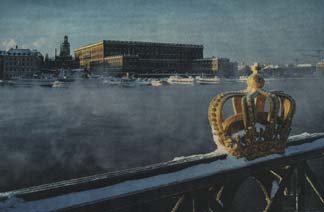
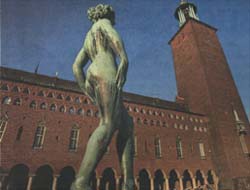
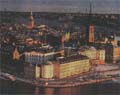
A glimpse of royalty Visit Stockholm and you'll find yourself in one of Europe's most beautiful capitals. This robust city is built on 14 islands, all connected by bridges crossing open bays and narrow channels. Practically every city corner grants one with a myriad of awe-inspiring scenery, appealing to the appetite of any trigger-happy photographer. Nearly 1.6 million inhabitants now live in the greater Stockholm area, yet it remains a tranquil, almost pastoral city. Here, a bustling, modern-day metropolis, trimmed with glass-and-steel skyscrapers, is united with history. Through twisting medieval streets, waterside walkways, cobble-stoned streets, narrow alleys and beautiful palaces, one recognizes why Stockholm was Europe's Cultural Capital of Europe in 1998. The capital is seductive and entices each visitor to explore all it is has to offer. The numerous museums, spectacular restaurants and nightclubs, array of shops and accompanied by breathtaking archipelago, create the right recipe for all travelers.
"The hotel is a part of the city," asserted Wallenberg. "Fortunately, we are very alone. This makes things tougher sometimes since we do not have any other hotel to compare ourselves to. As a Leading Hotel of the World, we compare ourselves to the other members and find new ideas through this method. We are making this old lady grow in the future and still maintain the old style and quality upon which it was established."
But hospitality and ambiance does not begin or end at the Grand. Just outside the city center, the Silja Hotel Ariadne, is set along the archipelago's coast. There is a warm atmosphere roaming through the walls of the hotel. With a more modern look, the Silja towers more than 17 stories high, offering more of a birds-eye-view of Stockholm and its surrounding waters. As a business address, or a leisure venue, the Silja Hotel Ariadne addresses all of a traveler's needs. With 14 conference rooms, each of variable sizes, this hotel is well equipped to accommodate the business traveler. Some of the facilities are on the top floor, granting a spectacular glimpse of the city as you conduct business.
Gothenburg, Sweden's second largest city, is nicknamed "Little London". It is the country's most pleasant city, an opinion shared by most Swedes and visitors who swarm the attractive and clean streets. But do not let the beauty deceive you. It is still the industrial capital of Sweden, home to Scandinavia's largest corporation, Volvo, as well as SKF and Hasselblad. This city has a magnificent archipelago of its own, accompanied by numerous restaurants and caf�s, the Maritime Center, the largest maritime museum in the world, and Liseberg, Scandinavia's largest amusement park.
HOME About Us Careers Contact Us Reports Advertisers About Japan Times © 1999 World
Eye Reports |