

|
|
|
| . |
|
Global food giant looks to Japanese growth
The main secret of Nestlé's success is that it has always been a company which has taken advantage of being a global leader while minimizing the drawbacks of its huge size. "Our purpose is to optimize our industrial infrastructure while maintaining decentralization in all those areas where proximity to consumers and clients is a key element of success," says the company's Executive Vice President Michael Garrett. "By decentralisation, Nestlé keeps close to local consumers. Our local management keeps up this relationship. This cannot be done by the worldwide head office." Besides management decentralization, another important policy for Nestlé is -- despite its size - always keeping a low profile as a foreign company when entering a new market. In this respect, Michael Garrett, Nestle's Executive Vice President and Zone Director for Asia, Oceania, the Middle East and Africa, regards the company as having "an unfair competitive advantage." "Coming from a small and neutral country is definitely helpful," he explains. "People are modest and used to working hard. Furthermore, Switzerland represents only a very small part of our worldwide sales. When entering a new market, we try to adapt to the local situation rather than impose our western thinking on the host market. Many companies whose domestic business represents an important proportion of their total turnover tend to adopt more aggressive penetration strategies. We try very hard to work within the existing local framework. I honestly think this is more or less a unique approach and has helped us to enter difficult markets like the Japanese market."
In Japan, Nestlé is still a mid-sized player overall, with strong positions in its traditional businesses in coffee, non-dairy creamers and confectionery. Japan is currently the fifth-largest market for Nestlé worldwide, clearly leaving room for advancement and expansion in what is the world's second largest economy. Sales in Japan, at 2.39 dollars, are 50 percent derived from sales of soluble coffee and coffee-related products. Nescafé is probably one of the most powerful brands in the local market. With it, Nestle dominates more than 70 percent of the Japanese soluble coffee market today, ahead of its chief competitor Maxwell. As a result, Nestlé Japan has become very much a coffee company, while other Nestlé products from its global portfolio lag behind. The company has used its leading position in the Japanese coffee market to diversify into other products such as Friskies pet food and Kitkat chocolates, where it ranks number two in terms of market share. With all this, Nestlé Japan still represents only 7 percent of Nestlé's total global sales. In order to beef up its local operations and become a major player in areas where it is not yet strong, the company's Japanese subsidiary has started forming alliances with domestic partners. For example, it recently entered into a tie-up with frozen foods maker Yayoi Foods and the trading house Itochu. Yayoi set up a production line for manufacturing Italian food products under the Buitoni brand, using raw materials procured through Itochu. Nestlé also formed a 50-50 joint venture with Japan's Snow Brand earlier this year in the hope that this alliance will lead to a major expansion into Japan's chilled products market. "Our alliance with Snow Brand is a very good example of the long-term relationship that we have established in Japan," Garrett comments. "We have been working in collaboration with Snow Brand on a number of projects for years. Our alliance was thus obvious and it has been a very fruitful partnership." Snow Brand produces and markets a range of Nestlé products including yoghurt, lactic fermented drinks, chilled drinks and desserts. "We launched two coffee products in ready-to-drink form in convenience stores," he adds. "This has been so successful that we have had to reinforce production capacity for the launch in supermarkets. We could not produce enough for the market demand, which was much higher than expected." The company's bottled water line is also in need of adjustment in the Japanese market. Nestlé's leading global water brands lag behind those of competitors, and sales account for only a fraction of the Swiss firm's total business in Japan. In an attempt to reverse this trend, Nestlé introduced its first Japanese brand -- Nestlé Kon Kon Yusui (KKY) -- in selected areas of the Chukyo and Hokuriku regions in 1998. Nationwide marketing of the new product was started in March last year. KKY has become the fastest growing bottled water brand thanks to its novelty and being locally sourced. Nestlé currently owns only one spring water source in Japan - albeit at the foot of legendary Mount Fuji. Nestlé's growth potential in the Japanese market is huge. New strategies like the alliances with the Japanese companies can open the way to achieving the same amount of local market leadership that the company already enjoys worldwide.
|
Ricola www.ricola.ch Hilti www.hilti.co.jp  |

 Michael Garrett has forged new alliances with Japanese companies in Nestlé push for growing market penetration in Japan
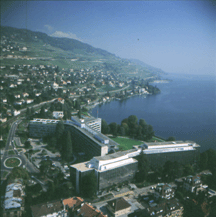 Nestle headquarters in Vevey is the nexus for global operations that achieved record sales of $49.6 billion in 2000 with 500 plants in 81 countries and a staggering total of 224,000 employees.