|
|
|
 |
The Japan Times WORLD EYE REPORTS  |
 |
|
|
|
| ©THE JAPAN TIMES |
Thursday, February 15, 2001 |
B1 |
|
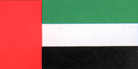
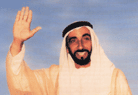
The United Arab Emirates emerged 30 years ago as an impoverished country made up of tiny desert principalities. Since then, it has transformed itself into a powerful political and economic federation. The Middle East has remained one of the most prosperous and vibrant growth areas in the world, with the UAE having established itself as a leading industrial, commercial and trading center in the region. And, thanks to careful long-term planning and a strategic geographic location, the country has achieved astounding progress and prosperity. Founded in 1971, the UAE is composed of the independent Arab states - or emirates - of Abu Dhabi, Dubai, Sharjah, Ajman, Fujairah, Ras al-Khaimah, and Umm al-Qaiwain. The emirates are headed by His Highness Sheikh Zayed bin Sultan Al Nahyan, whose family ruled Abu Dhabi for 250 years before he was chosen as ruler of the newly-formed country. Sheikh Zayed is highly-respected and well-loved because of his role in the country's success. The region's economy was initially built on pearl farming. But the industry collapsed in the 1930s, leaving the states destitute. In the late 50s, oil was discovered off the coast of Abu Dhabi (the richest emirate and the capital), spawning an economic boom. Soon after, oil was also discovered in the emirate of Dubai. Abu Dhabi is the financial powerhouse of the UAE, generating 60 percent of the country's revenues. In comparison, Dubai is an important center for imports, exports, and re-exports. In fact, it also is regarded as the most cosmopolitan of the seven emirates because of its openness to foreign cultures. With its highly-developed oil industry, other countries rely heavily on the UAE for their petroleum requirements. The country produces 10 percent of the world's oil supply. In the past few years, however, the seven-member federation has diversified its economy. New efforts have been carried out to develop the finance, service, and trade sectors. In fact, the UAE has paved the way to become the Middle Eastern hub for technology and e-commerce. In line with a policy to attract more non-oil firms, the UAE has set up special zones where international companies are given tax breaks and are exempt from regulations against total foreign ownership. "The UAE has the most dynamic economy in the Gulf region. We have wise leadership, flexible laws and regulations, and also enjoy political and economic stability," said Sheikh Fahim bin Sultan Al Qasimi, Minister of Economy and Commerce. "The UAE also has a nice environment where foreigners can work and relax in a very safe community. We're in a unique location between the East and West. The UAE used to be an important stop for the spices that were carried from India to Europe. Now, oil and other goods travel through the country, from east to west." Since the country's birth, the Japanese have had strong relations with the UAE, according to Toshio Mochizuki, the ambassador of Japan to the UAE. "In terms of state-to-state relationships, Japan is one of the first countries who recognized the independence of this country," Mochizuki said.
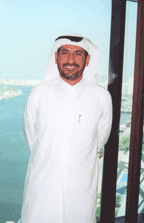
Abdul Rahman G. Al Mutaiwee, director general of the Dubai Chamber of Commerce and Industry "The overall relations between Japan and the Emirates was initiated, not by the government, but by the private sector, especially oil and gas related companies. We would like to focus our bilateral connections not solely on oil and gas relationships, but also on commerce, finance, and political and cultural relationships," he added. Al Qasimi agrees. "Japan is a major trade partner for the UAE by importing much of its oil needs from the UAE. We also import many things from Japan - high-technology, machinery, electronics. But the fact is that Japanese investment is very limited in the UAE," he said. "We try to tell them to take advantage of the benefits of doing business here. The UAE market is a very small market, but the re-export policies that we have are tremendous." In fact, Japan also has a huge interest in the UAE's government policy. "For Japan, the peace and security in the Gulf region, especially in the Persian Gulf, is of utmost importance. This may seem a very remote area, but most of our oil and gas comes from the Middle East. The peace and stability of this region is strictly interrelated with our peace and stability," said Mochizuki. To enhance mutual understanding between the two cultures, the Japanese Embassy and Japanese companies doing business in the UAE will organize an event dubbed "Japan Month." The three-month event will feature concerts, exhibitions, karate and judo demonstrations, and seminars that highlight Japanese culture. "If local people here have a better understanding of the Japanese community, then we will all benefit," said Mochizuki. "Japan is the second-largest supplier of goods to the UAE with a total import of 9 billion dirham ($2.45 billion), which constitutes about 10 percent of imports to the UAE," said Abdul Raman G. Al Mutaiwee, director general of the Dubai Chamber of Commerce and Industry. If unique location is the foundation of the UAE's burgeoning economy, the country's diverse population is its buttress. In mid-2000, there were 2.9 million people in the emirates. Of that figure, only 660,000 were UAE nationals, with the remaining 2.24 million being expatriates. Rapid economic growth entailed an importation of workers, ranging from manual laborers to CEOs. Since its inception, the UAE quickly established itself as a premier distribution center for goods between the East and West. Many people still remember living in small thatched huts. Today, the skyline is crammed with skyscrapers and on-going construction- a reminder of what is still to come for this country.
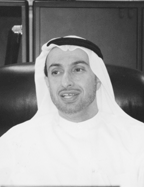
Only a few studies have had a similar impact on a nation's economy as that by Dr. Mohammed Al Zarouni on so-called free zones. Due to that study, Dubai Airport Free Zone has emerged as one of the best places to do business in the region. Located right beside the city's airport, the free zone aims to attract top names in trade, technology, and retail with a focus on high-value, low-weight goods. And, the venture has proven to be a success. "I am proud that today we have the best 100 companies in the world. Still, we are in the beginning," said Al Zarouni. Largely a result of this venture, Dubai airport is now one of the world's fastest- growing air terminals, and a new wing with 28 gates is now under construction. Establishing a business within the DAFZ has become a highly attractive since foreign firms are entitled to 100-percent ownership, a 15-year tax holiday (renewable for another 15 years) and full exemption from import duties and personal income tax. The location of the DAFZ puts companies by the doorstep of lucrative markets in the Middle East, North Africa, the Indian subcontinent, and the burgeoning economies of the Commonwealth of Independent States. Although several free zones dot the UAE, Al Zarouni has drawn up a different plan for the DAFZ. He wants the area to be the "rodeo drive" of free zones. "We received 500 applications and we accepted only 100. This means that our policies and strategies are dedicated only to companies with a sound reputation. We made available all the support and high standard of services that the world's leading companies require for their sustainable growth at DAFZ," said Al Zarouni. "We're trying to focus on those big names that bring technology to DAFZ- technology firms that are related to industry. For example, 25 applications received were related to manufacturing, and we accepted only one." Acceptance is assured as long as companies have a solid background and long-term plans to invest in the DAFZ. Soon after receiving an application, the DAFZ's research and development team begins an evaluation of the prospective investor. Al Zarouni explained, "When a company approaches the DAFZ, we ask them to submit their business plan for the next five years. And through that, we try to sort out a lot of things. We evaluate the amount of skilled, semi-skilled, or unskilled labor they will use; how much they will pay in wages; what their turnover will be." More importantly, the research department evaluates the worldwide demand for the applicant's product. Dr. Mohammed Al Zarouni, director general of Dubai Airport Free Zone Currently, there are 100 companies in the DAFZ, including Dell Computers, Porsche, Chanel, and Ricoh Europe. And there are plans to lure more Japanese firms. "We have three Japanese companies now. And, we're doing our best to bring in more Japanese firms to the DAFZ," Al Zarouni said. Recent figures show that Japanese trade with the member nations of the Gulf Cooperation Council, incorporating Bahrain, Kuwait, Oman, Qatar, Saudi Arabia and the UAE, increased by 4.6 percent last year, showing continuous growth in the export of Japanese goods to the Middle East and highlighting an outstanding investment opportunity for Japanese firms to set up shop at the DAFZ. The free zone covers 1.2 million sq. meters of land, with room for expansion. The first phase consists of a 1 million sq. meters equipped with 10 parking bays capable of accommodating up to 10 Boeing 747-400 aircraft. Restaurants, conference facilities and shops are also found within the area. Meanwhile, the Freezone Logistics Center serves companies with international storage and transportation needs, ensuring fast and efficient handling of goods arriving or departing through the DAFZ. "We are doing our best to offer an excellent standard of service to our clients. But the most important thing is to keep them in the free zone and make them happy," Al Zarouni commented. In Phase Two, the DAFZ will take in manufacturing firms and expand the area by 16,000 sq. meters, offering occupants additional space that comes with growth.
|
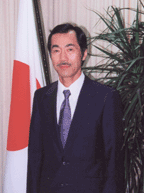 Toshio Mochizuki, ambassador of Japan to the UAE