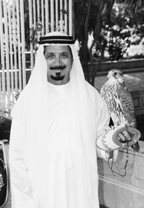
 Abdulla Mohammed Al Masaood, chairman of Al Masaood & Sons Abdulla Mohammed Al Masaood, chairman of Al Masaood & Sons |
|
"When we started the business, we didn't really look into the future," explained Al Masaood, whose company has grown into the largest trading and commercial organization in the UAE and the region.
Today, the Al Masaood Group represents a highly diversified enterprise with the Japanese industrial giants Nissan Motor Company, Nissan Diesel, and Bridgestone figuring among its high-profile clients.
"We have a nearly 29-year-old relationship with Japanese companies. Business with Japan is growing. Japan does a lot of business with the United Arab Emirates, especially with Abu Dhabi in the oil and gas sectors. We have very strong business relations with the Japanese," said Al Massaod.
|
And, realizing the need to preserve the region's freshwater resources, the group recently formed the Masaood Gulf Geophysical Services. The new endeavor has been tasked to ensure the sustained productivity of the land and marine resources using the latest and most sophisticated technology.
Meanwhile, two joint-venture companies have helped Al Masaood & Sons make a mark in the field of engineering. Masaood Mowlem LLC constructs so-called intelligent facilities such as, hospitals, schools, high-rises, and oil and gas processing plants, while Masaood John Brown, founded in 1979, provides gas turbine spares to the increasing number of turbine users in the Gulf region.
In 1985, Al Masaood acquired Bergum Spa, which specializes in all aspects of the construction and the manufacture of prefabricated and portable structures. The group is also engaged in property management, marine products and services, and engineering products.
Despite all the changes, the Al Masaood family has maintained its affinity to the sea. The conglomerate has a stevedoring division that owns and operates many vessels that provide offshore support to the oil industry in the Gulf.
As the UAE reduces its reliance on the oil trade and strives towards self-reliance, the Al Masaood Group has ventured into the tourism and agriculture sectors with the purchase of a luxury hotel and the establishment of a farming equipment firm.
But, the local production of goods remains important. "When we started here, everything was imported. Now, there are a lot of things made locally, which are much better than they were 25 or 30 years ago," said Al Masaood.
"I have a new project - growing roses," he added. "The UAE will be ready for the market. It is a nice thing, and has never been done here before. They are growing in the desert, in greenhouses. This is important because it is done here locally."
Ties between Japan and the UAE can be traced to the time when the pearl trade was beginning to become overshadowed by oil industry. And, as a representative of the UAE-Japan Society, Al Masaood knows the story well.
"This relationship started a long time ago, precisely in 1967 when His Highness Sheikh Zayed bin Sultan Al Nahyan, the president of state, granted three Japanese companies an oil concession," he said.
In 1968, the three firms established the Abu Dhabi Oil Co., Ltd. (Japan). From then on, relations between the two countries have flourished, with Japan emerging the leading trade partner of the UAE.
Al Masaood attributes the success of the country to His Highness Sheikh Zayed, whom the business leader calls "a great man."
In several ways, Al Masaood was also instrumental in the rapid rise and growth of the UAE. And, the success of the both the country and the conglomerate can apparently be attributed to foresight, determination, and pride.
"I think the future is for the people. It is up to them to do what should be done. I hope that people of the UAE will go the right direction in life and business. We are proud of our country. We are proud of our life. We are proud about how we live," said Al Masaood.
Nissan enjoys a smooth ride
Helping to enrich society and providing reliable and safe automobiles has been Nissan's mission. And this innovative corporate philosophy has been an essential building block to the success of the vehicle manufacturer in the Middle East.
|
|
 The nerve center of Nissan Middle East FZE in Dubai The nerve center of Nissan Middle East FZE in Dubai |
Managing Director Kyosuke Miyoshi takes pride that Nissan was the first Japanese car manufacturer to establish a regional headquarters in the Middle East. The territory of Nissan Middle East FZE covers 21 countries in the Middle East, North Africa and some states in the former Soviet Union. And, the last few years has seen steady growth for the Japanese company.
Although sales dipped from 63,000 units in 1999 to 82,000 in 1998, Nissan's market share in the Middle East has grown to 17 percent in the last five years.
Recognizing the importance on customer satisfaction, Nissan set up new headquarters in Dubai in 1994 as part of its commitment to be closer to its clients in the region. And, by introducing more competitive products and improving customer services, the car company hopes to boost its market share to 30 percent by 2010.
Nissan offers a diverse range of vehicles, but the most sought-after has been the four-wheel drives. The Patrol, Pathfinder, and Terrano-II series have proven popular among drivers who frequently negotiate the sand dunes and "wadis," or streams and rivers, in the area.
Nissan is also keen on setting the standard for luxury vehicles. The company plans to launch the new Infiniti Q45 and Infiniti QX4 this year. These vehicles embrace powerful, exciting performance with innovative technology and unmatchable comfort and class.
Recently, the company inaugurated a new state-of-the art office facility, stockyard, and training center in the Jebel Ali Free Zone.
"We have free trade and Dubai is a hub for various commerce- and trade-related activities for surrounding countries," Miyoshi said.
Meanwhile, Nissan Middle East FZE is committed to a mission to serve its regional clients.
"Our main concern is customer satisfaction. We are committed to providing our customers with high-quality vehicles that provide what drivers look for in a car- namely, safety, reliability, style and driving enjoyment and pleasure." said Miyoshi
|
UAE in Brief
|
|
|
|
Capital: |
Abu Dhabi |
|
|
Form of government: |
Federal, with some specific powers reserved to the 7 member emirates- Abu Dhabi, Dubai, Sharjah, Fujairah, Umm an Quwain, Ras Al Khaimah, and Ajman.
|
|
|
Population: |
2.4 million, including about 1.58 million non-nationals |
|
|
Area: |
82,880 sq. km. |
|
|
GDP per capita: |
$ 17,700 |
|
|
Inflation: |
4 percent (1999) |
|
|
Value of imports: |
$27.5 billion (1999) |
|
|
Value of exports: |
$34 billion (1999) |
|
|
Main export markets: |
Japan (30%), South Korea (10%), India (6%), Singapore (4.5%), Oman (3%) |
|
