|
World Eye Reports on Berlin |
||
| ©THE JAPAN TIMES |
|
B2 |
In addition to putting the roofs on the homes for people all over the greater Berlin metropolitan area, Eternit has been a major force in the renovation of the "plattenbautten," the type of buildings remnant in the former East Germany . These residential structures can range from 7 to 11 stories and are built from premanufactured components. Today, Eternit’s progressive products continue to play a role in renovating these buildings, and also contribute to reducing energy costs. The façade products built by Eternit not only serve as a cover for the buildings, but also enable the architects to custom-design facades. In all cases, color is added to the exterior. These products make the buildings more attractive and help create a more comfortable environment for residents and owners. Rüberg proudly explained that customer service is one of Eternit’s main strengths. "I think one of our main advantages, besides price and quality is our relationship we have with our customers," he said. "We are in the commodity business, and you have to develop customer relations and many things beyond price and quality. Zehdenick Electronic GmbH was established in 1991 from the former East German company Mikroeletronik, which was originally founded in 1921 and supplied the electronic industry with stamped products and manufactured tools. Just two years since it was established, Zehdenick Electronic built a client list that read like a "who’s who" in the electronics industry, with prominent clients like Bosch, Siemens and Deutsche Telekom. Today, the company has expanded into five business areas: automotive electronics, communication technologies, electrotechnical industries, semiconductor technologies and consumer electronics.
With a dream of being independent, Zender left his position as M.D. of the leading competitor in Hamburg, took the risk and started building up his company. The focus for Zender was to create a list of renowned clients and build on the technologies of Zehdenick Electronic's predecessor company. This included products ranging from tools for semiconductors, cable harnessing, injection molding and specially designed machines and assembled parts. "We are moving with the largest companies, and this means focusing more in both the automotive and telecom sectors," said Zender. "These are the markets guiding our future and we will not hinder this. We want to become a market developer and this means working with the market leaders and trend-setting companies to push ahead of the competition." Since then, Streib’s core message has been clear and he repeats it on every occasion that presents itself, "Thanks to its new role as a center for many political and business interests, Berlin has quite special, fascinating advantages by international comparison as a business location. The exciting thing about the German capital’s development is that no one can really say today where this huge center for business startups is heading. This is the new metropolis, in terms of architecture, people, society and business, to be created in such a highly industrialized country. What is more, we have more parks than any other European metropolis, a vibrant central area where people actually live, an outstanding range of cultural attractions and a unique choice of leisure-time activities." Streib is not only a seasoned ambassador on behalf of Berlin, but also an admirer of Japan and an expert on Asia. His motto "just different" means that foreign cultures are neither better nor worse than one’s own – just different. The motto is based on years of experience and has had a considerable shaping influence on Streib’s activities in Berlin, where the world’s cultures are now meeting once again in all their diversity. Streib lived and worked in Japan for eight years. He was general manager of Commerzbank’s outlet in Tokyo, and for three years prior to his return to Germany, he was president of the German Chamber of Commerce and Industry in Japan. One year before he moved to Commerzbank in Berlin, his book "The Typhoon: Japan and the Future of German Industry" appeared in Germany. The title was designed to generate something like a head wind and to blow up a storm of its own, as one German professor put it in a review of the book. Streib is also blowing up a storm in Berlin when it comes to the subject of globalization. He says that "globalization has not only created a world market in goods and capital, but also a world market in ideas." In order to make Berlin even more attractive as a business location, Streib argues in favor of a new constitution which will give more powers to those responsible for the city. He believes this way decisions could be made more rapidly and implemented more efficiently. In July 1996, shortly after he took up his position at Commerzbank in Berlin, Streib set up the International Counter at Commerzbank’s headquarters, right in the heart of Berlin, . He was convinced of the potential that lay in the idea of offering newly arrived foreign companies, embassies and newcomers to Berlin an entirely new style bank service which not only speak in the language of the customer, but also expertise on clients' needs in the new environment. He was proved right. His team at the International Counter is made up of qualified, highly motivated Commerzbank staff, who have expert knowledge of both Berlin and banking, and in addition are able to conduct their everyday business in several languages. Streib said, "Today, Commerzbank in Berlin is not only an ambassador for Berlin, but also the friend of many ambassadors. We are the No.1 bank in Berlin as far as looking after the international community is concerned. Our International Counter service is unique." In order to appreciate the ambassadorial role played by Commerzbank’s International Counter team in Berlin, it is worthwhile to take a closer look at their daily work, recognized for its quality around the world. "Virtually everyday, our team is confronted with unusual requests," said Ilka Hartmann, head of the International Counter. The International Counter’s nine-person team has dealt with more than 5,000 queries from foreign clients. Roughly 1,200 foreign firms and private customers are looked after by this unit. Such exceptional commitment has had a substantial impact on the reputation of the bank within Berlin’s international community. Recommendations are passed on by word of mouth. In addition, members of the team regularly visit embassies and consulates, look after multinational companies and organize in-house presentations and discussion forums for clients. Once a year, in February, the International Counter invites its multicultural clientele to an informal get-together. As a result, those taking part can also make social contacts in Berlin through the bank. As an ambassador for Berlin, Streib is definitely a model for Hartmann. "A friendly, smooth acclimatization is important for Berlin to really become an open metropolis," she said. Although for some people, Germany tends to lack quality services, she aims to create a climate which is attractive to company executives and investors alike. Knowing new Berlin Visitors from all over the world are flocking to Berlin, one of the fastest changing metropolis on the planet. The "new Berlin" is a European hot spot for sports, nightlife, shopping, and culture. Berlin is home to many five star, luxury hotels, including the historic Hotel Adlon, in the shadow of the Brandenburg Gate. Another lovely hotel is the Inter Continental Hotel. Both are located at different corners of the beautiful Tiergarden, an oasis in the middle of the bustling city. "The hotels are trying hard to build up a higher standard – an international standard for the city. If you compare this city to one like London, you have real value for money here," explained Willy Weiland, regional vice president of operations for Inter Continental Hotels in Berlin. According to Weiland, the number of rooms in the city has increased and so has the demand in the city. "Since the government has moved here, the city has a much higher exposure level. Many of the professional associations which were previously located in Bonn are now located here in Berlin. This creates a new meeting market," he explained. The Inter Continental caters to both leisure travelers and business travelers. Visitors are greeted by a courteous staff member upon arrival, eager to help you settle in. The 510-room hotel caters to the highest standards and helps to create a feeling of home for each guest. Guests can start the day with a refreshing swim in the pool and breakfast at the LA Cafe, an inviting restaurant serving delicious California cuisine. After a long day of sightseeing, guests can treat themselves to a massage and relax in one of the three saunas, then indulge in the tastes from Zum Hugenotten, the Inter Continental’s fine-dining restaurant. The Inter Continental also offers finess facilities, a cosmetic studio, a hairdresser, a bar, and 31 meeting rooms. "Being the Inter-Continental Hotel, we have always had a more international mix of guests than other hotels in the city. We have about 60 percent in domestic business whereas other hotels have about 75 to 80 percent German business. In the conference segment, our market is about 70 percent international business," said Weiland. The international flair that has swept through Berlin has influenced the fantastic shopping in the city. Shoppers can find fine jewelry, perfumes and chocolate on Friedrichstrasse, a street developed in the last few years from the rubble of the Wall. The Kurfurstendamm, or Kudamm , a 3.5 km stretch of boulevard, has always been known as ‚the shopping street in Berlin. While strolling down the street, visitors can also browse through the elegant shops and boutiques. And during the summer months, cafes stay open for 24 hours while people socialize and sip drinks into the night. For those who travel often, finding accommodation that makes you feel at home is as nice as a good book at the end of a busy day. Blattl’s Comfort Aparthotel in Berlin offers 174 apartments, studios and suites up to 50 sq. meters in size and provides the traveller with separate areas for work, relaxation and sleeping. Conveniently located near Tegel Airport, this "apartment hotel" is an ideal place for those who want the comforts of home with the conveniences of a hotel. The facilities include fully equipped kitchenettes with microwave ovens, spacious work areas with direct-dial telephone, fax and modem connections, pay TV and other amenities. Blattl’s Comfort Aparthotel is located in the residential area of Reinickendorf and is very reasonably priced. Berlin is becoming the first destination for many European travels – it is not an afterthought on travelers itineraries. With its rich history, the fascinating culture, and the abundant nightlife, Berlin is a must see for everyone.
HOME About Us Careers Contact Us Reports Advertisers About Japan Times © 2000 World Eye Reports |
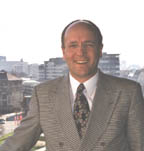 Werner Ruberg, chairman of Eternit
 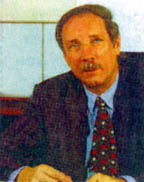 Stefan A. Zender, president of Zehdenick Electronic GmbH
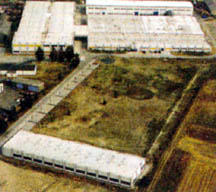 The Zehdenick Electronic factory: where precision and quality meet.
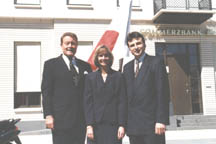 Ika Hartmann, head of Commerzbank's international counter, Gerhard Wiesheu, managing director of Commerzbank international capital markets and Folker Streib, general manager, Commerzbank AG, Berlin in front of "House of Commerzbank" next to Brandenburg Gate