  |
|
|
 |
The Japan Times WORLD EYE REPORTS  |
 |
|
|
|
| ©THE JAPAN TIMES |
Friday, August 25, 2000 |
B1 |
|
In the meantime, the city continues to move forward with its plans to build itself into the hub of media, science, culture, service and business, competing with other German cities known for their expertise these areas. The absence of the Wall has given all Germans and Europeans many new opportunities that were unattainable before. Past struggles, as difficult as they were, gave the city a unique character and fascinating history. The "new Berlin," as it is sometimes called, has evolved into a cultural, political, and economic center. In 1996 the seat of the German government moved from Bonn to Berlin, its original capital before World War II. With this shift, more political leaders, party headquarters, foundations, lobbyists, embassies, and media have moved to Berlin, changing more than just the physical landscape. It is expected that Berlin and Brandenburg, the area surrounding Berlin, will be united in the next few years. Brandenburg is rich in industry and will help to increase the region's economy. When the Wall fell, businesspeople from all over the world came to Berlin to capitalize on this emerging and exciting region. Global recognition brought new companies to Berlin, resulting in a boom of new construction and industry. The infrastructure of the new Berlin was not prepared for the large number of people and companies moving here. After a few years of heavy growth, interest in Berlin waned and companies stopped moving here. But in the last few years, the numbers have been increasing again. The focus of business has changed in Berlin. "Berlin is becoming more and more of a city of services," stated Dr. Hans Estermann, managing director of the Berlin Economic Development Corporation, the organization that promotes Berlin as a city for investors. Since the reunification, 290,000 new firms have been launched. Approximately 40 percent of these firms operate in the service sector, making this sector the most important employer in the city. Estermann continued, "I’m quite sure that the interest from Japan is coming back. I think we’ll see a lot more news and investment this year than last year. As the economy recovers, we have a lot more projects going on with Japanese companies who are interested in coming to Europe through Berlin." In the last few years, companies who moved to Berlin have finished the construction of their headquarters. "A lot of completions can be seen, like debis and Sony, who recently moved to Potsdamer Platz. The embassy of the Northern Countries (Norway, Sweden, Finland, Denmark) is also completed, so a lot has changed from the point of view of the state - of diplomacy, and of the economy," said Estermann. Since 1990, Deutsche Bahn AG and Elf Oil Germany moved their German headquarters to Berlin, and four of the largest companies in Berlin -debis, Adtranz, VEAG, Hoechst-Schering AgroEvo -were established. In addition, close to one-third of the world’s 50 largest companies and 75 of Germany’s 100 largest companies are now active in Berlin. Berlin is also reaching out to its neighbors to the east by serving as a bridge to Central and Western European countries, making it the political center of Europe. As the unsaturated markets to the East have become stronger, they have grown to be important trading partners for Berlin. Trade with the East European countries has increased by 170 percent since 1990. And Berlin is serving as their role model as they prepare for entry into the European Union. As the center of the Cold War years ago, Berlin is now the symbol of unity and is in a good position to advise other countries how to shift their economic and government structures without losing their cultural identities.
The managing director of the Berlin Economic Development Corp., Dr. Volker Hassemer, agrees. He outlined five strengths that Berlin has to offer potential investors and individuals planning to come to Berlin: "The first is our international strength. We are an East-West city. In the past it was our problem, and now it’s our chance for opportunity. We are a city of two different European cultures, and it’s amazing. "The second strength is being the German capital, and not only the German capital but the most important decision making center in Germany. The third strength is that we are creating a young industrial city. Young people are coming to Berlin because it’s a new situation, a new reality. It’s not an established situation createdby their fathers, because their fathers are in Dusseldorf, Munich or Hamburg."
Because of so many reasons, Berlin is the only German city that can compete with the cultural diversity and knowledgeable workforce of other major international cities. With development in all areas of business, Berlin is working hard to make itself attractive to foreign investment. "We have centers for all sorts of industries, stated Estermann. "Siemens started here 100 years ago with just two or three people, and today it’s a world corporation. Berlin is the center for new and emerging industries. We are looking for these new industries and the new services and want them to attract them to Berlin and let them grow here." Although the past 10 years have been difficult for Berlin, the future looks promising. The city survived a difficult time when companies decided to leave in the mid-1990’s, but since then, it has turned the economic focus to that of a service-oriented climate. The infrastructure for investment is now built and Berliners are ready for continued change.
Diepgen: We must not allow ourselves to restrict our vision for the future by looking back at the past. One hundred years ago, Berlin was at the top of the world list, along with New York and London. We call what has been built here over the last 10 years the "new Berlin". We are putting our faith in new technologies and future-oriented services. We will, in future, make the most of Berlin’s advantages: its central position on the old dividing line, what is today the connecting line between East and West, its good transport connections and its enormous cultural and scientific potential. WER: As German government organizations and industry set their sites on Berlin, what hopes do you have for a strong influx of foreign investment into the city and what specific efforts is your administration making to continue attracting it? Diepgen: Berlin has good conditions for investors from all over the world in the fields of biotechnology, medical technology and transport technology. Berlin is a particularly interesting city for investors because of its university and research facilities, its position between East and West and its excellent infrastructure. Additionally, the move of the Bundestag and the federal government was one of the most important preconditions for Berlin’s rebirth. This gratifying move will facilitate our efforts to preserve and expand the industrial basis as well as strengthen Berlin’s profile as the centre of the services industry. Nothing is so good that it cannot be improved. Many established enterprises have made huge investments in the city. However, the many small startup companies now operating in the fields of new technologies and media are just as important. We want to further expand our role as the capital city of startup companies and as the "capital of talent". WER: How important is federal funding in financing the renovation and when do you see Berlin as being able to stand on its own? Diepgen: The eastern part of the city was supported by the government of the former German Democratic Republic and the western part by the government in Bonn. When the Wall fell, this support was phased out far too quickly. This led to a relatively difficult financial situation in the 1990s. This difficult situation will slowly be alleviated through the move of the Bundestag and the federal government and the increased revenue from taxation to be expected from this move. By the end of this decade, we want to have a balanced budget and, if possible, to stand on our own feet financially. COMMERZ INTERNATIONAL |
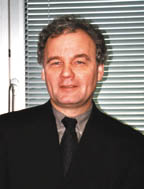 Dr. Hans Esterman, managing
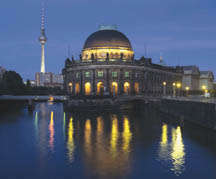 Berlin's radio tower overlooks the tranquil
 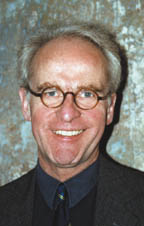 Dr. Volker Hassemer, managing director of Partner for Berlin
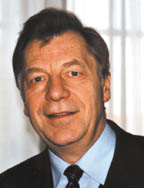 Berlin's mayor Eberhard Diepgen