World Eye Reports on HONG KONG |
||
| ©THE JAPAN TIMES |
|
B3 |
|
While the MDX-F3 continues to sell out across Japan. Kenwood's factory in southern China is working overtime to meet the demand. According to Kobayashi, who oversees the factory's operations, 200,000 units were exported to Japan between October 1999 and March this year. "We expect another 100,000 units to hit the Japanese market by the end of the year," said Kobayashi. Asked what made Kenwood such a popular brand, Kobayashi replied, "Kenwood particularly appeals to the younger generation because of our funky designs, bright colors and reasonable prices." Currently the MDX-F3 is only available in Japan but will eventually be launched in the United States and Europe. In addition to manufacturing the MDX-F3 personal stereo, Kenwood Electronics Hong Kong oversees the production of 10 other mini audio systems for worldwide export. Located in Guang-
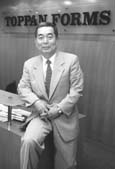
Kenwood Electronics Hong Kong is a subsidiary of Japanese consumer electronics group, Kenwood Corporation. The Hong Kong office was established in 1993 to support the factory operations in southern China in the areas of financing, logistics and materials purchasing. In today's competitive world, business is a game in which only the fit will survive. Increased competition, converging markets and advanced technology are just some of the pressures knocking at the corporate door. And for companies without a firm strategy, letting them in is inviting disaster. The solution for many companies today is to simply get back to basics and focus on their core area of expertise. According to Kiroku Kato, managing director at Toppan Forms (HK) Group, companies achieve this by trimming their auxiliary operations and outsourcing them to the specialists. "In a financial institution, such as a bank, the processing of customer statements is not their business, but traditionally they have had to perform this function. However, if secure, trustworthy companies can specialize in this field, then there is no reason not to outsource this aspect of the business," explained Kato. The Toppan Forms Group is one of a few outsourcing specialists in Hong Kong who can provide companies with complete business communications solutions. From its early beginnings in 1972 as a leading business-forms supplier, the Toppan Forms Group has expanded into card production and integrated business solutions. The group's prime shareholders are Toppan Forms Japan Ltd. and Hong Kong-based Kadoorie McAulay Ltd.
In a city like Hong Kong, in-house data processing can be an unnecessary expense. The equipment required is bulky and the space it utilizes is a costly luxury. "Processing statements is an exercise that most banks, or credit companies, will undertake for just two days a month. Therefore, the equipment's output peaks for a limited time, and then it stays dormant until the next month. So it is better to outsource the task to us," Kato explained. Banks however, have not been as quick to join the outsourcing bandwagon, mainly for security reasons. The concern of sensitive financial information could leave the confines of the bank is valid, however, Kato explained that stringent security systems have been installed on Toppan Forms' premises. "Even government officials must produce identification," he said. With a new state-of-the-art production facility in Yuen Long due for completion at the end of this year, Toppan Forms Group will be even more committed to serving the needs of the Hong Kong business community. Kato commented, "As a leader in the Hong Kong market, Toppan Forms must remain a step ahead with the latest business-solution technologies." Hong Kong's small-to-medium enterprises (SMEs) are the vertebrae that make up the Special Administrative Region's economic backbone. With an estimated 290,000 SMEs engaged in a variety of sectors, this dynamic community employs 60 percent of Hong Kong's workforce. Echo Electronics Limited is just one company whose unassuming presence belies the collective importance of the SME community in Hong Kong. Located in the industrious suburb of Tsuen Wan, Echo's office conveys a story of old-fashioned hard work. And so too does the company's managing director, Raymond Cheng. "See my hands, they're tough," proclaimed Cheng holding out his notably weathered hands. Echo manufactures buzzers, telephone ringers and sirens for several international markets. It is also an original equipment manufacturer (OEM) that produces components such as printed circuit boards. As with many local manufacturing companies, Echo maintains its headquarters in Hong Kong but has located its factory in Shenzen, southern China. Established in 1990, Echo started out with just 15 factory workers and today employs 400 people. According to Cheng, the company's successful expansion can be attributed to identifying market opportunities and acting on them. "Initially, we only produced a limited of product models, but these were not meeting customer demand. So in order to survive, we had to expand our production base," Cheng explained. Deciding on additional products to produce proved a challenging exercise because, as Cheng pointed out, "There were so many on the market." Finally settling on the telephone ringer (everyone needs a telephone) and security sirens, Echo has not looked back. This year the company's projected turnover is $5 million. But as a labor-intensive company, profits made will be reinvested into Echo's factory. "Manufacturing companies tend not to have a lot of money in the bank, as it is injected into their factories. At Echo we are continually improving or testing new equipment. This investment is nonstop," said Cheng.
According to Ito, there were two reasons Epson Hong Kong weathered the economic storm. The first was the increasing preference for color printing and the second, the explosive growth of mobile phones. "Recent years have witnessed a growing trend for people to use color printers," Ito explained. "In 1996, Epson promoted the color culture worldwide, and it really took off. People now enjoy Epson colors printers not only in the office but also at home to print photos and information from the Internet." While demand for Epson's flagship product remained strong, its other business, electronic components was also growing. Epson is a key supplier of LCDs, integrated circuits (IC) and crystal components for the world's leading mobile phone brands. "We estimate that Epson supplies around 60 percent of the global market. Our LCD modules can be found inside the most popular mobile phones," Ito commented. Epson's components have become the preferred choice for use in mobile phones due to their reduced energy consumption. Ito pointed out that their latest components originated from the wristwatch and were adapted to suit the mobile phone. "Energy efficiency combined with high performance are important factors for the discerning mobile-phone consumer. Epson's products make that happen," said Ito. Epson Hong Kong's energy-saving products is just one example of the environmental awareness that is pervasive throughout the company. In 1990, the Epson Foundation was established to support and promote community programs ranging from education and welfare to environmental protection. "Steady profits over the years have enabled Epson to become a financially active member of the local community. We always encourage associations to approach Epson for support," said Ito. Epson is currently the sole corporate sponsor of the Adopt-A-Dolphin-Program 2000, an initiative set up to assist in the conservation of Chinese white dolphins and their habitats.
Epson Hong Kong anticipates significant opportunities upon China's accession to the World Trade Organization (WTO). While its support services such as sales, marketing and product design are located in Hong Kong. Epson HongKong oversees printer and component manufacturing facilities in southern China. Its factory in Shenzen employs 10,000 people and is the largest factory for the Epson Group worldwide. "Design in Hong Kong, manufacture in China: this combination has the potential to be the strongest in the world," declared Ito. Many companies share this sentiment, having realized the benefits of straddling the border of Hong Kong and China. Cheaper labor costs and ample manpower make China an ideal manufacturing base, while Hong Kong offers sophisticated infrastructure and professional services. "Hong Kong is no longer an industrial-based economy. Its people are innovative and therefore development and design must be a key focus for the future. We have located a design center in Hong Kong so we can effectively serve our customers," explained Ito. However, with China inching towards a more liberal business climate, foreign companies are preparing to tap into the world's largest consumer market. Once the WTO agreement is signed, foreign companies will be given full trading and distribution rights. "We are eagerly awaiting China's entry to the WTO," explained Ito. "Epson has already established factories and a China regional headquarters called Epson (China) Company Ltd. in preparation for the inevitable change in regulations. Eventually all our products made in China will be sold in China as well. This will certainly help Epson's sales."
|
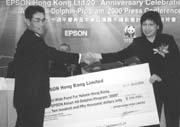 Giving back to the community: Epson Hong Kong's managing director Kazuki Ito presents a check to the World Wide Fund for Nature Hong Kong