Consisting of an ultra-modern intelligent building complex, the Cyberport will include offices, a shopping mall, entertainment facilities, hotels and residential apartments. This virtual community will be located on Hong Kong island's west coast, about a 15 minute drive from the central business district.
PCCW is responsible for the funding and development of the HK$13 billion project that commenced construction earlier this year. Phase one, comprising 9,684 square meters of residential space and 22,273 square meters of office development is due for completion in early 2002. Four subsequent phases are to be completed by 2007.
According to Alex Arena, managing director for PCCW, the Cyberport was conceptualized out of necessity. "In 1997, Pacific Century wanted to establish an Asian headquarters in Hong Kong to develop its new broadband internet technology, however there was no IT culture to support us," explained Arena.
"We had to initiate a strategy in order to recruit the thousands of staff that Pacific Century would need to facilitate its Asian growth. And so the Cyberport was born,"
Convincing the Hong Kong government that the Cyberport was an essential ingredient to maintaining the SAR's global competitiveness was easier than expected. The project PCCW proposed was well aligned with the government's policy vision to make Hong Kong a leader and not a follower in the information age.
 Hong Kong's Cyberport is set to position the city as a regional IT hub. Hong Kong's Cyberport is set to position the city as a regional IT hub. |
"In approaching the government for their support, we explained that the development of Hong Kong's IT infrastructure was a non-negotiable situation. In order to preserve the economy and give it a growth path, Hong Kong needed to nurture its knowledge-based industries," said Arena.
The Cyberport project was announced in March 1998 and has since triggered the interest of the global business community. PCCW has been flooded with overseas inquiries regarding employment opportunities at the Cyberport. Arena noted that many Hong Kong-born
|
Chinese currently working in the United States are keen to return home to work in IT, however, were apprehensive due to the lower quality of life.
"Why would you give up a Californian lifestyle to come back to Asia to live in a shoe box? We created the Cyberport around this perspective. In order to bring the skilled IT pressionals home, we had to create exciting jobs in expanding sectors coupled with quality lifestyles. The Cyberport offers this," explained Arena
Keith Kerr, managing director for Swire Properties Ltd., one of Hong Kong's leading property developers, believes that the mere concept of a technology park has made a difference to Hong Kong's psyche. He explained, "In essence, the project was an initiative to stimulate awareness about information technology in Hong Kong. In itself, the Cyberport is not big enough to change the city. But what it has done is to alter public perception and raise awareness. If the Cyberport was positioned as just a project with research facilities that would create a few jobs, it would not have had the same effect. In a way, the benefits of the Cyberport project have already been felt because it has forced businesses to consider how they should adapt to the new economy."
|
With firm commitment from the global IT behemoths to jump on the Cyberport bandwagon upon completion, Hong Kong's potential to become an information hub has significantly increased. To date, 15 leading multinational IT corporations have signed letters of intent to become anchor tenants. These include Cisco, IBM, Microsoft, Hikari Tsushin, Softbank, Hewlett-Packard, Oracle and Yahoo!
Annie Tam, Deputy Secretary for the SAR's Information Technology and Broadcasting Bureau, believes that the right mix of tenants is crucial to the success of the Cyberport. "We call the Cyberport the information infrastructure project because we are providing this in the form of a first- class working and living environment for IT companies," she explained. "We want to focus on those companies who are developing leading-edge applications of IT from fashion to finance. We are not just providing office space. The Cyberport's purpose is to form a cluster of strategic companies to stimulate creativity through interaction."
|
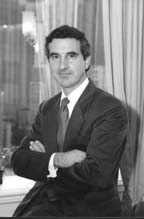 Alex Arena, group managing director of Pacific Century Cyberworks. Alex Arena, group managing director of Pacific Century Cyberworks.
|
Besides, the 15 anchor tenants, 112 companies have registered interest in becoming Cyberport tenants. Smaller companies are expected to benefit from working in close proximity to the multinational corporations and from the wide range of shared facilities and services on a "need-to-use" basis.
"We want to emphasize an interactive community," said Tam.
"Instead of having office blocks we have a linear form with several of interactive areas. We want to create a campus-like environment, with lots of parks and cycling tracks."
With the Cyberport project firmly underway, Hong Kong is set to lead the pack in the Asian realm of information technology. Arena explained, "The Cyberport was the fulcrum point when Hong Kong swung over from its finance and property focus to being interested in the online IT world. Hong Kong has definitely repositioned itself as a leader in the new economy space."
Pacific Century CyberWorks Limited has been the Hong Kong listed technology flagship of Pacific Century Group since August 1999. In less than a year, PCCW has grown to become Asia's biggest Internet-focused group outside Japan, and aims to be the world's largest Internet provider. Through investments in more than 40 content, technology and e-commerce providers, PCCW aims to create a one-stop shop for companies toextend their businesses on to the Web and to foster rapid growth across the larger Internet economy in Asia.
| Zero defects
Willas-Array shows that it has what it takes for continued success in the electronics industry. |
 |
Dr. Kei Blu Chan, managing director,
Willas-Array (Holdings) Ltd....
|
Dr. Kei Biu Chan knows what it takes to be a world-class competitor. As managing director for Willas-Array (Holdings) Ltd., a leading Hong Kong electronics manufacturer and distributor, Chan has a finely tuned strategy. Summarizing the three key elements for success, he explained, "A company must have a product of real significance, offer quality logistics and attract world-class clients."
Chan's vision for Willas-Array is to rank in the top 10 in the global electronics components industry, and is not far beyond reach. The company's expertise lies in the manufacturer of printed circuit boards using surface-mount technology (SMT). A method developed in Japan in the 1980s, SMT has enabled the continuing miniaturization of consumer electronics. "Market demands have coerced electronics products to become multifunctioned, lighter and more compact. SMT has made this possible," Chan said.
Previously, the printed circuit board was laden with bulky wires and components, restricting the ultimate size of the electronics product. SMT streamlined the circuit printer board replacing wires with components soldered to both sides of the board.
"In 1986, we were the first components manufacturer to introduce SMT to Hong Kong and China. At that time, a global trend was emerging for companies to outsource their components manufacturing. People wanted to specialize and not get their hands dirty," said Chan.
Citing size as a liability and vertical integration a hindrance, Chan believes that in today's technology driven market place, outsourcing is essential as it reduces risks, absorbs market fluctuations and allows greater flexibility. "The market is constantly changing due to the e-commerce wave. Therefore, large companies have to focus on their core competencies and leave the nuts and bolts to us," Chan explained.
With 3,700 employees at work in Willas-Array's Dongguan factory, the company is in good shape to tackle global competition. High volume, cost efficiency and zero defects are three basic requirements of the industry, three requirements that Willas-Array prides itself on.
"PC peripherals are a very cut-throat business, as there are really only 10 dominant players," explained Chan. "To survive, you have to make 1 million pieces of anything per month otherwise you're not in the game. You don't have the economies of scale nor the bargaining power with suppliers. You have to enforce a zero-defect policy because you are dealing with computer giants such as IBM and Hewlett Packard."
A strategic partnership
Willas-Array's impressive list of clientele is a testimonial to the company. Name a multinational electronics company and it is sure to have been a customer of this unassuming components manufacturer.
Chan has a particular soft spot for Japanese behemoth, Sony, as he believes that the success of Willas-Array has been contingent on their close relationship with the company. "Japan has always been an important player in the electronics industry and we have had a strong affiliation with Japanese companies since the beginning. Our company has grown because of our relationship with Sony. It is now a case if we want to work with a company, not the other way around!" said Chan.
Willas-Array currently produces 60 percent of Sony's floppy-disk drives, and manufactures approximately 8 percent of the total global market. "When prospective clients are shown around our factories where Sony products are manufactured, we received automatic approval. If we can make for Sony, Samsung and Toshiba, we can make for anyone!" Chan proclaimed.
|
)
 Shopping at the Cybermall