 |
WORLD EYE REPORTS  |
 |
| ©THE JAPAN TIMES |
|
B1 |
|
|||||||||||
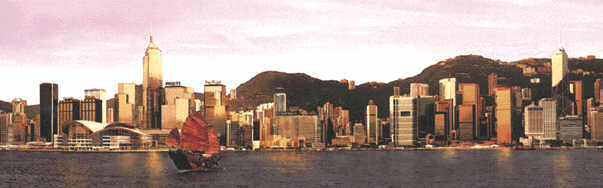
According to analysts, Hong Kong is uniquely poised to take full advantage of the information-technology and Internet age. With its market-based economy and free flow of information, Hong Kong is set to further strengthen its position as Asia's premier business hub. While the private sector is taking the lead and investing billions of dollars in cultivating Hong Kong's IT development, the government is actively facilitating the process by enhancing the SAR's legal infrastructure. In Tung's 1999 policy address, he outlined his vision for a Hong Kong culture that fostered innovation and technology. A prime example is the HK$13 billion Cyberport project, a multimedia and information center where creative genius will flourish. The Cyberport is a joint initiative between Pacific Century Cyberworks and the government, and is due for completion in 2002. Meanwhile, Hong Kong's service sector continues to prosper and has been further enhanced by the advent of new technologies. Hong Kong boasts one of the most sophisticated service economies in the world with 84 percent of the GDP derived from this sector. As the geographical heart of Asia, Hong Kong's aptitude for providing services in finance, telecommunications, legal matters, tourism, transportation, logistics as well as a host of other services has made the city a regional focal point and melting pot for international business.
With China's imminent accession to the World Trade Organization (WTO), Hong Kong's traditional role as a conduit for trade between China and the world has come under scrutiny. Many skeptics believe that Hong Kong's position as a middleman will be threatened once China fully opens its market and becomes more accessible to the world. Despite this fear, Hong Kong is expected to significantly benefit from China's WTO membership by assisting the populous nation with a wide variety of service industries lacking in the mainland. Capitalizing on Hong Kong's experience and knowledge in each service industry will create tremendous expansion opportunities. Dr. Victor K. Fung, chairman of the Trade Development Council, believes that with China's WTO accession, Hong Kong has a chance to replicate its earlier success achieved following the mainland's first economic opening back in 1978, but on a much larger scale and in a more sophisticated way. "Competition will intensify on all fronts and across all sectors. China's WTO accession and the further opening of its markets will trigger a global race for market share involving much bigger players than is presently the case. Hong Kong's 'first mover' advantage will be challenged," Fung explained. "I believe China's WTO accession will be a powerful catalyst for Hong Kong's economic rebound. It will set in motion Hong Kong's next economic transformation, creating new ways to add value, new jobs and new sources of wealth. This is a moment we have all been waiting for. Now it is up to us to seize the opportunity."
Polluting prosperity While Hong Kong looks north to the hinterland, the city continues to choke on its own fumes. Increasingly aware of this problem, Tung and his newly appointed task force has vowed to improve air quality to the standard of London and New York within five years. Sweeping measures to combat the city's air pollution include encouraging some 150,000 diesel vehicles to switch to cleaner fuel reduce roadside pollution. "I am acutely aware of the concerns of residents and the international business community about Hong Kong's air quality. With this in mind, a considerable section of my 1999 Policy Address was devoted to measures to improve and enhance the living environment in Hong Kong," Tung said. If Tung succeeds in reducing air pollution by 2005, it will be just in time for the grand opening of Hong Kong Disneyland, probably the most theatrical business deal struck in 1999. The government will contribute HK$22.45 billion to develop the home of the world's favorite mouse. Commissioner for Tourism Mike Rowse believes that Hong Kong Disneyland will strengthen the SAR's position as Asia's preferred holiday destination and will revitalize the tourism industry. "We want Hong Kong Disneyland to be for the whole of China and Southeast Asia. When families are making their holiday plans, Hong Kong should be top priority," Rowse said.
Japan is the fourth-largest source of foreign investment in Hong Kong after Britain, mainland China and the United States. Approximately 2,300 Japanese firms operate in Hong Kong from a broad spectrum of industries, with 456 having regional headquarters or offices here. Japan is the largest investor in Hong Kong's manufacturing sector, contributing 41 percent of the total value of external investments. World Eye Reports met with Japan's Consul General Itaru Umezu to discuss Japan-Hong Kong relations. WER: How would you assess the current state of relations between Hong Kong and Japan? UMEZU: The relationship between Hong Kong and Japan remains very favorable. Our partnership is based on our good, stable and mutually beneficial relations. We have a relationship that is constantly developing and it is becoming both stronger and more diversified as time goes by. Japan retains a strong and healthy commitment to Hong Kong, and during the recent economic downturn, Japan remained one of Hong Kong's biggest business partners. It is a widely shared view that in Hong Kong that economic recovery in Japan is crucial to the revitalization of the Hong Kong economy. I am confident that the Japanese economy will fully recover and I hope this in turn will help the Hong Kong economy grow further. WER: What have been some of the Japanese consulate's strategies to promote and enhance bilateral relations, both economic and cultural? UMEZU: We fully support the Hong Kong-Japan Business Cooperation Committee, whose meetings, involving Japanese and Hong Kong business professionals, are held annually. We also support the activities of the Hong Kong- Japanese Chamber of Commerce & Industry that has a membership of approximately 700 Japanese companies. In addition, cultural exchange plays a vital role in promoting and enhancing mutal understanding and friendship between the peoples of Japan and Hong Kong, and we will continue to support these activities. One such example was last year's Japan Festival, which was appreciated by thousands of Hong Kong people and helped exchanges at grassroots level. WER: Many Japanese companies have recognized Hong Kong as an effective location to establish operations. From your perspective, what do you consider to be the greatest advantages of Hong Kong as a place for Japanese investment? UMEZU: Hong Kong, with Mainland China as its hinterland, has vast business experience in acting as a gateway to China. Therefore, Hong Kong provides an important base for foreign companies wishing to do business in China. In addition, Hong Kong has long been an attractive business center for foreign enterprises. It enjoys a free economic policy, low tax rates, dependable rule of law, transparent and efficient administration and the open and smooth circulation of information. Also, the city's excellent transportation infrastructure --superb airport and seaport facilities, and good road and rail links --makes Hong Kong an ideal place for Japanese companies to operate. WER: How will China's eventual accession to the World Trade Organization impact upon Japan-Hong Kong relations? UMEZU: China's accession to the WTO will increase business opportunities in Hong Kong. After China's accession, companies from all over the world will seek entry into China to do business in various fields. There will also be many opportunities for Japanese firms to cooperate with Hong Kong firms who have experience in doing business with mainland China. WER: Why do Japanese tourists prefer Hong Kong as a travel destination? UMEZU: Hong Kong remains a key destination for Japanese tourists due to its close proximity to Japan, its unique history as a fusion of East and West, its spectacular harbor setting, delicious food and excellent shopping facilities. Furthermore, in 2005, Disneyland will open in Hong Kong, which will certainly be attractive to Japanese visitors. WER: As the newly appointed Japanese consul general, what do you hope to achieve during your time in Hong Kong? UMEZU: Hong Kong's prosperity is beneficial to Japan, the Asia-Pacific and the world as a whole. Bearing this in mind, I will do my best to further promote and enhance business cooperation between Japan and Hong Kong. I would also like to see greater mutual understanding in the fields of art, culture, language and education, and as such I will be working hard to further ties between Japan and Hong Kong in these important areas.
HOME About Us Careers Contact Us Reports Advertisers About Japan Times © 2000 World Eye Reports |
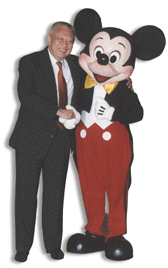 Chief Executive Tung Chee Hwa with Hong Kong's newest resident
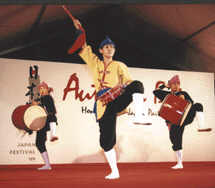 Japanese dancer performs during the 1999 Japan Festival.