

|
|
|
| . |
|
In the last ten years, the Italian government has drastically reduced its participation in state-run utility companies. With increased convergence within the European Union, Italy has gradually shed its subsidies to most industries and minimized its role in business to encourage fair competition. One company that has faced this change head-on is Acquedotto Pugliese, which manages the historic acqueduct and the water service in Italy's Puglia region.
"Nine years of work - from 1906 to 1915 - were needed before water could be brought to Bari," explains Pallesi. "Today, the aqueduct is the biggest in Europe, and serves about 850,000 consumers in 429 centers. Built in the pioneering age of civil engineering, the system is now getting quite old. We have therefore implemented important projects for the future involving redevelopment of the whole network." Projects underway include building a new tunnel at Caposele, because the original one is over 90 years old. A drinking water plant must be built at Conza, and another pipeline in Bari and Apulia, to give them the water they will need by 2005. ENEL, Italy's main energy utility, is expected to become Acquedotto's main shareholder. "They already operate in telecom, gas and electricity services," Pallesi points out. "Our water pipes can also be used to lay wires for television and telephones. What I have tried to do is link the clients and the shareholders. The services must be run in a different way from a financial company, as this is a long term investment." Pallesi's strategy has always been to treat water services as a blue-chip sector - a long-term investment in which the economic results of redevelopment may not be seen for decades. "Many Italians feel that water is a gift of God - a free commodity," he notes. "We have to re-educate them to show them that if we invest in redeveloping the system now we can help business flourish, encourage foreign investment and give better service to our people in the long term. But we cannot do this for free. The key is to spread the capital among the users, give them double quality, and earn profits for our shareholders."
|
 |
|||||||||||||||||||

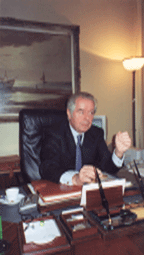 Managing Director Lorenzo Pallesi has taken Acquedotto Pugliese from losses to positive results and future privatization.