

|
|
|
| . |
|
It was only a year ago, amid a frenzy surrounding Sweden's new technology companies, when many of the country's traditional heavyweights struggled to grab some media limelight. Today, with the recent collapse in the share prices of several high-profile Internet companies, traditional companies seem to be back in vogue. Indeed, there is something reassuring about a company such as Scania, which traces its origins to as early as 1891 and remains one of the best-evaluated companies in Sweden. Scania AB, which has operations in more than 100 countries, is among Sweden's truly global corporations. Unlike its many competitors, Scania has concentrated its resources in the heavy transport sector to continue being one of the world's leading manufacturers of trucks and buses. It is considered by many Swedes as one of the country's most successful corporations for not having posted a loss in revenue in at least 70 years. Such a record is a testament to the durability of this Swedish manufacturer. Why has Scania proven so durable when other more high-profile companies have faltered? Three reasons stand out among the many for Scania's success: focus, sound management and long-term planning. Scania has stayed faithful to its core competence - the heavy-transport segment - but this has not hampered its ability to reinvent itself within the sector. In fact, staying focused has given more punch to Scania's innovations in the heavy-transport segment. In the areas of trucks and buses, Scania's two major business sectors, the company is among the top five producers worldwide. In the truck category, Scania's models boast some of the toughest frames, highest ground clearance and best mobility. In the buses and coaches segment, the company has started to implement innovations in engines for alternative fuel, reducing the environmental load of public transportation. Summing up Scania's strategy, President and CEO Leif Östling explained, "We are a niche company, focusing on road equipment. In all the markets we go to we look to establish an impact within our niche. We have been able to resist the temptation to go out of our niche and expand into other areas. We are a focused company and that is why we are successful." The way a corporation is managed during a slump is proof not only of its stability but it also determines its performance in an upswing. The true test of mettle is not what is done during the boom years but rather what comes out of the lean ones. For the heavy transport industry, it is a ten-year cycle, wherein the industry goes through seven good years and three bad years. Scania has proven very successful in building its business over these ten-year cycles. With 26,900 employees globally and growing, Scania's management team headed by Östling has not only weathered downturns, but has, in fact, thrived during the hard times. "The secret to Scania's consistent growth has been our approach of developing our organization gradually," explained Östling. "In every market we choose to enter, our goal is not to outpace it but rather to grow along with it." It is this level-headed approach that makes the company's stocks a favorite among investors even during downturns. With a home market of slightly under 8 million people, Scania from a very early stage in its life understood the need to broaden its focus to the global market. The company began major expansion of its production activities and sales in the early-1950s. Today, around 95 percent of its output is sold outside Sweden, with Asia being the biggest overseas market. Having interests in the Korean, Japanese, Chinese, and Southeast Asian markets, to name a few, Östling believes that Asia is due for tremendous growth. "Asia is due for some prosperous years and I recognize this. The region is reorganizing itself very well and investment in infrastructure is growing at a very high rate. It is necessary for us in Scania to create a position in this market at an early stage. I have always had a fascination with Asia, not only from a business point of view, but from a cultural standpoint as well." Internet start-up or not, much can be learned from Scania's run of more than six decades of profits. What really determines a company's long-term strength is not the amount of marketing dollars spent but the durability of its name - not only when the sun is shining but, more importantly, when the rain starts pouring.
|
Honda www.honda.se Yamaha www.yamaha-motor.se Scania www.scania.com IFS www.ifsworld.com  |

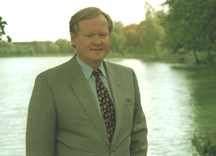 Leif Östling heads one of the best-evaluated companies in Sweden, which remains a favored firm among Swedish market players.