

|
|
|
| . |
|
|
A small nation in the world's big leagues
There are fewer better advertisements for the success of the Swiss economy than the annual report on world competitiveness published by the International Institute for Management Development (IMD), in the city of Lausanne. According to that survey, Switzerland is the 10th most competitive nation worldwide. This is quite impressive given that given that Switzerland is a country of just seven million people. Only five European countries are in the competitiveness top ten: Finland (3), Luxembourg (4), the Netherlands (5), Ireland (7), Sweden (8) and Switzerland (10). The same survey ranks Switzerland ninth worldwide with an inflation rate of 1.6 percent, and the second lowest rate of unemployment at 2 percent. In addition, Switzerland runs by far the biggest balance of payments surplus of any industrialised country -- 12.7 percent of GDP, which ranks it fourth worldwide. The country's standard of living is understandably amongst the highest in the world. The question posed by many analysts is whether Switzerland's economic performance will fall out of sync with the general economic cycle at a time when the world is worried about the threat of economic slowdown. Economic indicators remain optimistic. For example Kof, the institute for business cycle research at Zurich's Federal Polytechnic, is expecting growth to slacken to 2.1 percent in 2001 and 1.6 percent in 2002, stressing that a growth rate of just a touch below 2 percent remains reasonably robust.
Because of its small size and of its lack of resources, Switzerland has always been forced to look abroad, and as a result it depends more heavily on foreign trade than most countries. As a matter of fact, international trade accounts for nearly 40 percent of its GDP. In some sectors, such as the pharmaceuticals industry, micro-technology and reinsurance, more than 90 percent of goods and services are exported. Couchepin argues: "We are a highly competitive and open economy and we encourage private initiative. The Swiss economy thrives on competition, not state intervention. Many people who criticised the slow pace of change over the 1990s, are now surprised to see how quickly the Swiss economy has restructured and adapted to new economic realities. As a result of liberal free-market policies, we have managed to transform the whole economy into a healthy mix -- between the "old" economy and the "new" econiomic sectors." There is also a strong tradition of research-and-development (R&D) in Switzerland. The country is a world leader in terms of total R&D expenditure per capita. Three percent of GNP is spent on research -- extremely high in comparison with other countries, and three quarters of this R&D expenditure comes from the Swiss industry. In many other regions, industry spends far less on R&D than the governement. "The high R&D intensity is very important for us" explains Couchepin. "In order to maintain our high standard of living and environmental quality, we are increasingly focusing on high value-added production". In general, Switzerland imports bulky raw materials and exports high-quality goods. The Swiss economy is not built on mass production, but on highly-qualified work. Many businesses have also followed a "niche strategy", concentrating on a small range of high-quality products. The quality of Swiss products is the basis of a successful export economy. The Swiss themselves have a reputation for hard work and a tendency towards precision. "Precision and perfection are the strengths of many Swiss products" says Couchepin and many Swiss manufacturers agree by stressing that the label "Made in Switzerland" is a sign of prestigious and a guarantee of good quality.
|
Ricola www.ricola.ch Hilti www.hilti.co.jp  |

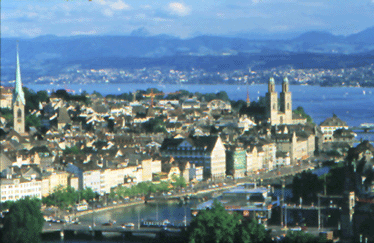 Against the backdrop of its stunning surroundings, Zurich epitomizes a competitive and open economy based on private initiative
 Pascal Couchepin, Switzerland's minister of economic affairs, is confident that slower but sustain -able GDP growth will not impede continuin