)

|
|
|
|
The Japan Times
WORLD EYE REPORTS
AUSTRALIA |
|
|
|
|
|
©THE JAPAN TIMES
|
Friday, August 2, 2002
|
|
The "Lucky Country's" secret: Make your own luck
 Sydney's iconic Opera House presides over its magnificent bay in a country richly endowed with natural and human resources. Sydney's iconic Opera House presides over its magnificent bay in a country richly endowed with natural and human resources.
Australia, rich in natural resources and a continent in itself, is sometimes called the "lucky country". But its performance in the midst of global turmoil owes nothing to luck and everything to canny management of its economy. Japan is its most important trading partner, and Australia now looks to the rest of Asia for growth while offering a strong economy that is increasingly attractive for foreign investors.
|
|

The Australian Federal Government is an official portal that provides a comprehensive access to every government ministry and agency. It also has links to a Who's Who in the federal parliament. www.fed.gov.au
The Australian Stock Exchange (ASX) maintains an on-line ticker that lists share names, latest prices, and volume for all stocks traded in the market. The also provides users with information on listed companies, upcoming initial public offerings (IPOs), and market statistics. www.asx.com.au
The Australian Securities and Investments Commission (ASIC) is one of three government agencies that regulates financial services. ASIC oversees Australia's 1.2 million companies. On its Web site, the user can search for Australian companies, find financial tips and financial services for investors and consumers and, get news about the Australian market and finance. www.asic.gov.au
Thakral Holdings is one of Australia's largest publicly listed property investment companies. It currently owns 12 hotels serviced by Accor, Hilton and Marriott and six retail commercial centers. It also holds a wide-ranging development assets portfolio. With a strong management team and asset base, Thakral Holdings continues to deliver increased shareholder returns and overall profit growth. www.thakral.com.au
eBox
|
While 2001 was a year of downturn for most of the world, it was a year of records for Australia. By midyear exports were at their highest since the Korean war boom of 50 years before. According to the country's Federal Reserve Bank governor Ian MacFarlane, both business and consumer confidence were above average in 2001, raising household consumption 4.2 per cent and making up about half of the total GDP of $320.25 billion. Australia has also experienced remarkable high productivity growth over the last 10 years.
This growth has primarily been in communications and utilities, wholesale trade, construction, finance and insurance and transport and storage. The Australian economy is today the world's 16th largest, with 1.1 percent of the global gross domestic product . It also remains one of the fastest growing economies internationally. FULL STORY
|
T-Corp- a model for the world
With the Australian state of New South Wales' (NSW) high business diversity and a solid percentage of government involvement in the corporate world it is no surprise that the state's Treasury introduced the Treasury Corporation Act of 1983. With this act, T-Corp was established -- shifting the financial management of the public sector from the hands of the government to an external organ that could work outside the borders of bureaucracy.
T-Corp was originally established to arrange borrowings for state entities. Today it has the authority to carry out, participate in, and advise on the management of liabilities and assets of the government, public authorities and other public bodies.
|
|
 Wayne Jarman, CEO of the New South Wales Treasury Corporation, or T-Corp Wayne Jarman, CEO of the New South Wales Treasury Corporation, or T-Corp |
According to Wayne Jarman, the company's CEO: "T-Corp is based on economies of scale. We are outside the state bureaucracy and achieve this by consolidating different authorities who normally would have done their borrowing separately. We have 17 electricity authorities that essentially bank with us, we have a water authority and about 130 other government businesses." FULL STORY
Selling Western solutions from Down Under
 Shuichi Tsukahara, Canon Australia's managing director Shuichi Tsukahara, Canon Australia's managing director |
|
"2002 will be very exciting for Canon," begins Shuichi Tsukahara, managing director of Canon Australia. "In many of our core markets we are experiencing rapid rates of innovation, leading to the introduction of many new products coming out this year -- including digital cameras, copiers, and printers. It is our job to bring them to market."
Known worldwide as a leading manufacturer of copiers and printers, Canon continues to extend its tradition of excellence in the Australian market. "While Canon Bubble Jet printers have nearly 40 percent of the Australian market, and Canon copiers have a solid 20 percent market share here too, the future of Canon lies in offering our customers complete solutions," Tsukahara adds. "Box sales are important and will continue to be, but on top of that we have to sell solutions."
|
Consumer electronics is a fickle industry; to compete successfully companies must strive to be at the cutting edge of development. CISERA, the research and development company owned by Canon, is intended to further this trend with innovative solutions. Working in conjunction with Canon's Tokyo head office, CISERA is pursuing new software developments for export to North America and Europe from its location outside Sydney. FULL STORY
|
An easy touch gains key partners
Australia's energy sector has gone through a transformation over the last seven years. Since 1994, the electricity market has been deregulated and utilities have been separated, each of them taking on a separate role within the electricity market.
In 1994, Pacific Power International (PPI) was the biggest utility company in Australia, employing 12,000 people. Today, the staff has been reduced to 450 and its role in the electricity sector is radically different.
|
|
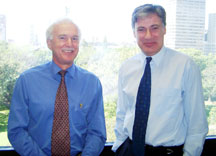 Robert Lang (right), CEO of Pacific Power, with John Williams, the company's strategy manager Robert Lang (right), CEO of Pacific Power, with John Williams, the company's strategy manager |
The process of establishing Pacific Power's role in the competitive electricity market commenced in 1995 and ended in August 2000. In those five years, PPI separated various generator and transmission components. FULL STORY
|
Australia
Capital: Canberra
Area: 7.62 million sq km
Population: 19.36 million (2001 est.)
Other main centers: Sydney, Melbourne, Brisbane, Perth
Currency: Australian dollar (AUD)
Exchange rates: $1=1.79 AUD
GDP: $445.8 billion (2000)
GDP growth: 4.7% (2000 est.)
GDP per capita: $23,200 (2000 est.)
Inflation: 1.4% (2000)
Unemployment: 6,4% (2000)
|
|
Total exports: $69 billion
Total imports: $77 billion
Top five imports: Passenger motor vehicles, Crude petroleum, Telecommunication equipment, Computers, Aircraft and parts
Top five exports: Coal, Non-monetary gold, Crude petroleum, Iron ore, Aluminium
Leading export markets: Japan, EU, ASEAN, US, South Korea, New Zealand, Taiwan, Hong Kong, China
Leading import suppliers: EU, US, Japan, ASEAN
|
|
 Source: The CIA Factbook Source: The CIA Factbook
|
|
|
|
|
|
|
|
|
|

|

|

