|
World Eye Reports on Austria |
||
| ©THE JAPAN TIMES |
|
B2 |
|
Sony DADC (www.sonydadc.com) in Salzburg, a 100 percent owned affiliate of Sony Corp. of America, has adopted a progressive mix of the old and new economy in its operations. Founded in 1986, Sony DADC manufactures optical storage media for the European market and is part of a worldwide CD manufacturing network with facilities in Japan, Hong Kong, Australia, Canada, Brazil, Mexico and India. The firm has a wide array of products, ranging from prerecorded minidisks to DVDs, but the CD line of products has been the most important. It is also the product with the longest history at Sony DADC. Dieter Daum, president and CEO of Sony DADC Austria, said, "This industry is like the fruit and vegetable industry. CD manufacturing is always by order and does not lend itself easily to mass production. We can't plan anything. Music is based on feelings. Some titles sell and some don't. You have to deliver when the demand is there. "With 2,000 customers and commitments to deliver in over 100 countries, Sony DADC is more than a run of the mill manufacturing plant. "From the beginning we have been very international," Daum explained. "We are also into logistics and financial services, and we have a management responsibility for the Sony Music International Corporations Group, just to name a few of our other fields. We are not just a factory; we are a real company." Having such a diverse and interactive set of responsibilities, Sony DADC has worked to integrate the Internet into its corporate structure in order to better meet the demands of its customers. Chris Reiser, executive vice president for finance and information systems, noted, "The e-business throughout the company has changed. We use it to receive orders but also to transfer data. We receive graphical components and data through the network. We transfer purchases using the Internet. Also important is the online ordering that has been developed in-house. We have our own engineering resources.
He continued, "If you compare the U.S. and European e-commerce systems, Europe still has different laws and currencies. Sony is developing and fulfilling all the legal requirements in this multilingual and multi-currency environment." Now one may ask how integrated a company should be with the Internet and how great the danger is of a company becoming a slave to the Net. Sony DADC's answer lies in finding a middle ground. With its primary focus as a manufacturing plant, Sony DADC has found ways to embrace technology and incorporate it into its systems. New fields of operation have spawned out of this, but the focus of the company has remained the same – the customer.
As multinationals grow in size and profitability, so do their responsibilities to the community and environment. But the question facing the multinational corporation today is how accountable and responsible it is to its surrounding communities. Answering that question is not easy because every corporate entity works within a given structure. But today's global corporations have undeniable responsibilities to their people and their surrounding communities. One company that embraces such community responsibility is Amada Austria. Established by the Japanese Amada group in 1986, Amada Austria has worked with its local community to bring prosperity back to the region. Setting up the production facility of Amada Austria in Ternitz, Lower Austria, was an effort by the Amada group to provide faster and more efficient distribution reaching all of Europe. The state-of-the-art production facility produces bandsaw blades and bending implements, all integral components for the range of industrial machinery produced by the Amada group. Through this production facility, Amada Austria has resurrected the old industrial town of Ternitz from its slumber by providing hundreds of jobs for its people. But the true of impact of Amada Austria on the people of Ternitz goes beyond the stability it has provided to the region; the company's corporate values have had an impact as well. Since taking the position of managing director of Amada Austria, Yuji Fujita has been implementing a three-point policy emphasizing quality, cost and delivery in just about every aspect of production in the firm. Fujita explained: "The QCD emphasis is a very simple policy that revolves around the customer. We only produce quality goods made of only the best raw materials. Our cost relationship with our customer is something we are always looking to maintain. We produce quality products for the right cost. This makes our customers happy. Finally we have delivery, which is as important as quality and cost, because we are always looking to satisfy customer needs. "Having quality products, for the right cost, at the right time is essential. That is why delivery is indeed an important part of the three-point policy here at Amada Austria." This QCD policy of Fujita has brought unparalleled success to Amada Austria. With 65 percent of its exports going to EU countries and 35 percent to the United States, Amada Austria has been a key producer for all major markets of the Amada Group. Fujita's policy has brought the customer to the center of every aspect of the business. "We must listen to, understand and respond to customer needs. This is what QCD is all about," Fujita stressed. Fujita has brought about a great number of operational improvements in Amada Austria, but his most significant contribution will not be found in production figures or cost savings. It is in the honor that this firm instills in the people of Amada and Ternitz. After all, what QCD ultimately strives is to achieve is honor – honor in the quality of the firm's products, in costs and in delivering on its word. These are values that multinationals all over the world are being held accountable for. The people's bank To be called "The People's Bank" and to be perceived by the people as one is not an image that can be established arbitrarily. So what enables Österreichische Postsparkasse (P.S.K.) to stake its claim as the People's Bank? It is simply the logical consequence of its product philosophy and distribution structure. P.S.K. is able to offer a product range that is highly developed and highly standardized. Every financial service product they offer can be quickly explained and fits snugly into the overall product mix of the institution. The range offers something for everyone – from the "Postal Personal Loans" to the "Postal Mutual Funds". P.S.K. provides attractive financial terms to their clients, a feature that's already part of their product design. To ensure that absolutely everyone is able to access their financial services quickly and without fuss, the nearest P.S.K. is just around the corner in every post office and there are over 2,300 offices throughout Austria. There is practicality at post offices working hours, from Mondays to Fridays from 8 am to 5 pm. P.S.K. is also a market leader in Austria when it comes to payments. One-third of domestic voucher-based payment transactions are processed through P.S.K.. In short, everyone who is looking for speedy and simple solutions and to whom quality and security are important, individual depositors and corporate investors are in safe hands at P.S.K.. A niche market success Austria is famous for its high percentage of niche market players, and Horiba GmbH offers some behind-the-scenes products that help make cleaner air and water standards possible. And that is an important step toward a cleaner planet. Horiba is a Japanese company that specializes in the production of analyzer systems that measure pollution in water, air and smokestacks. But the cash cow for Horiba is in the analysis of car engine emissions. The automobile emission testing division has been influential in the establishment of some overseas subsidiaries. Soon after Horiba's incorporation in 1953 in Kyoto, international expansion followed in the world's major automobile producing cities. In the U.S., Horiba founded a division in Ann Arbor, Mich., conveniently close to the famous motor city of Detroit. In Europe, Germany became the European headquarters, also due to its prominence in the automotive industry. Choosing Austria as Horiba's springboard into Eastern Europe was an obvious decision for several reasons. Austria is as far east as one can go in Europe and still find the level of stability and technological knowhow that most companies require. The country also has a strategic eye on the emerging markets of the East and a business environment that offers state-of-the-art technology and educational facilities. Willibald Zibuschka was chosen to lead Horiba Austria in July 1991. His knowledge of English, German, Czech and Romanian, along with his engineering background, were perfect qualifications to ensure Horiba's success in its march into Eastern Europe. Now nine years later, Horiba Austria enjoys market penetration of up to 75 percent in some Central and Eastern European countries. "Our flexibility is one of our greatest advantages," Zibuschka explained. Horiba Austria competes in a very technical field. The firm's ability to coordinate high-tech machinery with various countries' national standards has been one key to Horiba Austria's high market penetration. The company is also very comfortable with the challenge of calibrating and designing analyzing equipment to meet different requirements. With its Austria-based staff of highly trained engineers, Horiba Austria modifies high-tech analyzer equipment from Japan and makes its own machinery to fit the sensitive calibration requirements of its assorted range of customers. Beyond Horiba Austria's merit as a niche market success story is the environmental benefit its services ensure. Providing many nations with the technology to measure pollution is an important step in a cleaner direction. Zibuschka is optimistic about the ecological future of Europe and the development of the European Union. He feels the air and water quality standards required for entrance into the EU could serve as a catalyst, stimulating aspiring member nations to initiate cleaner systems as law.
HOME About Us Careers Contact Us Reports Advertisers About Japan Times © 2000 World Eye Reports |
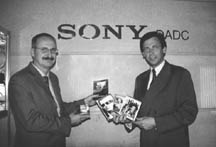 Dieter Daum, president, and Chris Reiser, executive
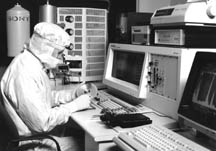 Dieter Daum, president, and Chris Reiser, executive
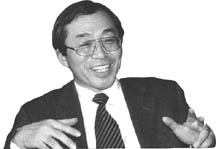 Yuji Fujita, managing director of Amada Austria