

|
|
|
| . |
|
On the 1st of January this year, against the backdrop of the harsh Nordic winter, Sweden took over the six-month rotating presidency of the European Union following the frenetic marathon sessions of Nice. Miles and months away from Brussels, Sweden has been determined to inject a sense of cool and calm into the activities of the 15-member association. A relative newcomer, Sweden entered the Union in 1995 and has held on to a patent pragmatism with which it approaches most European issues. Having opted out of the first wave of the single currency, the Swedes, along with the British, are viewed by many as the least enthusiastic members of the Euro club. But, that view has not hampered Sweden's resolve to stamp Europe with its brand of Nordic Cool, a distinct quality that has undeniably made the country one of the most successful exporting economies on the planet. Göran Persson, Sweden's staunch Social Democrat prime minister, has focused Sweden's agenda on the so-called Three E's. The long-running and pressing issues of environment, employment, and enlargement has been given the importance they deserve before the leadership shifts in July to Belgium where talks on political integration are expected to take centerstage. It is, however, in the issue of the EU's projected enlargement where Sweden's leadership is making its mark. Persson has repeatedly pointed out that if the EU is to stake its claim as an economic powerhouse and a model of political stability, then the Union must shed its country club image and implement solid steps towards eastward expansion. Mindful of the considerable demands that enlargement poses on the EU, Sweden has used its term to fine-tune the criteria to be applied to candidate countries. "The key issues that have to be tackled may differ from country to country, but generally environment is considered to be a problem in most negotiations," remarks Persson during a recent interview with World Eye Reports in Stockholm. "Recently, we concluded an agreement on environmental questions related to EU membership with Slovenia and we hope that this agreement can be used as a model for similar agreements with other countries," the prime minister adds. Another problematic issue, according to the Swedish leader, is the free movement of people within the EU. "Several EU states want to have transitional periods for the new members regarding this area; but that is something applicant countries are opposed to. The European Commission came up with a proposal of its own and we hope the proposal can be used as a basis for a well balanced compromise." The list of aspiring members consists 10 former Eastern bloc countries, as well as Cyprus, Malta and Turkey. The 10 Central and Eastern states are Bulgaria, the Czech Republic, Estonia, Hungary, Latvia, Lithuania, Poland, Romania, Slovakia, Slovenia. It is a foregone conclusion that all will not be granted immediate entry but that is not Sweden's goal. It is Persson's and his government's firm desire that the Union be able to offer the candidate countries what they most want- a clear target date for their accession into the EU. Currently Sweden is also undergoing a sustained period of economic expansion. Unrecognizable from the nation that only five years ago was in recession, Sweden has witnessed its economy grow by four percent in the year 2000. "In 1996, we set the goal to reduce unemployment from 8 to 4 percent of the workforce by the year 2000. Last fall, we met this goal and we are now working towards an employment rate of 80 percent by 2004," Persson stresses. The economy has rebuilt itself on the strength of the technology industry and a revived entrepreneurial spirit. Until a few years ago, heavy tax burdens and an inflexible labor force had hampered the growth of business.
Despite suffering a recent rash of dot-com failures, Sweden's technological entrepreneurs still have reason to be optimistic. Within the Nordic region, Sweden ranks as the highest in on line revenue at 59 percent. In terms of technology infrastructure, the country only trails behind global leader, the US. Although the nation's economy is still dominated by powerhouses such as Scania, Volvo, Tetra Pak, and Ericsson, it is this new entrepreneurial culture resulting from technological innovation that has been opening doors globally No longer bound to corporate Sweden, attitudes towards employment have also changed drastically. A growing number of 20- and 30-somethings have been turning their ideas into successful ventures. Factor in Sweden's track record of success in the world market and it may only be a matter of time before the next wave of innovative Vikings comes charging out. For Sweden, the EU leadership has been an arduous six months. It has tackled the issues of the environment, employment, and enlargement without much fanfare but with great resolve. Being in the European spotlight is something new to the Swedes, but in true Nordic fashion they have just buckled down to work and remained cool under pressure.
|
Honda www.honda.se Yamaha www.yamaha-motor.se Scania www.scania.com IFS www.ifsworld.com  |

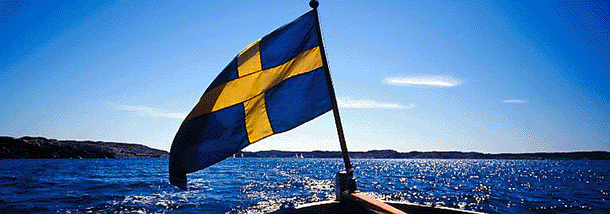 Leading with Nordic cool
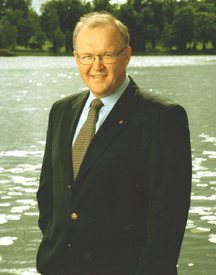 In pursuit of a larger Euro club, Swedish Prime Minister Goran Persson boosts efforts to admit new EU members