)

|
|
|
|
The Japan Times
WORLD EYE REPORTS
HAMBURG AND SCHLESWIG-HOLSTEIN |
|
|
|
|
|
©THE JAPAN TIMES
|
Friday, March 29, 2002
|
|
Centuries-old trading hub sets a foundation for the future
The city-state of Hamburg is Germany's oldest commercial center. Today, it is the country's most important foreign trade hub. Hamburg's trade links with Scandinavia and Eastern and Central Europe are 800 years old. The first English and French trade links were set up in the 16th century, followed by the Dutch and the Spanish in the early 17th century. Merchants from Hamburg were traveling as far as Japan, China, and Indonesia by the 19th century. Built upon such strong traditions, the city of Hamburg has grown into Northern Europe's premier business center.
|
|

This is an excellent guide to what's currently happening in Hamburg's varied cultural and social scene. www.hamburg-fuehrer.de
Hamburg's official Web site is partially available in English, French, Spanish and Mandarin, as well as German. It features information on the city-state's politics, culture, traffic, tourism, and more. Check out the current video, "Hamburg on a Perfect Day." www.hamburg.de
eBox
The Economic Development Corporation of Schleswig-Holstein produces this well-designed site filled with detailed information on Germany's northernmost state. www.wsh.de
|
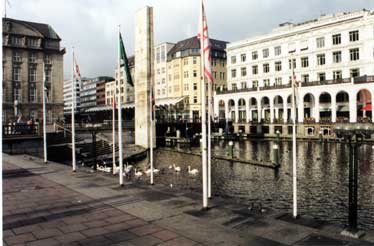 Hamburg has outlived and outclassed several cities as a bustling trading center. Hamburg has outlived and outclassed several cities as a bustling trading center. |
|
With such a long history of trade, it is no wonder that some of the world's oldest institutions were founded - and are still operating - in Hamburg. Hamburg is home to Germany's first stock exchange, which opened in 1588. This was joined by what was to be the world's oldest private bank -- Joh. Berenberg, Gossler & Co -- in 1590. The Hamburger Feurkasse, the world's first insurance company, was established in 1676. FULL STORY
|
|
Germany's window to the Baltics and Asia
WER met with Hamburg's state senator for economics, Gunnar Udall, to discuss the importance of foreign trade to the city-state.
WER: The Port of Hamburg Germany's largest, but also its fastest-growing. What impact has the port's rapid growth had on the economy of Hamburg?
Uldall: Hamburg has a number of significant advantages compared to other European ports. Being Europe's northernmost and easternmost port, it is an important link for Scandinavia and the Baltic states to countries in Asia and North America.
|
|
 Hamburg State Senator Gunnar Uldall Hamburg State Senator Gunnar Uldall |
Hamburg also profits by its excellent hinterland connections - especially to Eastern Europe - and by its proximity to Berlin. With the deepening of the fairway of the river Elbe and the Altenwerder port extension, Hamburg is telling the world that its port is climbing the ranks among in the world's ports.
Last, Hamburg is known as a technically advanced and reliable port. All these reasons make it attractive for the container ships to come to Hamburg. Let me mention that the Port of Hamburg hosts the European distribution centers of many companies from Japan and other countries. FULL STORY
 Deodatus Schrenk, Chairman of the management board of Schümann Sasol Deodatus Schrenk, Chairman of the management board of Schümann Sasol
|
|
Waxing a smooth road to the innovation
While most of the world's wax use continues to be in the traditional candle industry, Hamburg-based Schümann SASOL has developed a large number of other applications, all of which help to make products last longer and perform better.
The world's leading producer and supplier of wax material deals with two general products. The first is paraffin wax, a crude oil derivative used largely in the candle industry, which is produced in Hamburg. The second is Fischer-Tropsch wax, a synthetic hard wax made for applications that require a high melting point. It is produced in Sasolburg, South Africa. FULL STORY
|
|
Hamburg
Area: 18,116 sq km.
Population: 1.71 million (1999)
Currency: euro
Average exchange rate: $1 =1.15 euro
Total GDP: $60.96 billion
GDP growth rate: 2.8 percent
Unemployment rate: 9.9 percent
Total exports: $ 35.76 billion
Total imports: $ 17.39 billion
Major export markets: EU, central and Eastern Europe, East Asia, North America
Major import markets: EU, central and Eastern Europe, East Asia, North America
|
|
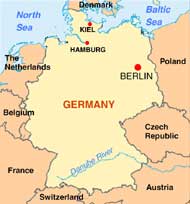
Source: Hamburg Business Development Board, Business Development Corporation of Schleswig-Holstein |
|
Schleswig - Holstein
Area: 15,771 sq km.
Population: 2.76 million (2001)
Currency: euro
Average exchange rate: $1 =1.15 euro
Total GDP: $54.84 billion
GDP growth rate: 0.6 percent
Unemployment rate: 8.4 percent
Total exports: $ 9.34 billion
Total imports: $ 10.71 billion
Major export markets: Denmark, Britain, U.S.
Major import markets: Britain, Netherlands, Italy |
|
|
|
|
|
|
|
|
|
|

|


