

|
|
|
| . |
|
More importantly, JVC has positioned itself where it can continue this rate of increase through cautious yet lucrative diversification into higher profit margin areas, such as in professional electronics, which accounts for 11% of turnover and was once the domain of larger and perhaps less focused industry giants. Meanwhile, JVC President Yuichi Eguchi has not made the mistake of considering Spain as a single unified market. Having been previously based in Britain, the company executive has developed an astuteness in distinguishing domestic and foreign markets that are completely different in terms of consumers, distribution, and retailing practices. "Looking from the outside, Spain seems to be a single country but looking from within, it is many different countries," Eguchi explained. "In the UK, you have an incredibly concentrated retail sector, with a few groups controlling distribution to most of the consuming public, while here over 50% of our turnover comes from smaller shops." The global trend towards digital networking among consumer electronics companies such as JVC has also meant there are several regions that have yet to achieve technological saturation. And, this seems to be the case for Spain (although not wealthy Catalonia, perhaps) which, according to sector analysts, remains two years behind the norm. On another front, JVC's current challenge is to apply the concept of user-friendliness to digital networking. "The TV is simple. Press the button and it is on. It is purely passive with no interaction. The trick is user-friendliness. If most people are unable to understand how to use and benefit from the technology, the advantages of digital networking will be lost to the average consumer," Eguchi points out. The minimalist architecture of JVC España's head office is an indication that it regards its vision and goals seriously. Amid all the talk about a digital revolution, the only companies that will survive the competition will surely be those that make advanced technology simple to use. Madrid may have a right to claim the title of business and financial center of Spain. But, Castellon, located along the country's coast, surely makes up for what industrial Madrid lacks in logistical advantages and utility supply. Historically, a maritime province, the expansive and populous region of Castellon has become a hub for several industries. From here, companies in specialized fields, such as ceramics, fine chemicals, speciality products, and transportation equipment, have secured leading market positions for themselves around the world. One typical example is speacialized caprolactam producer PQM, the European arm of Japanese firm UBE Industries. UBE Industries acquired a stake in PQM in 1993 to boost its caprolactam business and, a year later, assumed management control of operations through UBE Corporation Europe S.A. (UCE). Then, in the middle of 1999, PQM launched new production operations that consolidated its status as one of the major players in the chemicals and plastics sector. "Caprolactam is a raw material found in the production of Nylon-6. It is used in textiles (monofilament), engineering plastics, wrapping film and car components," explained Shinobu Watanabe, president of UBE Corporation Europe (UCE) and PQM. "Having an increased annual caprolactam production capacity of 75,000 tons, we provide stable supplies to customers in Europe and Asia. We also believe our product is better because we are specialized in what we are doing," Watanabe added. The company also realized that if it was to offer a full range of products for the European market, it must not only consider the present production of caprolactam but also diversify in the field of fine chemicals. So, in August 1999, PQM began manufacturing 1,6-Hexanediol, a raw material used in high-grade polyurethanes, polyesters, various new adhesives, and other compounds. "Our aim with 1,6-Hexanediol is to increase the present capacity of 3,200 tons a year primarily for the European market where the demand is looking very healthy," said PQM managing director Ricardo Lopez Soria. "We also manufacture crystal ammonium sulphate and UBESOL 45, a bigger size granular crystal, using UBE Industries-owned technology. And, this value-added product has strengthened our position in the fertilizer business." In the future, the team at UCE plans to add Nylon 6 and co-polymers Lauryl-Lactam and Nylon-12 to its product list. The move would allow the company to gradually expand into the production of hoses and tubes used for the automobile industry and other industrial applications. "The economic results of the last few years have allowed us to not only finance all the projects carried out with our own resources or with the support of the central and regional government but also maintain a cleaned up cash position for dealing with new projects," Watanabe said. Regardless of immediate objectives, UBE Corporation Europe SA look set to quickly boost its standing as a leading supplier in international markets.
Meanwhile, established U.S. and European giants such as Ford, GM, Daimler-Benz, Fiat, and VW dominated the market. These carmakers built plants and set up distribution and marketing platforms in the 1950s and 1960s, allowing entry into Spain's protectionist market. Automoviles Nippon and Toyota Motor Corp in Japan knew that the Spanish market would open up eventually. All they needed was a plan to position themselves in the psyche of Spanish consumers. The initial step was to establish a joint venture company named Toyota España SL, with Automoviles Nippon holding a 65-percent stake and Toyota Motor Corp taking the rest. The next step was to map out an entry strategy into the market. "We started out by focusing on 4x4s and sports cars; and we had to focus on the two biggest markets, Madrid and Barcelona. We were hampered by the quota; but in order to build the Toyota brand, we needed to make an impact somewhere. By initially focusing on this niche market we built a strong customer base and a reputation for quality and style within Spain," explained Toyota España Managing Director Alfonso Saavedra. From a handful of dealerships in Barcelona and Madrid, the Toyota network expanded in conjunction with the receding quota to over 100 dealerships across the country that reach 90% of the Spanish population. While the company is structured strictly as a wholesaler with the dealerships being 100-percent privately-owned, Saavedra maintains an ear very close to the ground in his relationships with the dealers. "We maintain a nimble structure that allows flexibility and dialogue between dealerships and us at Toyota Espana S.L and ultimately Tokyo. Our dealers are very motivated and have enabled us to introduce 10 new Toyota models a year in the Spanish market, the most (compared to) any brand. Anyway, if someone needs to talk to me I am only a phone call away. So, we can respond to any situation quickly," Saavedra said. Spain's entry into the EU and liberalization in the general market have brought about a third stage in the development of the Toyota brand in Spain. "We had developed a reputation among Spanish consumers of something of an elite brand." "More significantly, people would associate Toyota with the model of the car rather than the Toyota name. The Celica, for example, was incredibly popular among customers and the model perhaps more well know than the brand itself," the executive commented. Also, the 4x4 and sports car markets are nearly saturated, with Toyota maintaining a wide edge over its competitors. With that, the next goal for Saavedra is to move into the large mid-sized passenger car sector. "I think that we will succeed here just as we have done with the other models. The key I believe is in strong after-sales service. Word of mouth is the best way to sell. Reputation helps enormously. If a customer calls and has a problem and you fix it within 24 hours you have a happy customer. We have to give the customers the feeling that buying a Toyota is a great experience," he said. With the move into the passenger car market, Saavedra has his sights set on doubling his current market share from 2.5 percent (30,000 units) to 5 percent (60,000units) in the next three years. Although the figure is much lower than Toyota's average market share in other overseas markets such as the U.S and Canada, it fits into the carmaker's model of the EU market. For Toyota, the bottom line is that the brand has acquired a reputation in Spain for quality and excellence. But, that has not stopped the company from stepping its marketing plan to target a broader segment of the population. Economic forecasts indicate that the Spanish economy will continue to see healthy (if not robust) growth resulting in higher disposable household income and continued strong business confidence. As affluence increases in this country of 40 million people, the road ahead only looks brighter for Saavedra and the people at Toyota Motors in Japan and Spain. Focusing on strengths Pioneer Electronics Iberica has seen its growth in the Spanish market reflect that of the national economy as a whole: strong, robust and unrelenting. Established in the early 1980's through a joint venture with a local producer of electronic equipment, Pioneer has benefited from Spain's success but has, in its own way, brought success to Spain itself. Antonio Punti, the president of Pioneer Electronics Iberica, has been with the company since the start. He admitted that when Pioneer first was reached Spain, it was an unknown brand. Today, Pioneer Electronics Iberica boasts annual sales of around $120 million, manufactures optical disks in Spain (through Pioneer Optical Disk Europe), and distributes media CDs. The company's territory extends westward to Portugal. Punti believes that specialization brought success to Pioneer. "In the electronics market, Pioneer has made a choice to focus on its strengths: displays, DVD, audio, recorders for digital TV and pay TV. We have these three of four main strengths. This makes the company more strong. If we push everything, we will not be strong." Pioneer is well known internationally for the important innovations in the high tech sector. It blazed trails when it developed interactive Cable TV in 1977, GPS car navigation in 1990, DVD in 1996, and plasma displays in 1997.
Also, the company has maintained a unique and individual character, which is a strong asset in the increasingly amorphous world of "convergence" in the IT and electronics industries. As Spain becomes increasingly in tune with the IT revolution sweeping the world, Punti foresees both danger and opportunity for companies trying to cash in on the IT boom without consideration. "The Internet will present lots of opportunities. However, lots of opportunities do not mean that a company will be successful or not. It depends on the people the company has, its products, corporate infrastructure and level of service to the consumers," he remarked. Moving full circuit Spain hosts its fair share of companies from the electro-mechanical industry -- ABB, GE, Schneider, and Siemens. These firms have a sizable presence but none of them use the country as a central platform in their global operations but only as a part of a regional supply and manufacturing network. Yet, there is an exception to this landscape. The Osaka-based Terasaki International Group entered Spain 13 years ago precisely with the goal of setting up global platform in the country. Terasaki is a mid-sized global company that established its reputation as a specialist in developing, manufacturing, and distributing electric energy protection systems. Why would an industry leader, which developed the world?s first Molded Case Circuit Breaker (MCCB) in the late 1940's and the world?s first Current Limiting Circuit Breaker in 1963, want to establish its global platform in Spain? Terasaki Espana, S.A.U. managing director Jaime Balde Muxi attributes the move to foresight. "Around 15 years ago Terasaki could see the future. In the business of power controls (circuit breakers), there were two main standards: the US one and the European one. The European standard (IEC) was winning market share. Terasaki bought this plant and now has the production facilities, the European market, and the technology," he explained. The main applications of the technology are contained in the TemDin (DIN Modular series) line of circuit breakers produced by Terasaki España. These Miniature Circuit Breakers (MCB) with a smaller power threshold (0.3 Amps to 125 Amps) use the IEC standard and are designed for tertiary, commercial and household applications. Through its Spanish subsidiary, Terasaki supplies its entire global network with the TemDin range and consequently complements the group's higher performance products. Presently, Europe is the single biggest market, accounting for 50% of turnover (including Spain). But, the company believes that the markets of South East Asia and particularly Latin America will boost its turnover in the future. Turnover has doubled in the past four years to 1.6 billion yen and has been estimated to double to 3.2 billion yen within the next three years. Following its initial investments from 1990 to 1991, Terasaki recently spent another 10 billion ten in a new plant and machinery. The staff has grown from 107 to 180. In the wake of this increased investment, some of the giants, such as GE and Siemens, have just begun to upgrade its technology to catch up with the smaller but perhaps nimbler and leaner Terasaki. But, the best is yet to come. Besides its current markets, Terasaki has witnessed a huge of momentum in its biggest market for IEC technology. In Japan, authorities have begun final preparations to introduce the IEC standard in the country. Being a leader in its technology and possessing a strong domestic distribution network, Balde is certainly happy that the products made in his factory will soon be going full circuit back to Japan.
Like many foreign companies that entered Spain before trade liberalization in the European Union (EU), Japan-based Yamaha penetrated the Spanish market in the early 1980s by investing in an existing local factory. Since then, the market and the corporate structure of Yamaha have changed considerably. "Back then, Spain did not allow any foreign motorcycles into the market without prohibitive tariffs," explains Jorge Lasheras Allue, president and managing director of Yamaha Motors España S.A. "We had to take part ownership of a local company and only then, could be bring our products into the country." Spain's entry into the EU in 1986 meant that countless locally-based companies, including Yamaha, had to shed their branch-plant mentality and view the country as more than just one more market in which to sell. Integration of pan-European operations became as important a goal as satisfying the needs of local consumers. Soon after taking full control of the local vehicle maker Yamaha Motor España began the process of becoming a supplier to other regions in Europe. Capacity at their manufacturing facilities was ramped up from 26,000 units a year to over 130,000. Currently, more than 76% of its production heads to EU markets such as Italy, Germany and France. As part of efforts to have lean and efficient operations, Yamaha España has narrowed its production to 50cc to 125cc scooters. "We have to always become more efficient, and these efficiencies lead to a quality product. Of course profit is one of the most important goals, but quality is more important," Lasheras remarked. Meanwhile, the expanded focus on Europe has not meant that the local market has gone neglected. Sales been very strong; and the company's market share in Spain is close to its global average of 24 percent.
|
IMADE www.imade.es  |
 Toyota Espana Managing Director Alfonso Saavedra
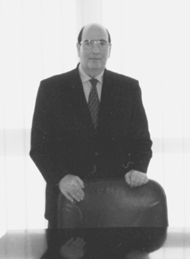 Pioneer Electronics Iberica President Antonio Punti