

|
|
|
| . |
|
Hisato Harada, the president and managing director of Panasonic España, S.A., has witnessed first-hand these changes to the business landscape of Europe and the rest of the world. From Singapore where he oversaw the South East Asian operations of MEI, Harada was sent to Hamburg to head Panasonic Marketing Europe, which was responsible also for sales to the Nordic countries. "Matsushita has a new mid-term plan that reflects changes in the European structure as a whole. First, the recognition is that Europe is a pan-European Market (PEM). With Panasonic Marketing Europe, we have restructured marketing to incorporate all 6 of the Nordic countries," he explained.. This middle-term business plan, dubbed "Value Creation 21," will allow Matsushita to reinvent itself as a "super manufacturer" for the 21st century, according to company president Kunio Nakamura.The changes also aim to realign Matsushita's different product lines and allow more flexible management. This corporate revamp will result in the creation of four new divisions, namely AVC Networks (AV and Information & Communications), Home Appliances, Industrial Equipment and Components & Devices. Meanwhile, Panasonic will boost Matsushita (in the AVC Networks division) in terms of the two highly critical areas of access for consumers of the digital world: home and mobile terminals. Harada likes what he sees in the European market. "The home is one of two critical areas where digitalization connects with information and communications. In Spain as elsewhere in Europe the government is pushing for total digitalization of the networks by 2007. The standard will come not later but sooner." Standardization of digital format in the homes will complete the entry point for the majority of consumers and will lead to a wide-scale adoption by consumers of the newer Plasma Display Panels (PDP) and continued strong sales in DVD products among others. "The handy terminal (mobile phone) is one of the most important areas for us. With the UMTS (3G) networks being developed, we will move far beyond GSM (2G, the current standard). There will be a whole host of new applications such as video on demand and access to services of all kinds," Harada pointed out. "The most significant will be the single worldwide standard which has so far not been possible with different countries using different standards. This will not be simply a phone: it will be a totally integrated item, integrated with the whole world of digital data," he added. Certainly in Spain, as in the rest of Europe, mobile telephony has taken off. Already 60% of a population of 40 million use a mobile phone. However, the European handset producers Nokia and Eriksson, still have larger market share than that of Panasonic. To overtake these established companies, Panasonic has introduced extra services targeted towards the professional market. "The important thing is software as well as the quality of the handset. We have decided to work together with Lucent to provide software and other such services. But, the most important thing is the operator. One of our successes in Japan is our partnership with NTT DoCoMo. We will work with Telefonica to attract both the professional user and the general user," the executive said. The goals and changes at Matsushita have been reinvigorated for the demands of the digitized economy. Clearly, it takes a focused and lean approach. Being huge does not mean one cannot be nimble. For Pfizer, life is its life's work Seated behind his desk, Pfizer España president Emilio Moraleda gives out a brief, confident smile as he discusses the company's exceptional year. Last year, the company's revenues surged by 20 percent and became the world's number one company in prescription sales, he boasts. Moraleda attributes the company's phenomenal success to a string of innovative and effective in-line and alliance products that were launched beginning four years ago. "In 1997, with Warner Lambert, we discovered Lipitor, which is also the number-one selling drug in Spain. Then, in 1998, we introduced Viagra, the worlds leading treatment for erectile dysfunction. In February 1999, along with G.D. Searle & Co. we launched Celebrex, a leading drug for arthritis, which was discovered by Searle," he relates. Added to that, the company claims to have scored the feat of being the only pharmaceutical company to have seven medicines reap annual sales of $1 billion or higher. "Setting records is very easy for us because we have such a strong base. Our whole organisation is pro-active and our manner very professional. We invest at least 20 percent of global sales on research and development of new drugs and that amounts to $4.7 billion every year," the company chief says. Asked why Pfizer became one of the market leaders in Spain, Moraleda cites that highly-skilled workforce and the strength of each teams: "Our mathematicians, computer experts, lab technicians, and administrative staff all believe in the name "Pfizer." We have attracted the best people for the job and this has been a one of the factors of our success. Innovation products, and good people - that is our bottom line." A recent merger with Warner Lambert also strengthened the presence of both companies locally. Prior to the partnership, Pfizer had a market share in Spain of 3.7 percent, which has since grown to 5.5 percent. Currently at the second spot in Spain, Pfizer hopes to grab the top position by next year. "In Spain, I have to say the transition was conducted very efficiently. In fact, by September 1st of 2000, we had the new teams in place and were operating as single company from that day," he added. Based on Moraleda's assessment, Pfizer was sure to reach its objectives because of a decision to keep a tight corporate structure, employ only top-calibre employees, and spend much money on R&D. "Pfizer is advancing in every area and to accommodate the extensive number of projects, we have developed a bio-medic center in Spain. It is focused on managing data from the other centers in Europe and producing analysis from clinical areas," he explained. As he looks to the future of Pfizer Espana, Moraleda expresses much confidence. "We have never been stronger, and with our existing portfolio, we'll continue to grow. By the end of this year, we'll be the number one player in the Spanish market."
While all the major multinational sector players have significant operations in Spain, it is the homegrown companies that exhibited why the industry has been very dynamic in Spain. One of the local sector leaders is Gestamp Automocion, whose business has expanded well beyond Spain's borders in the past several years. The firm specializes in die manufacturing; welded blanks; as well as in small- medium-, and large stamping, sub-assemblies and systems Last year, Gestamp Automocion posted a turnover of $700 million and the workforce in its factories in Europe and in North and South America exceeded 6,000. Chief Executive Francisco J. Riberas attributed the expansion to the company's commitment to keep pace with globalization. "Gestamp Automocion as a car component company has to follow the globalization patterns of the car makers." "If a company moves into a certain market, we have to follow them. We have an industrial presence in South America, North America, and Europe. By showing that we are able to compete as such globally, we have been able to bring value added products and services to our customers," he explained Regular investment in research and development and in human resources have led to a reputation of quality among its customers, which include the global giants GM, VW, Ford and DaimlerChrysler. Despite its reputation of quality products and services, Gestamp continues to aim high. The company hopes to double sales within three years and to quadruple them to 3 billion euros by 2005. Leading Spanish firms in its sector, Gestamp is also doing something else. The company is proving that Spanish industries - besides banking, telecomm and energy - are capable of taking a path of leadership globally. Twenty years ago, no one would ever have thought it possible.
Though not as battered as the dot-com and IT sectors, the telecom industry has suffered huge hits as well recently. Investor confidence has been badly shaken by growing corporate debts incurred from expensive 3G licenses. Then, there has been increasing doubt whether 3G technology could really deliver the promised services and the predicted revenue. Yet, writing off the sector as a whole would be as foolish as relying on WAP technology for weather and share price updates. The case of Spanish telecom giant Telefonica punches through the point. The country's largest in terms of market capitalization and turnover, Telefonica has defied the glut. Last year, the company generated revenue of over 26 billion euros, achieved dominance in the 350 million-strong Latin America market, and made inroads in the highly competitive telecom sector in Europe. Privatized in the mid-1990s, the company carried out a vertical restructuring plan and spun off its business units along global product and service lines in 1997. Under the plan, the holding firm Telefonica S.A. set up Telefonica España (for fixed-line and broadband telecommunications), Telefonica Moviles (mobile telephony), TerraLycos (an Internet portal), Telefonica Data, among others. Meanwhile, Telefonica subsidiary Atento, together with Japanese partner Pasona, recently launched its first 24-hour customer service center in Tokyo. The joint venture, dubbed Atento Pasona Inc, will employ more than 1,000 employees who will attend to the needs of customers, ranging from directory inquiries to technical assistance. Atento, which has operations in 15 countries in Europe, the Americas, and North Africa, generated earnings of $487 million last year. The company hopes to earn some $17 million during its initial year of operations in the Japanese region of Kanto and expand operations to Osaka, Hokkaido, Okinawa, and other areas by 2003. Japan represents more than 10 percent of the potential revenue in this market, while the industry in Asia is predicted to grow by 30 percent annually for the next several years, according to sector analysts. The company's headquarters is located along Madrid's Gran Via (the Hispanic world's Main Street or High Street), which was once the center of the former Spanish Empire. From that landmark building, Telefonica also hopes to meet its biggest challenge - managing a telecom empire that spans Latin America, Asia, and Europe. In the last few years, consolidation of the EU combined with the privatization of flagship sectors led to the carving up of the telecom sector within the 15-member common market, prompting a handful of industry leaders to gobble up their smaller rivals. Amid this trend, sector players that have been caught without a strategy perished. As European competitors such as Vodafone, Deutsche Telekom, British Telecom enter the Spanish market, Telefonica has tightened its defenses in the domestic front and took the battle for market share into the rest of Europe. "We are very optimistic. Our competitors are coming to our market. Therefore, we have to face them. The best way to face them is in their own backyard too," Telefonica CEO Fernando Abril Martorell remarked. But, the brutal battle for market share in Europe left most telecom with huge amounts of debt, significantly lowered market capitalization, and weaker long-term viability. Among the high-profile victims included BT, Deutsche Telekom, France Telecom, and Vodafone. These companies have since considered implementing a corporate structure similar to that of Telefonica. Telefonica emerged virtually unscathed since it did not spend as much money and resources as its rivals to pursue the much-vaunted 3G licenses across Europe. Instead, it forged partnerships that allowed access to 85 percent of the market within the EU and Eastern Europe. While BT, France Telecom and Deutsche Telekom and others were weighed down by heavy debt and saw share value sink, Telefonica maintained a strong cash position and a high share value. And, from the point of view of the consumer, a hefty war chest is vital since the nature of the business is capital intensive and demands liquidity to provide up-to-date services and consequently, boost its customer base. Abril, a former investment banker with J.P Morgan, elaborates: "We are facing an industry which is still both capital intensive and uncertain. Typically, what happens in this situation is that the market will consolidate quicker. It was already consolidating; now, it is only going to move faster." "We hope to be number one. Why not? Not so long ago, AT&T was (number one). It no longer is. We have 60 million clients, of whom 40 million are fixed-line and 21 million are mobile customers. We want to be closer to the customer and be able to satisfy all of the clients needs. We believe if we have solid critical mass in those fields, we will be among the leaders of the pack, which will also create shareholder value," he adds. With the well laid-out plans, the future of Telefonica seems clear: Dominance in the "home" market of Spain, Latin America, and Portugal, as well as a strong presence in Europe.
|
IMADE www.imade.es  |
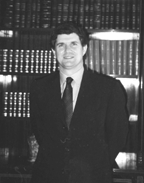 Gestamp Automocion Chief Executive Francisco J. Riberas
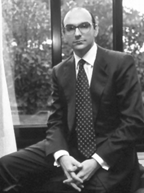 Telefonica CEO Fernando Abril Martorell