

|
|
|
| . |
|
Lladró is a local success story. The three Lladró brothers (Juan, José and Vicente) started the company in 1953 when they built a small Moorish-style kiln in the patio of their modest house and began making porcelain flowers. Soon after, they developed their own styles - known as Classic Naturalism and Modern Naturalism - that distinguished them as true artists and propelled them to success. As people became aware of their work, demand for the art objects and their fame grew.
At the center of the sprawling headquarters dubbed The City of Porcelain, company president José Lladró built a large swimming pool, as well as basketball and tennis courts, for the use of his more than 2,000 employees. Although success and fame stemmed from the creative genius of the three brothers, Lladró likes attributing the company's achievements to its staff.
"Human capital inside Lladró is the most important factor and that means personal friendship and esteem between all people. We support "human capitalism" and will never sacrifice these principles. If people use their hands you get more. If they use their brains, (you get) even more. If they, in addition, use their hearts you have everything you need." The company's holistic view of business and the pride of all the employees in their work has ensured that the art of Lladró will live on well into the future.
The image of Madrid as a city of bullfights and flamenco is misleading. Although known more popularly as the capital of Spain, the city is also part of a huge province called Communidad de Madrid, which has been the center of all that has happened to the country's economy in the past 30 years. The region is no longer the provincial backwater that it was in the early 20th century when the northeastern port city of Barcelona was the economic heart of Spain. Today, Madrid province is home to about six million people, lures 60 percent of foreign direct investments (FDI), and has over 12 universities that specialize in a wide range of fields, including information technology and aerospace engineeering. The large concentration of financial institutions, together with the highest level of R&D spending (over 33 percent compared to 20 percent in Catalunya), has made Madrid a hotbed of IT, chemical, pharmaceutical, and high-end precision manufacturing companies, as well as the administrative, political, and business center of Spain. Rodrigo Martinez Val Peñalosa, general manager of the regional government agency IMADE, identifies the several advantages that Madrid has over other European destinations in becoming a vital center for business and a strong magnet for FDI. "Specifically there are 12 points to our success. The first is that Madrid is the capital region. We have most of the headquarters of Spanish companies, banks, other financial institutions, multinational companies, and of course the government itself. We are close to the point of power," Martinez explains. "Secondly, Madrid is a very compact area with high spending capacity. Here, our spending power is 30 percent higher than in the rest of Spain and 15 percent higher than the EU average. In other words, you have access to high spending markets," he adds. "Another very important point is that Madrid is the business and financial center of Spain. Madrid was a secondary city in the early 20th century. Since the late 1940s and the 1950s, Madrid has had a rejuvenation, a change of atmosphere. We have attracted people, industry, corporate Headquarters - everything. Now, its population is two times that of Barcelona; while before, it was only half," he points out. For several decades, there has been a passionate but friendly rivalry between Madrid and Barcelona. But, a tour of Madrid would reinforce the claims of Martinez. Scattered across the city are smart and sleek high-tech industrial clusters. Public transport, communications, motorways, and railways operate smoothly and efficiently. Outside the capital, aerospace, fiber optic, and pharmaceutical companies sprout in sprawling, modern industrial parks. As Madrid moves towards value-added, information-based, high-tech industries, the companies that base themselves here and potential locators find within the region a huge pool of talented and skilled people. As the university center of Spain, Madrid has a student population of over 250,000; while the average wage is much lower than that in Germany and Britain. Continuing the long list, Martinez provides further advantages. "We have attracted business by providing infrastructure, facilities and land far cheaper than the equivalent land in the Northern European countries. The regional government of Madrid is very active in this area." "One of the weak points we have addressed is that some industrial areas were underdeveloped. In response to this, the regional government took steps to create new land and renovate obsolete industrial land. We have launched a plan to create 10 million sq. m of new industrial areas and renovate the same amount of old industrial land. Simultaneously, we are increasing the amount of residential lands available. We are creating new land to bring better opportunities for people and industry," he explains. Madrid is landlocked and right in the heart of Spain. Aware that effective logistical transport links to the rest of Spain, Europe and the world is important to industry, authorities have created a massive logistics platform near the airport. A large "dry harbor" is connected to four major sea harbors in Spain and offers rail, air, and sea links. In addition, all customs procedures have been centralized. "We also believe that for any enterprise with long-term plans for the Latin American market, Madrid is the ideal place to be established. Not only do we have more direct air links to that market than any other place in Europe, we also have our linguistic and cultural ties with Latin America," the official says. "In addition, as you know, the biggest investors to that region are all based here in Madrid: Telefonica, the big Spanish banks, and our energy companies. There is not only a wealth of direct links and linguistic and cultural expertise. But, there is also financing, partnerships, and access to the market through the "Madrid bridge,"" he remarks. As Spain redefines itself into a major global economic player and a leader in Europe with a developed and mature economy, the city and province of Madrid apparently provides the lead toward these directions. No longer a minor capital focused exclusively on the tourist trade (although it continues to draw in a horde of tourists), Madrid has embraced the challenge of gearing up for the globalized economy. For both Japanese and non-Japanese investors, Martinez has one message: Madrid is now one of the best places you could invest in, visit, or do business in whether it is in relation to Spain, Europe or the entire world. The old idea about Madrid as merely a place to see flamenco or bull fights no longer applies.
Discovering the City
Classic Gifts
Restaurant Via Veneto -cosmopolitan fare with an exceptional wine cellar. Ganduxer, 10-12 Amaya Restaurant - situated on the famous La Rambla Where to Stay The Regente Hotel Plaza Catalunya
|
IMADE www.imade.es  |
 Opening Night, one of the pieces in the latest of Lladro's creations
 Jose Lladro Dolz, President of Lladro Porcelain
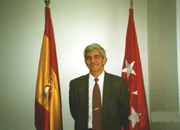 Rodrigo Martinez Val Penalosa, general manager of Madrid's provincial government development agency IMADE
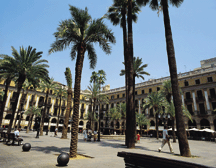 Placa Reial
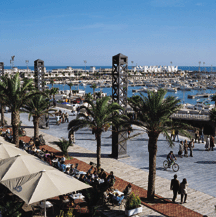 Port Olimpica