|
|
||
|
©THE JAPAN TIMES
|
|
B2 |
|
JAPANESE INVESTMENT
The localization of management The idea of management localization has long been practiced among today's major global players. Assigning a local management team not only brings familiarity of a market but also guarantees a cultural synergy between market and product. Although many of today's corporation boast of management localization, a closer look will show that only few corporate managers are given the true autonomy to work and develop within their specific markets. Matsushita Electric Works (Europe) AG, the umbrella group of the various Matsushita Electric Works subsidiaries in the European market, is one of the few multinationals that has embraced the true concept of management localization. |
|
Officially established as Matsushita Electric Works in 1989, the corporation has been operating in the European market for over 30 years. Originally known for their specialty in the area of relays and electrical components, the group has now started a push to extend its product offerings in the European market.
"We have done very well here in the German market with our different products. The demand for new technology is moving at break-neck speed and I feel we have a lot of new products that we can use for new applications here in Germany. We are in a position to fill the demand gap for new technology," Dr. Eggl stressed.
Hamamatsu Deutschland's main market remains that of analytical and spectroscopic instruments. The firm, for instance, manufactures unobtrusive technology to control the quality of drinking water for the beverage industry. So, beverage makers determine right away the quality of water using these instruments, which emit and read the light absorbed by the water sample. Refusing to limit himself to the traditional industries that employ photonics, Dr. Eggl has started to apply the technology to the German automotive industry. "The auto industry is now beginning to substitute copper cables in favor of optical communications. And, this will open up doors for us," the company official said. In recent years, the industry has seen the development of remote-controlled door locks, smoke sensors, and even laser radar to ensure a safe distances between moving cars, spurring growth in photonics. These new products may still be beyond the full grasp of the average consumer. But, in the near future, they will certainly be essential and standard. The Bavaria headquarters of Sony's Digital and Telecommmunications Devices division is an exception to Sony's other offices around the world. The atmosphere resembles that of a start-up as employees work go about frenetically designing and developing the company's new products. The headquarters also brings together personnel from 30 different countries, among them GSM engineers and other specialists tasked to coordinate the operations of five separate production sites around the globe in the manufacture of digital telecommunications devices. This division of sony established an office in Munich after forming a joint venture with Seimens in a bid to break into Research and Development in the telecommunications market. After having developed new technologies together and having reached their common aim, the two companies parted ways and excelled on their own. Presently, Sony Digital Telecommunications is developing not just simple mobile devices but also GSM, 3G, and other related products and services, particularly those aimed at facilitating e-commerce. Mike van der Wallen, Managing Director of Sony International Europe GmbH, cited the advantages of integrating his division's digital telecommunications products into the entertainment field, in which Sony has played a leading role the past several years. In fact, the company envisions a seamless Sony World in the future. "We clearly see digital telecommunications as one of the main gateways to the broadband arena. Information and entertainment are both available on these networks," Van der Wallen said. Four key platforms are vital in the creation of Sony World: telecommunications devices, play stations, digital TV, and the IT platform with personal computers. Already a major player in each of those four sectors, the Japanese giant must now capitalize on core activity to bring new high technology devices to the mainstream consumer market. Given this strategy, it is clear that Sony is competing in a niche market for mobile devices that will carry not only voice traffic but also a wide range of entertainment data. Internal alliances to pair technologies and devices have given Sony a unique comparative advantage in the entertainment sector and have allowed for faster development of new products and consumer-friendly services. Geographical variations in standards and the degree of market development are clearly an important factors in determining the future success of Sony. Van der Wallen asserts that i-mode in Japan is a good example of how telecommunications devices will develop in Europe. In the United States, geographical size just limits the extent to which any of the different networks used can fully service the market. The GSM standard, pioneered out of Europe, is the most firmly established standard for mobile telecommunications worldwide. Still on Europe, GPRS (generation 2.5) will shortly provide the building blocks for a new revolution in the way consumers will use their mobile telecommunications devices. But, 3G technology, which has seen billions of dollars paid in investments and licenses, remains the key platform of Sony's vision of a seamless digital world. For the consumers anxiously awaiting the birth of Sony World, Van der Walen sets the scene. "From a seat in a café, I will be able to plan a night at the cinema by downloading a trailer of the film I want to see onto my mobile device. Then, the device can indicate which cinema is closest to the café, check availability of tickets, make the booking, and provide a map to this cinema," he said. "Other Sony devices will even be able to record the movie but that would be illegal. With Sony's music division, however, recording from mobile devices will definitely be an option," he added quickly If the 1980's marked the point that Japanese capitalism went global, the following decade was a period the powerhouse retreated dramatically. Japan Inc. apparently was toppled from its lofty position in the arena of global economics. Although not evident to the average investor on the street, Japan has very clearly scored a tremendous comeback in the past few years. Spurred by the reorganization of its industry giants, Japan has recovered lost ground due to a strategy distinctly different from that during the 80s. Practically silent the past decade, these Japanese transnationals have been beating the drums again in marching outside its borders. But, in doing so, they have brought with them a new mindset molded by lessons learned during the turbulent 90's. In the German market, Japanese investment is flourishing once more. Capitalizing on the expanding German and European economies, profits are rising at a highly satisfying rate as Japanese firms develop new and clever plans to regain market shares. In Fujitsu's Munich-based subsidiary, Fujitsu Deutschland GmbH, a re-engineering of sorts has been launched - an effort that is indicative of the "New Fujitsu" in Europe. Having gained an international reputation as a maker of hard disk drives, magneto-optical storage products, dot-matrix printers and high-end document scanners, Fujitsu may be thought to implement a re-engineering program in its product line and production method. But, that is not the case. The biggest change is happening in the sphere of perception. Fujitsu Deutschland President Ichiro Hirose has a lengthy "wish list" regarding the goals set for the German subsidiary. Although ambitious, the objectives boil down to a two-point game plan that sees several revitalized Japanese corporations optimize autonomy and encourage fresh learning in the work place. Autonomy within one's market has never been more evident than it is now. The emerging Internet-based economy has challenged the subsidiary to move with the same speed and skill that rival start-ups have handled with much deftness. Fujitsu's business model has always called for autonomy within its different markets. Yet, for Hirose, autonomy in itself is not enough. The crucial difference can be found in a company's ability to optimize "self-rule with discipline." "Historically, the reason Fujitsu established a variety of Fujitsu-owned companies was to give autonomy in our respective markets and sectors. This has worked well for us, but now, I feel we have to take it one step further. We are and will always be part of the Fujitsu umbrella but we also have to think of ourselves as individual entities as well," Hirose said. "We have to develop our own way of giving the best pro-active support to our customers and we also have to develop our own brand of partnerships with the local customer. After all, this is our market and we know it best," he added. A globally recognized brand alone is not sufficient enough in today's sophisticated market place, as well as a guarantee to success. Prosperity and effectiveness demand a local face. Hirose realizes the value of these concepts and uses them to enhance his approach. Like all good concepts, Hirose's optimized autonomy approach possesses its risks. By being overzealous, a company may run the risk of becoming over-localized and alienating the subsidiary from the global landscape. So, the executive has his own guidelines. "Optimizing the benefits of autonomy is not an easy task for most heads of subsidiaries. One must have a firm grasp of the mother company's global direction and strategies. Once you understand the goals and objectives of your corporation as a whole, then I believe that local autonomy should be applied as much as possible," he said. Just like several global firms today, Fujitsu is not only after new markets but new knowledge as well. This is what has been the driving force behind the re-engineering of Fujitsu in the German market. "It is through integration and gains in our intellectual property that will ultimately spell the difference for us here in the German market," Hirose explained. By integrating the workforce's ideas with an approach marked by a German-Japanese perspective, Fujitsu Deutschland has gained valuable new knowledge on how to consolidate the company's position. "In the German market, we have a goal of being the most respected sales company by our customers. This can only be done by playing to our strengths as Japanese and Germans working together. New knowledge is not just built on new technologies and systems. New knowledge comes from cultural exchanges within the work place as well," he said. With that, Hirose has staked his claim on the German market for Fujitsu. The executive is not out to overpower the local market; rather he is out to grow with it, of course, with some autonomy. |
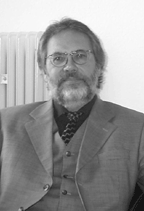 Spreading the light: Dr. Peter Eggl sees the day when the technology of photonics will spread to daily applications.
 Team Sony is creating a single multimedia world. From left to right, Support Functions Director Ian Gardner, Managing Director Mike R. Van der Wallen and Deputy Managing Director Mitsuya Kishida
 An advocate of self-rule, Fujitsu Deutschland President Ichiro Hirose ensures that his company grows through a healthy dose of autonomy.
|
© 2001 World Eye Reports |
