|
|
||
|
©THE JAPAN TIMES
|
|
B5 |
| GOING GLOBAL II Transforming Asian skepticism into profit A global giant craving excitement should try strapping itself into the Asian region. As the region's financial markets took investors on a roller coaster ride, it was unsurprising that several Western corporations have approached this otherwise promising market with a rather guarded stance. Nobody could blame them. Following the economic turmoil of the mid-1990s, the full recovery of the so-called tiger economies has to happen. The performance of the financial markets has remained lackluster. |
|
Currently, several of the world's worst performing stocks and markets can be found across Asia. Political unrest in several large Asian markets has raised concern among Western investors and has kept them at bay. Yet, is the economic situation in Asia really a ball of chaos analysts from the West paint it to be. Nobody can be completely certain but the clear consensus is that the Asian market is one of huge rewards that outweigh the risks. The region has the largest population in the world. The number of the developing countries is growing. The consumer base is steadily expanding. Asia provides a market base like no other place in the globe. What many several Western companies have done was to assess whether the risks are worth the rewards to be reaped in the future.
As a leading global producer of hyperpure silicon products for semiconductor devices, Wacker Siltronic is bent on further globalizing its business. With the growth of the semiconductor sector centered in Asia, the company has made a commitment to consolidate its base in the region. But, the move was not easy for Wacker Siltronic. At the peak of the global glut in the semiconductor industry in 1997 and 1998, the corporation made the tough decision to set up its first silicon wafer production plant in Asia. Dr. Robert Römer, President and CEO of Wacker Siltronic AG, held his ground and believed that the Singapore plant was vital to ensure the growth of the company. "We could not skip any strategic investment despite the downturn. Most of my people were telling me to hold the investment but I refused to back down from our commitment. Asia is a big market and we need a solid presence there. Now, we are on our way to achieve great advances in this region. From Singapore, we can supply the hungry markets of Southeast Asia and Japan," he related. So, have the rewards outweighed the risks? The figures speak for themselves. Since its opening early last year, the Singapore plant has been producing over 100,000 silicon wafers a month. By the end of 2000, sales were expected to grow more than 45 percent. With its foundation in Asia solidly in place, Wacker Siltronic has set its eyes on Asia's plum prize - Japan. In November 2000, Wacker Siltronic acquired a 55% equity stake in NSC Electron Corporation of Japan. The joint venture, known as Wacker NSCE Corporation, was formed to consolidate the activities of both companies in Japan, according to Römer. "We feel our partnership with NSCE will allow us to get deep into the Japanese market. Now, we will have a strong Japanese sales organization with a foothold in production. This will change the total picture of Wacker in Japan," he added. Indeed, the prospects have changed for Wacker not only in Japan but in the global market as well. Because of the partnership, Wacker NSCE Corporation emerged as the second biggest wafer manufacturer in the world. Skepticism over Asia will always have its proponents and their concerns are well founded. But, the reality is there is too much at stake to look away at one of the fastest growing economic regions it the world. In today's shrinking global marketplace, turning a blind eye towards Asia may cost a company dearly. Hamamatsu GfK Group
There is a razor-sharp line between tradition and progress in today's business world. As companies rise and fall amid economic cycles, it is very rare for a privately-owned firm to keep a firm hold on its market position. For nearly 100 years, Leistritz AG has not only survived the vicious cycles of economic booms and recessions but has, in fact, grown significantly. "We are in a very nice area and our products are supplied mainly to OEM producers. This means our business is dependent on long-range planning and not really subjected to economic upturns and downturns. Our customers are mainly global operating corporations that have long term contracts. This makes us very stable as producers", Mr. Helmuth Schaak, president of Leistritz AG, said about the stability of his operation. With its headquarters located in the Bavarian industrial city of Nuernberg, Leistritz AG has held a core competency in five areas of production: Turbine and Compressor Blades, Screw Pumps, Hydraulic Elevator Systems, Extruders and Extrusion Systems, and Machine tools. From the aerospace to the automotive sectors, Leistritz components act as the foundation behind innovation. Although the company offers a diverse range of applications, its success is based on a structure that treats each division as an independent entity. "We treat each area of our core competencies as individual operations. They are very diverse and we manage them as like they were their own company. This allows each business area to find specific markets where demand for that product is high. It is a very focused approach and when you look at the group as a whole you will see that this individual approach has been providing us with great success?, explained Schaak. In the Japanese market, Leistritz's machine tools division has been the one that has experienced tremendous growth. "Today, we have made significant progress in the Japanese market. This has been done through collaboration with Japanese machine tool corporations. We are now active in the automotive, bolt screw applications and plastic industries in Japan," he said. Asked about the potential progress in the rest of the Asian market, Schaak replied: "We see a long-term need for our products in most of the major markets in Asia. Our aim is to secure a position as one of the leading brands in all our business areas in the Asian market". Nowadays, finding success in the global market while remaining a privately-owned firm is a feat nobody can just brush aside. For Schaak and Leistriz AG, the formula has been simple - be absolutely free and independent in all decision-making and handling. "Everything we do for ourselves is for others; everything we do for others is for ourselves" - Japanese proverb In comparing the workplace of 40 years ago with that of today, the current breed of workers certainly spend more time fixed to their chairs. Because of the longer working hours and increased use of computers, more time is spent sitting rather than standing or moving about. The modern-day phenomenon has raised serious concerns regarding the physical well being of today's office worker. The Bavarian-based Dauphin Office Interiors Holding, a DM 300 million enterprise - has been addressing this concern by applying a holistic approach to the design of work furniture for the office and home. Headed by the company's leading brand, Dauphin, has become one of the leading office seating manufacturers in Europe. The success of the company has been a result of its commitment to a healthy posture. In all segments of the office furniture market, Dauphin supplies systematic seating solutions, combining ergonomic functionality and design for physical well-being at the office. "The headline of our company is ergonomics. Our aim as a company is to meet the specific functional and anatomical demands of seated workers. In addition to the brand Dauphin, we want to address the most varied market segments with our two other independent brands Trend!Office:, for the young and trendy consumers, and Züco, with its Swiss-made background for the top design oriented sector," explained Mr. Henner Hantel, Managing Director for Marketing and Sales of Dauphin Office Interiors Holding. To complement these lines, another subsidiary, Bosse Design, offers products for flexible room dividing systems in combination with mobile storage and working area solutions. So, the Dauphin holding firm provides complete solutions as a competent supplier for the office. Friedrich W. Dauphin founded the company Bürositzmöbelfabrik in 1969. Meanwhile, things have gone a long way since then. The holding firm Dauphin Office Interiors, established in 1992, is the umbrella group with thirteen subsidiaries, seven production facilities, as well as numerous branch offices, agencies and licensees in more then 50 countries. From an office in the central town of Hersbruck, managing directors and shareholders Elke and Friedrich-Wilhelm Dauphin and their daughter Antje direct all the activities of the group of companies. The priority of the family-run company is to expand its leading global position in the office seating furniture area. The success of Dauphin in the international market can be felt from the United States until Asia. In Japan, Dauphin is successfully represented by its exclusive partner Kurogane who fitted the International Conference Center at Kansai Airport in Osaka with its highly sophisticated ergonomic chairs. In tracing the origin of Dauphin's success in the global market, one would have to point to the attitude of the group. "Because we are an export-driven corporation we have a very global attitude in our company. For us all customers are important. No matter how big or small, we treat them with equal care. We adjust our actions to the different cultures we deal with. I think this is one of our biggest strengths. We have a very personal approach to the customer. And, we are searching for further cooperations in the Far East market, outside of Japan," explained Mr. Hantel. Taking that Japanese proverb above to heart, Dauphin has seen its different customers around the world drawn not only to its products but also to its corporate culture, which is characterized by innovation and concern for the client. Hawe and half a century of distinction Fifty years of industrial excellence does not come easy. For Heilmeier & Weinlein Fabrik für Oelhydraulik GmbH & Co. KG, or Hawe Hydraulik as the company is better known, an enviable reputation was a result of innovative ideas, top quality products, and a firm commitment to growth. President Mr. Karl Haeusgen had a direct hand in the expansion plans of the company, which has set up more than 30 representative offices abroad and bolstered its worldwide sales network. "I knew that if this corporation was to continue to flourish, we would have to concentrate our efforts into bringing our technology to the rest of the global market. This has been one of the primary focuses here at Hawe Hydraulik, not just to bring our technology to the global market place but to educate our customers globally on the advantages of our systems," Haeusgen said. The success of the expansion efforts of Mr. Haeusgen can already be felt in the Japanese market. Through its representative in Japan, Daido Machinery, Hawe Components has steadily boosted its market share. Also, the Hawe has strengthened brand recognition among demanding Japanese consumers. With a product range that covers standard valves to custom-made valves, Hawe takes much in the three defining features of its goods. Unlike some the products of rival brands in the fluid power industry, all Hawe goods are based on modular design concept, made of steel, and meet the strict ISO 9001 quality standards. With such standards in place and the aggressive globalization strategy, Hawe looks set for another half a century of industrial excellence. |
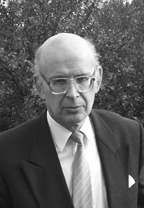 Daring optimist: Dr. Robert Romer of Wacker Siltronic AG has staked the company's future on Asia, a region that continues to scare away even the mildest skeptics.
 Striking a balance: Leistriz President Helmut Schaak combines both old and new wisdom to stay on top of the field.
 It's all in the family: The Dauphin family has been in the business of making spaces comfortable, healthy and aesthetically pleasing. Shown are managing directors Friedrich-Wilhelm (right) and Elke Dauphin and their daughter Antje.

© 2001 World Eye Reports |