|
|
||
|
©THE JAPAN TIMES
|
|
B4 |
| THE OLD MEETS THE NEW Bavaria's medium-size industries prove strong and prosperous Today, Germany stands as one of Europe's most fundamentally sound economies. The country's success as Europe's largest and the world's third largest economy is a direct result of the strength of its small- and medium-sized enterprises (SMEs). The Mittelstand, as they are known locally, act as the engines of economic expansion in the past 50 years. Having a broad base of SMEs, Germany has hedged its exposure to an unpredictable global economy. But, after 50 years in the making, the formidable model seems to show some cracks. |
|
Yet, for several Bavarian companies, size just does not matter. They defy conventional wisdom by showing that survival, and even growth, is not solely dependent on a pursuit of alliances but also on sound management and financial fundamentals. The Draexlmaier Group, which integrates electric and electronic components into complete interior systems for automobiles, has proven to be one of Bavaria's most successful mid-sized corporations because on its fixed focus on fundamentals, which eased the need to ventures outside of its field and territory.
"As a corporation, we have not been effected dramatically by the consolidation that has taken place in the German auto industry mainly because our products are very specialized. So, from day one, we have been producing tailor made products for our customers," Fritz Dräxlmaier, the Chief Executive of the Draexlmaier Group, explained. "We have no ambitions of going out of our area of specialization. Our main focus has been to stay in our market and to keep the level of service in our segment at a prime," he added. But, Draexlmaier has not been completely isolated from the global market because the German automotive companies thrive on being transnational. So, the Bavaria-based firm has been thrust into several markets around the world. Meanwhile, the company head has refused to give up the flexibility of his mid-sized corporation. " I think flexibility in doing business is key. So, if middle-sized corporations are to survive as suppliers to the auto industry, they must find a combination. Alliances are key so they will be able to service their customers globally but they must also retain the flexibility. This has been the distinct advantage here in the Draexlmaier Group as a mid-sized company." Building on this mixed approach, Draexlmaier is now servicing its customers with operations in five continents. And, the focus on quality customer service forms the foundation of the group's success worldwide. In line with this thrust, the Draexlmaier chief launched a customer division program. Although its is made up primarily of the major German vehicle manufacturers - such as Audi, VW, BMW, and DaimlerChrysler - the company also services non-German clients. Under the customer care program, the Draexlmaier Group set up separate teams within the company to attend to each of its clients. These teams are tasked to develop specific solutions for electric and electronic components, as well as for interiors and trimmings. Consequently, the company is able to provide a level of customer assistance that a top-heavy organization would not be able to provide. "The customer division approach has been very key in our success as a corporation. Each major customer has a specific division working for him in all areas of our core competencies. By having these customer divisions, we are able to build a real relationship with our major customers. It is a very specialized approach because we only have a few major customers. I also believe that because we are a mid-sized player, we are able to give a very focused product service and support," the executive said. The rush towards mergers and acquisitions is justified. For many investors, profits from home and regional markets are no longer sufficient. The world is only beginning to see a true global economy take shape. But, the age of globalization clearly does not spell the end of the SMEs. As shown clearly by Draexlmaier, the small- and middle-sized players can complement each other and thrive together. Hamamatsu GfK Group
Chances are every conversation, whether it be a formal interview or an informal chat, will open with a comment about the weather. The trivial remark will serve as an "ice breaker" just before delving into the real aim of the encounter. A meeting with the president and CEO of Munich-based MTU Aero Engines would be no different. Though, the unusual thing about an interview with Dr. Klaus Steffens is that it becomes instantly evident that he appears unable to stop thinking in terms of his expertise even in casual mode. His greeting consisted of an explanation of the local weather phenomenon known as Foehn, which is a result of warm winds from Italy and the Mediterranean sweeping over the south side of the Swiss Alps and swooping down the other side of the mountain range. It is a meteorological occurrence unique to Bavaria. So much for the small talk for Dr. Steffens is not a man of words but of action. Dr. Steffens has just led MTU - one of the world's largest designers, producers and repairers of civil and military aircraft engines - through a sweeping reorganization and impressive expansion phase, which has resulted in record-breaking revenues and profits for this DaimlerChrysler subsidiary. As Germany's leading sector player, MTU attends to the operators and manufacturers of aircraft engines and industrial gas turbines across the world. Its global presence and the Grade-A know-how are key to this firm's success. With nearly 7,000 employees worldwide, MTU links up with the world's major systems integrators and engine producers, including Pratt & Whitney, General Electric, Rolls-Royce, Snecma, Volvo and FiatAvio. But, the last decade has been anything but a smooth flight. Following the collapse of the Eastern Bloc, the bottom fell out of the multibillion dollar military industry, compelling many companies in the industry to scramble to regain their foothold in the post-Cold War marketplace. It is remarkable how MTU Aero transformed itself in the wake of downswings in the industry. The first crisis came when the military hardware industry plummeted following the fall of the Berlin Wall in 1988. MTU was doomed to crash and burn as the company's activities focused mostly on the repair and development of military jet engines. Another obstacle cropped up when sales civilian aircraft took a nosedive with the weakening of the U.S. dollar in the early 1990s. Nearly all the sales in the industry were conducted in the U.S. currency. The trauma of the period has finally vanished in the horizon but he work carries on. Asked if the reorganization was completed, Dr. Steffens emphasized that restructuring must never be over. "We accomplished a very important part of the restructuring which was triggered by the crises. We reduced the number of employees from over 8,000 to below 7,000 in a very short period. We also had to change our corporate structure." "One of the key elements in this process was the introduction of individual profit centers. What was once a very function-driven organization was reformed into a company with various profit centers acting as their own company. This program was quite successful," he also said. The timing was also good because just as the reorganization got underway, the market recovered and the U.S. dollar gained lost ground, according to Dr. Steffens, who pointed out that the company had embarked on "an extremely extensive growth strategy." Dr. Steffens is also convinced that company, considering its size as the world?s fifth largest aeronautics engine maker, can only survive amid the merger trend if it grows based on its strengths. In 1998, MTU Aero Engines laid out an aggressive plan to double sales by 2009 but it expects to hit the target six years ahead of schedule. In the late 1990s, MTU set up a generic engineering company called Athena, which offers engineering services to several sectors, including automotive, machine tools, and civil engineering. The new company, which set up four offices in Germany and will open one in the United States, has proven a huge success because of a huge demand for high-engineering services, according to Dr. Steffens. Half of the company's revenues come from the development and production of components for new civil aircraft engines, including spare parts; while 30 percent is generated by civil repair and overhaul business. The other 20 percent comes from the military industry, including the repair and overhaul activities for the German military. The company is also involved in the development of new engines for military aircraft, such as the Eurofighter. MTU spends about six 6 percent of its revenues on R&D, which also receives some funding from the federal and state governments, as well as from the EU for special projects. The investment allows the company to take part in the development of the new generation 3E Engine, which aims to reduce noise, fuel consumption and CO2 emissions by 30 percent each. The company is also involved in the building the so-called Recuperating Engine, which will further cut fuel consumption by 20 percent. This development of the new generation engines is driven by a desire of airline companies to fly more passengers longer distances for less money. "Everything that reduces fuel increases range. With fuel prices the way they are, fuel consumption rates are very important to the customer. This is due to environmental considerations as well. Also, long-range aircraft require higher thrust at the takeoff point so the capability of an engine to be stretched to higher thrusts often drives the range of the aircraft," the MTU chief explained. Meanwhile, Dr. Steffens looks to Asia as a region with a huge potential. "Asia is the most important market because it is the place of growth. Within Asia, China is very important because of its growth rate and vast potential. Japan, however, is also important because it is the area of technical excellence and stability in Asia." "Regardless of what China or the Tiger economies will do, Japan will remain the point of capital stability and engineering excellence. We have very close business cooperation there with companies such as IHI, KHI, and MHI. We are together in the B2500 program and others. We also share several of the problems and advantages of doing business, such as high manufacturing costs and technical excellence," he added quickly. Having spread its wings to new sectors and other major global markets, MTU Aero is confident about remaining above the rest of its rivals. "We will remain the number one independent aero engine overhauler. The market is developing incredibly fast, which means you have to run and not walk to stay ahead." Creating a cooler Europe The European automotive industry has been undergoing a re-emergence of sorts over the past decade. The industry, formerly characterized by a number of fragmented national makers, joined the consolidation bandwagon to regain its dominance in the global economic arena. Consolidation has certainly been positive for the European automotive industry not solely because it spawned more efficient production and clearer, more exciting branding. More importantly, the trend has forced carmakers to focus again on the primary task - building the best product possible for the buyer. Today's higher-end models to the more affordable models are fitted with more features and options, perform better, and meet a higher standard of luxury like never before. For the carmakers, success has been due to finding the best suppliers and meeting the needs of consumers. Up until 1990, the penetration of air-conditioners in automobiles for the European market reached only 10%. Interestingly enough, it was shortly after consolidation started to gain ground in the 1990s that the market penetration of air conditioners began to shoot up. Manufacturers realized that if there was progress to be made, providing customers with the necessary comforts would have to be a priority. Heat was no longer enough; Europe needed some cooling. And, in pursuing this project, European car manufacturers look to Japan for help. Showa Aluminum, a leader in the field of air-conditioner heat exchangers, provided just that. Mr. Akira Tabata, Managing Director of Showa Aluminum Europe, said European car makers turned to his company having known that Japan developed an expertise in the field of air conditioning because of the hot spells the country faced often. "Up until 1990, their was no local air-conditioner supplier in Europe and as you know, Japan is a very hot country, so air-conditioning technology started very early. We at Showa Aluminum have always been active in this type of technology and many of the European car producers recognize this. Because of our experience in this field we have been able to make progress in the European market". Currently, Showa Aluminum supplies industrial automotive giants, such as Volkswagen, with condensers. However, it is not only in advanced technology that Showa Aluminum has been able make progress in the Europe. The company's global network has also raised its premium as an ideal partner. Recent figures show that 60% of automobiles are now equipped with air-conditioning, a six-fold increase since 1990. According to estimates, the numbers will increase with further consolidation in the continent and innovation from the East. A cooler Europe is definitely just around the corner. |
 Thriving among giants: As the head of the medium-size Draxlmaier Group, Fritz Draxlmaier has clearly shown that size does not necessarily matter amid a mad rush toward mergers.
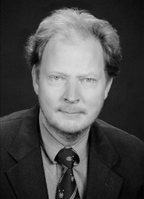 MTU Aero Engines President and CEO Dr. Klaus Steffens has led his company's phenomenal recent performance in the aeronautics industry.

© 2001 World Eye Reports |