 |
|
|
 |
The Japan Times WORLD EYE REPORTS BAVARIA |
 |
|
|
|
| ©THE JAPAN TIMES |
Wednesday, February 28, 2001 |
B1 |
|
Since the end of the Second World War II, Germany has regained its status as the largest economy in Europe. In reviewing the economic development of Germany over the past 50 years, there is not one state that can apparently serve as a microcosm of the nation than that of Bavaria. Just as Germany evolved from a devastated nation during the era of the Marshall Plan to an economic powerhouse before the fall of the Berlin Wall, Bavaria also transformed itself from the laggard of the Bundeslaender to a state with the fastest growing economy in German republic.
Bavaria's economic renaissance can be divided into stages, the most recent of which saw the emergence of the new economy as the state government lured millions of dollars in foreign investment. In 1999, direct foreign investment in the hi-tech sector resulted in the establishment of 807 corporations, up 16 percent from the previous year. In 1998, direct foreign investment surged 53 percent. A recent survey among young IT professionals ranked the Bavarian capital Munich, as the fourth most livable city after the Silicon Valley, Boston, and Tel Aviv. The poll many tempt ordinary people to presume that the Bavarian state has achieved a rather comfortable position. On the contrary, because of its tremendous success in building up its new economy, Bavaria faces a new and tougher challenge: to balance the booming hi-technology sector with that of its established more traditional sector. The reality is that the Bavarian economy is moving at break-neck speed and the smaller nations of Europe dash at the chance of occupying the German state's current economic status. Although the challenge remains unfulfilled, the Bavarian government has not stepped back from the formidable task. Along with the rest of Germany, Europe has been watching the balancing act with close interest. For Bavaria, an economic challenge is familiar territory. Only a generation ago, it faced a similar situation. Once known as Germany's breadbasket, the southeastern state saw its economy move from an agriculture-dominated one into an industrial-driven one. From the farm fields of Bavaria, industrial giants, such as BMW, took center stage. And, the 1972 Munich Olympics served as a coming-out party for the newly-transformed Bavarian economy. In analyzing the change, one may come to realize that the transformation is not as radical as many perceive it to be. Indeed, the focus of the economy was directed towards industrial products and machinery but Bavaria never abandoned its agricultural roots. Industry existed side by side to agriculture. Through industrialization, the agricultural sector modernized its methods and consequently developed into a more productive entity. Today the peaceful co-existence has remained evident. Bavaria is still the major food producer in the Federal Republic of Germany although, 35 percent of the state's GDP (DM 850 billion) is generated by the industrial sector. Mindful of the complementary roles played by industry and agriculture in the state's economy, Bavaria's Minister Economic Affairs, Transportation and Technology, Dr. Otto Wiesheu, has drawn up a model wherein the old and new economies need not remain distinct. Hamamatsu GfK Group For Wiesheu, the task is not so much about aiming for a strict balance between the old and new. Rather, it is about finding a way that both the old and new economies will complement each other and eventually, integrate themselves with each other. The task is by no means easy and it will certainly take time. Also, because new technology is unpredictable and traditional industry not as flexible, success is not guaranteed. They will be subjected to fickle market forces. However, should the model succeed, it would most likely be in Bavaria. The Bavarian government's efforts towards the integration of economic sectors have been executed very carefully. Wiesheu and his economic team have launched several hi-tech initiatives not only to allow the global technology firms to consolidate their positions but, more importantly, to also permit start-ups to perform a more significant role in the local economy. Nearly every traditional manufacturer in Bavaria has turned to IT to enhance productivity and incorporated hi-tech systems into their own products. OEM suppliers have also diversified by supplying most of their goods to the hi-tech sector. Meanwhile, the hi-tech sector has begun to supply their software and know-how to the traditional industries and wealthy Bavarian IT professionals have purchased manufactured goods by bulk. It is a complex web of exchange of products and services that makes it harder to distinguish the difference between old economy and new. Although hard figures do not reflect their contribution, the start-ups have clearly altered the economic landscape by injecting a different kind of energy and more vitality into the already robust Bavarian economy. With the new economy's position secure, the task of integration can now begin.
Excerpts from an interview with Bavarian Minister President Dr. Edmund Stoiber WER: Bavaria has enjoyed the fastest economic growth rate among all the German states. To what can you attribute this economic success? Stoiber: In broad terms, the engine of growth in Bavaria is an entrepreneurial spirit, the diligence of the workers, and last but not least, an efficient economic policy. Bavaria provides excellent infrastructure in sectors such as transport, telecommunications, and energy. That guarantees optimal links and support to international markets. We also offer a high level of education and continuing education. The state also extensively promotes research and technology. The government and industry spend an average of 2.8 percent of its GDP on research and development. Bavaria also has an efficient administration, quick planning and authorization procedures, as well as reliable and pro-business practices. At the same time, modern-day Bavaria managed to safeguard and increase its quality of life, particularly in aspects such as tradition, security, cultural life, and the environment. The core of the U.S. economic wonder, which is characterized by full employment and strong inflation-free growth, can be found in Bavaria too. WER: Recently, Munich rated number four among cities with the highest employment opportunities in IT. How committed is the government to continue promoting IT-related industries? Stoiber: With six IT clusters employing a total of 25,000 information and communications staff in about 15,000 IT companies, all within an hour's drive away, the state of Bavaria is by far the most important IT region in Germany. More than 8,000 companies employing 150,000 staff are to be found in Munich alone. Forty-percent of all software companies based in Germany are located in Bavaria. In addition, important user industries of software, such as the electronics industry, media companies, banks, and insurance companies, are to be found here. Bavaria is also the location of a steadily growing venture capital scene, with over 30 investment funds in the capital Munich. One of the most important factors for locating companies in Bavaria is the highly-qualified workforce. Bavaria boasts an excellent higher education environment with 11 universities and 15 technical colleges. Bavaria also enjoys an excellent reputation in the field of professional and vocational training. WER: With the advent of globalization, how is the Bavarian government helping local industry respond to the challenges of the global market? Stoiber: Many measures have been taken by the state of Bavaria to promote our economy. During the last six years, for example, we have reinvested private benefits of about DM 5.5 billion deutsche marks into an extensive modernization of industrial sites. One important cornerstone of this program is the building the foundation for new high-tech enterprises. With 20 municipal and nine technology-based centers, we have created good infrastructure for the founders of new businesses. There is also Bayern Kapital, which offers venture capital to young entrepreneurs. Then, a credit program for medium-sized industries has assisted more than 11,000 business founders in the last five years. Bavaria is also helping small- and medium-sized expand into the world by organizing local participation in international trade fairs, informing local industry about opportunities to promote international trade, and implement new initiatives to support the commitment of Bavarian companies abroad. I am convinced that our economy as a whole is well-prepared for global competition. WER: How would you assess the inflow of foreign investments, particularly Japanese, into the region? Stoiber: In the age of globalization, inflow of foreign capital and investments is crucial to any advanced economy. Bavaria traditionally has been claiming the lion's share of direct investment to Germany. In spite of this, the Bavarian state government is keen to improve on this record, particularly with regards to future-oriented technologies. We, therefore, established earlier this year a new agency called Bayern MIT. It is an agency for media, information, and communication technology in Bavaria with the specific task to attract new and innovative companies from media and ICT industries to Bavaria. WER: Looking at the next five years, what are your goals for the development of the Bavarian economy? Stoiber: The state government is now supporting the Bavarian technology initiatives with a further DM 2.65 billion deutsche marks derived from privatization proceeds. This assistance targets branches deemed crucial to Bavaria's future, like pharmaceuticals, applied microbiology and genetic engineering, information and communications, new materials, environmental engineering and medicine, automation, and electronics. Thanks to these investments, we are sure that we are going to consolidate our economic lead in Germany for a long time.
Making mergers work in the auto industry It isn't easy running a global automotive corporation nowadays. As globalization spawned a trend towards consolidation, several middle-sized manufacturers have put their "brands" on the block, hoping to land a huge merger deal that would make them major global players. Mergers have been the trend over the last several of years. On a closer look, several of those acquisitions have apparently been ill-considered and even disastrous. The daunting question that faces today's small- and medium-sized carmakers is simply: What fundamentals must be present for a successful merger? In a recent interview with World Eyes Reports, Dr. Helmut Panke, Member of the Board of Management of BMW gave a three-point checklist that spell success or failure for companies on the lookout for a smaller company to acquire. Below are the key factors corporations must consider, according to Dr. Panke: Commonalties in cultures: "If you analyze what is going on currently with some of the mergers and acquisitions, I think it is a reasonable conclusion that in those cases where there is an acceptable fit between corporate cultures, a merger or acquisition would work. No company, no manager, no leader should fool him or herself by thinking that they can change a culture." Commonalties in strategy: "When one partner intends to go to a premium-based strategy and the other goes strictly into volume then it will never work. One must analyze the complementarity of product programs and distribution channels. Only when there are commonalties in this, can one really start to look seriously into the merger or acquisition." Commonalties in values: "You can relate this very much to my first point of commonalties in culture but this goes deeper as well. Any company or group of managers must believe in the same values. After all, when you look at the core of things, it is values that will ultimately drive a company forward." However basic the points stressed by Dr. Panke, several companies fail to realize the importance of first identifying commonalties among each other before embarking on a merger. Apparently, opposites don't attract.
|
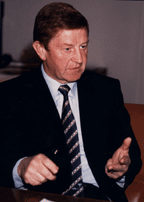 Sage of growth: Bavaria Minister of Economic Affairs, Transportation and Technology Dr. Otto Wiesheu
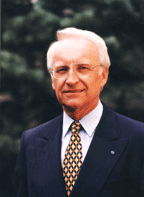 Minister President Dr. Edmund Stoiber makes the pitch for Bavaria
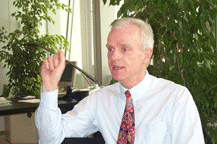 There is no magic in mergers. BMW management board member Helmut Panke shares his knowledge of M&As.