|
|
||
|
©THE JAPAN TIMES
|
|
B3 |
|
BAVARIA GOES GLOBAL
Undressing the global market: A focus on Triumph Say you have great new product and want to create a global business out of it. Simple. Get on the Internet, launch a web site and get the e-commerce system going. Running short on cash? Ring up the local venture capitalist, and hand him a semblance of a business plan and the check will soon be in the mail. Say you want your enterprise to actually turn a profit. Not so simple. The reality is building a successful and profitable global enterprise is not as simple as drafting a basic business plan and launching an e-commerce site. |
|
Conquering the international market involves dealing with foreign suppliers, employees, distributors, and even politicians. Also, effective entry into different markets requires the company to operate within a variety of environments and adapt the product to those different cultures. Triumph International is a $1.6 billion, privately-owned company with over 30,000 staff around the world. Established over 110 years ago, Triumph achieved success slowly, following fundamental rules that even the Internet Age has yet to debunk. This piece wishes to look into three basic concepts that has made the global push of this undergarments producer the billion-dollar enterprise that it is today.
Planning your mode of entry into a market. Present in 125 countries, Triumph with no doubt is as global as any brand can get. The company has successfully established a reputation for quality in markets as culturally diverse as the United States and China. But, the daunting question facing most corporations during global infancy would be in what manner to enter a specific market. Mr. Günther Spiesshofer, the president and member of the founding family of Triumph International, outlined his philosophy: "Generally, when we look to enter a new market the first objective is to establish a 100% fully-owned Triumph subsidiary not a joint venture. Yes, it may take longer and profits may not be realized as quickly but even taking it from the medium-term, we find it much more effective." "Within our subsidiaries we look for a local management team. They provide us with the local knowledge and know-how that is essential to thrive in a given market," he also said. The fully-owned subsidiary approach is apparently a wise one. But, Spiesshofer grants the subsidiaries a certain amount of autonomy to position itself firmly in their different markets. The key to a successful subsidiary is the local knowledge that it possesses and can come only with a local management team. A look at the Triumph group today would reveal that the company is not only the most global in reach but also the most multicultural as well. Adapt your product. Flexibility will spell success in the global market. The 1950s marked a milestone for Triumph as it first expanded into the European market. But, the true test of the company's dynamism came in the early 1960s when it embarked on gaining a position in the Asian market. As a young Spiesshofer took over the purchasing of Triumph in Hong Kong, he realized the opportunities that could be for Triumph in the Asian market. In 1964, he kicked off the company's entry into the Japanese market. Asked about the success of Triumph in Asia, he cited the importance of customization of the products. "We realized quickly that we could not live on the traditional product we were marketing in Europe. By downsizing and adjusting sizes, we realized that bodies of Asian women were different and we had to adjust to this. We moved designers to Japan and installed a design center in Hong Kong with 60 design departments and 250 people," he related. "Adjusting the product to the market is essential. A lot of market research was necessary, talking to people and designers to see how styles were perceived," he added. This strategy has not stopped in Asia. The company now creates tailor-made products for all their major international markets. At present, activity in Asia, South Pacific, and South America now represent about 60% of total turnover. This points to a valuable lesson for aspiring global enterprises: You have to make the right product for the right market. Hamamatsu GfK Group Presence Although presence may be defined in a variety of ways, companies must focus on presence of a leadership organization. For Triumph International, the philosophy requires setting up 125 autonomous groups in its 125 different territories. Leadership and a firm presence from top management is essential to keep a complex web network of different subsidiaries moving smoothly and performing in line with revenue and growth targets. Spiesshofer's brand of presence is, simply put, hands-on. "I travel 250 to 300 days a year making sure that everyone in the Triumph organization is working to his or her full capacity," said Spiesshofer, explaining his formula on how to keep the organization running at full speed always. Much can be drawn from Triumph's success in the global market. Theirs is one filled with old lessons that many of today's new economy start-ups have chosen to forget. One must remember global success takes planning, innovation and most importantly, commitment. It does not come from a click of a mouse. Should the aspiring global corporation of today follow this, she may actually be triumphant.
A group called Invest in Bavaria has identified bio-technology as a major growth sector that would bolster the German state's economy top position in Europe. One such company benefiting from a boom in the medical technology sector is the multinational Bionorica. Bionorica, which specializes in herbal medicines, has posted significant growth because of the so-called community effect that is taking place as medical companies set up offices across the region. However, it would be a mistake to group Bionorica with the new breed of biotechnology companies. The company was founded in 1933 and has since produced a variety of top-quality medication, including Sinupret, which is registered in 15 countries around he world. In the last 14 years, the family-owned corporation has been run by a third-generation descendant, Prof. Michael Popp. Since 1987, Prof. Popp has overseen a major export drive, which aims to raise revenue from overseas sales from 7% at the beginning to 50% in the next few years. Success has also been attributed to investments in R&D ranging between 10% and 15% of revenues. The company has set up R&D sites around the world. As Vice President of the Federal Association of Pharmaceutical Industries, Prof. Popp also works closely with the European Union to harmonize regional standards regarding biotechnology. Meanwhile, Prof. Popp hailed the effectiveness of herbal medicines. According to the Bionorica head, their products performed just as well as the standard pharmaceutical products in several clinical trials. Also, herbal medication causes fewer side effects, he added. Prof. Popp also pointed out that their medication had a higher level of compliance, or the degree to which a prescribed drug is taken, since patients trust herbal medicines more and tend to carry on with the course of treatment until the end. Bionorica gathers its raw materials from newly-developed plants species. From there, the company uses patented methods to analyze the beneficial qualities of these plants and their by-products. And, as herbal medicine becomes more complex in use and ingredients, the company has entered the biotech world to provide less costly processes to develop new medicines. Prof. Popp has more plans to consolidate the gains achieved by the company. The management is looking at the possibility of going public and expand its projects together with major multinational companies. In fact, joint ventures the are due to be implemented in Asia are expected to bear its first fruits this year. Globalization has posed both countless opportunities and just as many problems for the world's business executives. The opening of economic borders around the world has allowed businesses to broaden their reach beyond a limited local or regional market. As a new economic order emerges, companies have bolstered their financial positions and forecasts have grown even brighter. The globalized economy has also redefined the rules of the game. So, several companies have had to brush aside marketing conventions in favor of new ideas adapted for the new business landscape. And, amid this economic evolution, the field of market research has been thrust into the forefront of global business development. In the last few years, the market research sector worldwide posted an annual growth of nearly 10 percent. Meanwhile, total sales reached $14.6 billion in 1999; while recent forecasts show that sales will rise a further 10 percent in the next few years. Established 66 years ago as the country's first market research organization, GFK has been playing a lead role in the development of global market research. Employing around 4,300 experts around the world, the organization provides clients with business information services to support their strategic and operational decisions in marketing, advertising, and sales. Asked about the evolution of market research, Klaus Wübbenhorst, Chief Executive Officer of GfK, said the field had become a global growth sector. "Market research today has changed significantly. If you look at the top 10 players in our industry today, you will see that all are operating with a global network." "Because of the rise in global business among our customers, the picture of market research has changed from small country to country type businesses, led by individual researchers, to more global type groups like GfK. So, you can say that the business has "industrialized" to a certain extent," Wübbenhorst added.
Meanwhile, Wübbenhorst has kicked off efforts to integrate different technologies into GfK's different business areas. "We see good chances for us to develop new products and services that are linked to the Internet and new technologies. We have also already started to apply standard products of ours to the Internet," he said. "I see the integration of these new technologies, as well as the opening of new markets, as the next growth area for us here in GfK," the CEO predicted. GfK's success in applying the Internet and new technologies is nowhere more apparent than in the Japanese market. GfK has established an electronic platform for product information and trade dubbed ENCODEX. Originally started in the Netherlands and later brought by GfK to the Japanese market, ENCODEX is an electronical catalogue on the Internet with more then 450,000 products and more than 100 categories ranging from consumer electronics to photography and imaging products. The ENCODEX user can obtain comprehensive information about every product from a single database. From that platform, each product is shown with all its relevant features, including the technical and logistical specifications. Wübbenhorst outlines the benefits of this innovation and its success in the Japanese market. "What we do with ENCODEX in Japan is that we contact all manufacturers and feature their new products on the ENCODEX site. We put all the information - from technical characteristics to photographs - on our databank. The different retailers can then go to the site and get all the pertinent information." "This is a great innovation because in the old days when the manufacturer had a new product, it would have to send all sorts of catalogues explaining their products to the retailers. This would sometimes cause a lot of confusion. With ENCODEX, we act as intermediaries in the information process between manufacturer and retailer," he explained. The astonishing growth in the number of ENCODEX users in Japan has been a clear testament to GfK's expertise not only to identify new market research products but also to its ability to identify the proper markets for its innovations. With the aggressive efforts to adopt new technology and find uncharted markets, GfK has achieved double-digit growth in the last several years. Having developed into a truly global company, GfK takes in 64% of revenues from overseas markets and aims to raise that target to 70%. |
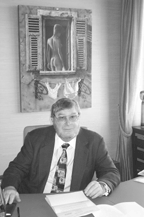 An adept adaptor. Triumph International President Gunther Spiesshofer has conquered hundreds of markets by keeping his ear to the ground.
 Leader of the pack: Dr. Michael Popp has consolidated Bionorica's top position in the biotech industry since 1987.
 Market specialist and GfK CEO Klaus Wübbenhorst has integrated new technology into market research.
 Increasing internationalization: The growth of GfK's total earnings in the last 10 years (in million euro)

© 2001 World Eye Reports |