|
|
||
|
©THE JAPAN TIMES
|
|
B6 |
| HIGH-TECH COMPONENTS Where the thinking never stops Soon after arriving at the Electronica trade fair in Munich with an entourage of company officers, Dr. Ulrich Schumacher, the chairman of Infineon Technologies AG, started the interview. He did not even pause as a member of the entourage vigorously sewed a shirt button that had come loose. The executive clearly likes to keep a frantic pace. When it was spun off from the Siemens Group in April 1999, Infineon was number eight in the semiconductor industry worldwide held back only by restrictions in capacity. The rationale behind the establishment of the new company was summed up by Schumacher. "Focusing on everything is no focus at all," he stressed. |
|
The semiconductor division is fast moving and completely different from all the other businesses of Siemens. The business also calls for a distinct management style. So, splitting up slow-moving masses and making them fast-moving ones was the focus. From its inauspicious beginnings in 1991, the three-man Siemens Semiconductors had come a very long way. By the time it was divested eight years later, the division took around 30% of the Siemens Group's annual investments in technology. Back then, there were few of the cross-cultural issues associated with a global company. Recently, the internationalization of Infineon has facilitated a much change in cultural outlook.
Schumacher asserts that he will take bits of these different cultures and integrate them into the firm. "We can't expect all of our global operations to be just like our Munich Infineon." Currently, there are over 30,000 employees in major R&D facilities in 26 sites around the world. Also, Infineon has nearly reached the amazing feat of having one patent for every employee. Venturing further into new areas of research, Infineon is scheduled to open a new campus for its staff in Munich in 2002. Realizing the importance of continuing education and its role in retaining staff in this high speed industry, Schumacher is understandably excited about this project. The campus project is clear evidence of the commitment of Infineon to keeping its roots in Bavaria. "I believe that Dr. Wiesheu has been brilliant in promoting the technology industry here in Bavaria. The state is definitely one of the major IT regions in the world - in the same league with Silicon Valley and Israel. There is definitely a synergy created here due to the presence of others in the industry," he also said. Infineon has become the market leader in important growth areas such as UMTS, blue tooth and broadband networks, as well as smart cards. While those sectors bring most growth for Infineon, the automotive industry increasingly draws profits thanks to the development of high technology value-added products, such as Global Positioning Systems. High capacity storage components, such as its DRAM commodity business, also provide new sources of revenue in computing, Internet, and networking solutions. Infineon ranks 3rd worldwide in the DRAM commodity business. "We have an excellent position for our future success: leading technology, state-of-the-art R&D and manufacturing infrastructure, valuable strategic partnerships, a world-class customer base, and most importantly, independence," Schumacher said. Meanwhile, Infineon is striving to be number 1 in the smart-card business and in the top 2 in the wireless sector. In the PMC business, Schumacher would be happy to maintain the company's number three position in the DRAM business. Schumacher predicts that the next two years will be very profitable for the semiconductor industry. As it aims to be among the top 10 global players in the sector, Infineon shifted its focus from size to market share in its different areas of competency. And if Infineon holds on to its strong positions in those areas, the company can "probably make some money," the restless executive remarks. Economic forecasts point to 2001 as the start of the "European decade." From the mid-1990s, the European economy's achievements were eclipsed by America's miracle growth. But, things are clearly changing. As the American economy heads for a slight slowdown, more eyes are slowly shifting towards Europe. Hamamatsu GfK Group
Because of globalization and stiffer competition, European industry has undergone a drastic facelift. Huge corporations have adopted a less top-heavy approach, allowing them to negotiate the world market with as much nimbleness as a start-up. Industry is undoubtedly thriving but what will ultimately spell the difference in what has been dubbed "the European decade" will be the move by those corporations to adapt new technologies and bridge Europe's old and new economies. Molex GmbH, the world's second-largest maker of electronic, electrical, and fiber optic interconnection products and systems, is one company to bridge that gap. The German firm has been strengthening its position as one of the best partners for Europe's two hottest sectors: the telecommunications and automotive industries. Mr. Werner Fichtner, President for European Operations and Corporate Vice President, has his eyes set on the mobile Internet. A forward thinker, Fichtner has been instrumental in leading Molex through the European telecom boom of the 1990s. By building global partnerships with mobile giant Nokia and working successfully in the development of their GSM handsets, Fichtner has positioned Molex to play a vital role in the development of third generation of telephony (3G) in Europe. When asked about the development of the 3G standard, Fichtner was quick to point out a transition period between technologies, "I personally believe that there will be two systems operating: 3G and GSM. Many consumers who just do telephone calls will stick with GSM because the operation fees will be cheaper. But nevertheless, the content that you will be able to receive via 3G will eventually break into the mass market. This will come in time". Currently Nokia's leading supplier, Molex is guaranteed to remain at the forefront in the industry's push towards 3G. With new technology constantly on the roll out in the mobile phone industry, product life cycles are limited. So, Molex cooperates with clients such as Nokia at a very early stage in the design and concept for new products. Looking into the future, Fichtner is confident that he will be in the position to supply complete systems or modules to mobile phone manufacturers. "From 11% last year, now telecommunications accounts for 22% of our turnover. Furthermore, we see this sector, along with networking and fiber optics, as the areas that will provide us with the greatest growth," he said. Mobile connectivity is now expanding beyond the individual. Global Positioning Systems (GPS) in cars rely on constant connectivity to help us navigate. These GPSs and other systems require an entirely new generation of terminals and connectors, which Molex has designed to meet tough German engineering standards. The proof of the potential in this industry was a decision of leading automotive manufacturers to increase battery voltage to 42 volts. In the last three years, Molex has provided twice as many connectors in the average new vehicle. Many of the new safety systems that people normally take for granted, such as airbags, rely on Molex technology. "We have developed leading technologies and we see a major business increase starting in 2003 with many of the major automotive producers," Fichtner said confidently. Meanwhile, the trust of global automotive and telecommunications brands has been increasing. To maintain its position in the forefront, Molex has worked as a development partner with customers to integrate and use its innovations as integral features of their systems. The project has required investment both in facilities and capital exceeding 1.1 billion dollars in the past five years. Also, with a long list of global players as clients, Molex is able to offer services at a local level from its 50 manufacturing facilities spanning 21 countries. For Molex in Europe, Fichtner has set his standard. "We will continue to focus on the automotive and telecom industry. We will continue our high innovation by developing new products and doing 30 percent of our annual business with them. New products per Molex definition are products developed in the last two years," Fichtner said. Much can be learned from Fichtner's new product approach. The approach calls for constant innovation, as well as the discovery of new applications and industries to service. For Fichtner, the challenge is not just for his technology to develop, but for his people to grow as well. Eleven years ago, global industrial giants Siemens of Germany and Matsushita of Japan established a joint venture to conquer the electronics industry. Unsurprisingly, the first few years were rough for the new alliance as the two companies struggled to reconcile different corporate cultures. However, a common objective and persistence led to the launching of EPCOS AG as a stand-alone firm in 1999. Since that time, President & CEO, Klaus Zeigler has overseen an expansion in product range and launched an IPO, which saw a three-fold rise in share prices of the company a year later. Backed by two reputable electronic companies, Ziegler had always been confident over the prospects of EPCOS AG. But, he did not expect the tremendous growth of the company, which currently produces "The main growth is coming from telecommunications and automobile electronics. But, at the same time, we have very good growth rates coming from consumer products and from what we call industrial electronics," the EPCOS chief said. "Industrial electronics is everything that is not telecommunications, automotive, or consumer electronics. Industrial electronics plays a rather important role in our case. High speed trains or equipment for plants and machinery also use our capacitors," he explained. With core products such as capacitors, Epcos has expanded into ceramic components, SAW components, and Ferrites to provide a wide range of electronic parts and components for major clients worldwide. As a global broadline supplier, Epcos is one of the few companies to provide a virtually complete spectrum of passive electronic components. Epcos is the number one player on the European market and is ranked third globally supplying more than 15,000 customers with over 40,000 different products. To maintain its leading position, Epcos has followed the development of its customers, not just to service them, but also to make inroads into other markets. For instance, Epcos launched products for the mobile communications sector since it had emerged as one of the most important industries. The company has since become famous for its mobile telecommunications products and has used them to rationalize expansion into other parts of the world. The expansion not only cuts short delivery time to their customers? factories. By relocating manufacturing facilities to areas with major customers, Epcos enjoys the same benefits such as lower wage costs and increased access to local or regional markets. But, Epcos still makes 30% of its products in Germany. At the same time, the company is strengthening its presence in Western Europe and eyeing Eastern Europe as a new market. By maintaining a close working relationship with sector giants Siemens and Matsushita, Epcos appears set to remain at the forefront in achieving more advances in the business of electronic parts and components. |
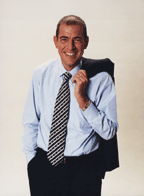 An executive perpetually on the move, Dr. Ulrich Schumacher has led Infineon to penetrate the tough semiconductor industry.
 As the main man of Molex, Werner Fichtner has overseen the company's entry into the "European decade."
 Fully backed with the support of two global giants, Epcos President and CEO Klaus Ziegler launched an IPO and expanded the company's product range.
|
© 2001 World Eye Reports |
